Division of Zoonotic and Vector Borne Disease Research, Center for Infectious Disease Research, Korea National Institute of Health, Cheongju 28159, Korea.
Glycobiology Unit, Department of Biological Science, Sung Kyunkwan University and Samsung Advanced Institute for Health Science and Technology (SAIHST), Suwon 16419, Korea.
Int J Mol Sci. 2022 Sep 1;23(17):9931. doi: 10.3390/ijms23179931.
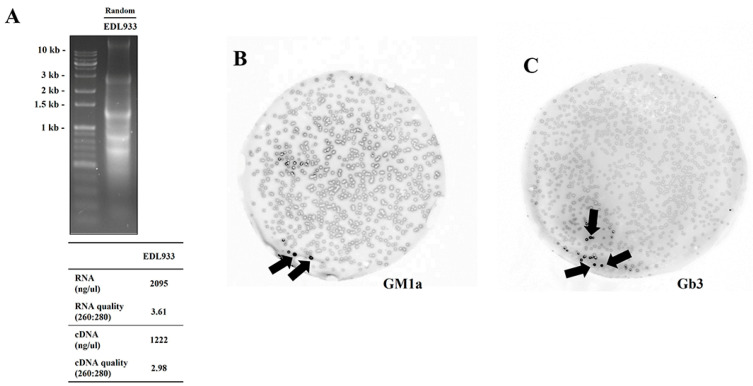
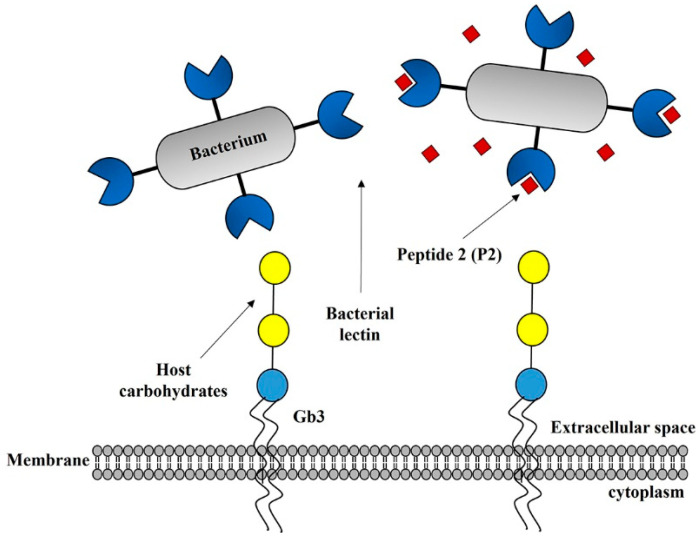
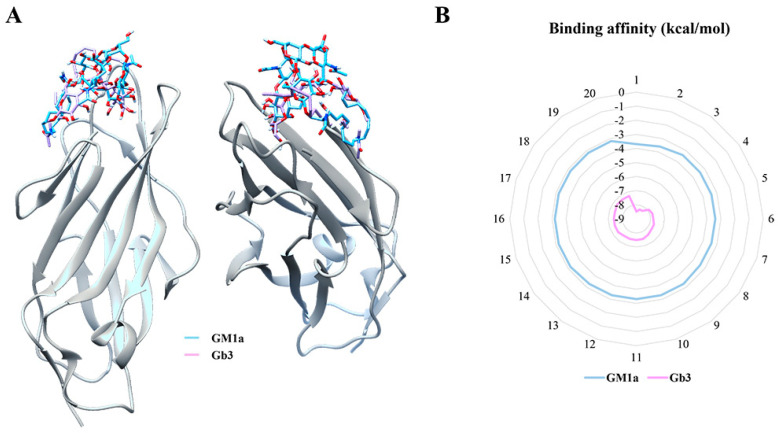
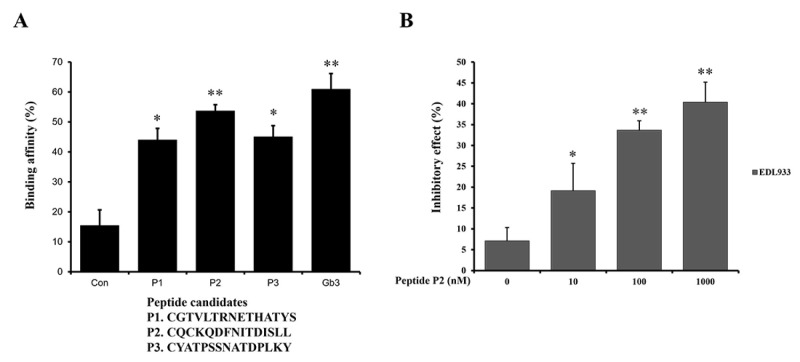
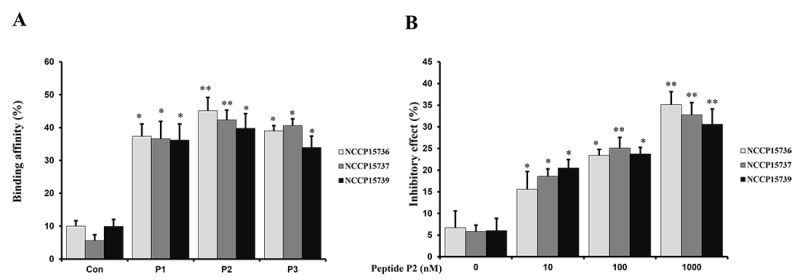
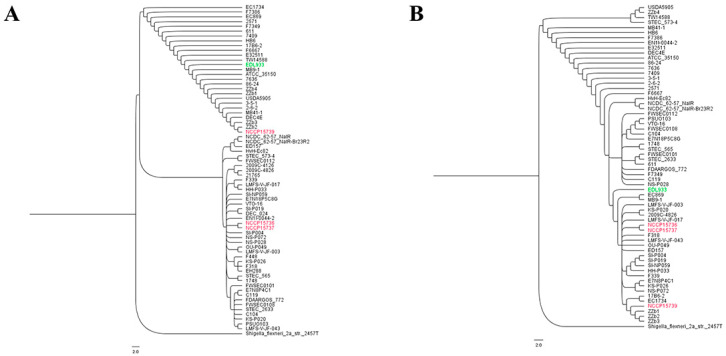
In this study, we tried to develop a FimH inhibitor that inhibits adhesion of enterohemorrhagic (EHEC) on the epithelium of human intestine during the initial stage of infections. Using a T7 phage display method with a reference strain, EHEC EDL933, FimH was selected as an adherent lectin to GM1a and Gb3 glycans. In order to detect the ligand binding domain (LBD) of FimH, we used a docking simulation and found three binding site sequences of FimH, i.e., P1, P2, and P3. Among Gb3 mimic peptides, P2 was found to have the strongest binding strength. Moreover, in vitro treatment with peptide P2 inhibited binding activity in a concentration-dependent manner. Furthermore, we conducted confirmation experiments through several strains isolated from patients in Korea, EHEC NCCP15736, NCCP15737, and NCCP15739. In addition, we analyzed the evolutionary characteristics of the predicted FimH lectin-like adhesins to construct a lectin-glycan interaction (LGI). We selected 70 recently differentiated strains from the phylogenetic tree of 2240 strains with Shiga toxin in their genome. We can infer EHEC strains dynamically evolved but FimH was conserved during the evolution time according to the phylogenetic tree. Furthermore, FimH could be a reliable candidate of drug target in terms of evolution. We examined how pathogen lectins interact with host glycans early in infection in EDL933 as well as several field strains and confirmed that glycan-like peptides worked as an initial infection inhibitor.
在这项研究中,我们试图开发一种 FimH 抑制剂,以抑制肠出血性大肠杆菌(EHEC)在感染初期黏附到人类肠道上皮细胞。使用参考菌株 EHEC EDL933 的 T7 噬菌体展示方法,选择 FimH 作为黏附凝集素,与 GM1a 和 Gb3 糖结合。为了检测 FimH 的配体结合域(LBD),我们使用对接模拟,发现了 FimH 的三个结合位点序列,即 P1、P2 和 P3。在 Gb3 模拟肽中,发现 P2 具有最强的结合强度。此外,体外用肽 P2 处理以浓度依赖的方式抑制结合活性。此外,我们通过从韩国患者中分离的几种菌株,EHEC NCCP15736、NCCP15737 和 NCCP15739 进行了确认实验。此外,我们分析了预测的 FimH 类凝集素样黏附素的进化特征,以构建凝集素-聚糖相互作用(LGI)。我们从基因组中带有志贺毒素的 2240 株菌株的系统发育树中选择了 70 株最近分化的菌株。根据系统发育树,我们可以推断出 EHEC 菌株动态进化,但 FimH 在进化过程中是保守的。此外,从进化的角度来看,FimH 可以成为药物靶点的可靠候选物。我们检查了病原体凝集素如何在感染早期与宿主聚糖相互作用,在 EDL933 以及几种现场分离株中进行了检查,并证实了聚糖样肽作为初始感染抑制剂的作用。