Departamento de Química Inorgánica y Orgánica, Universitat Jaume I, Av. V. Sos Baynat s/n, 12071 Castellón, Spain.
Unidad Predepartamental de Medicina, Universitat Jaume I, Av. V. Sos Baynat s/n, 12071 Castellón, Spain.
Int J Mol Sci. 2022 Sep 5;23(17):10162. doi: 10.3390/ijms231710162.
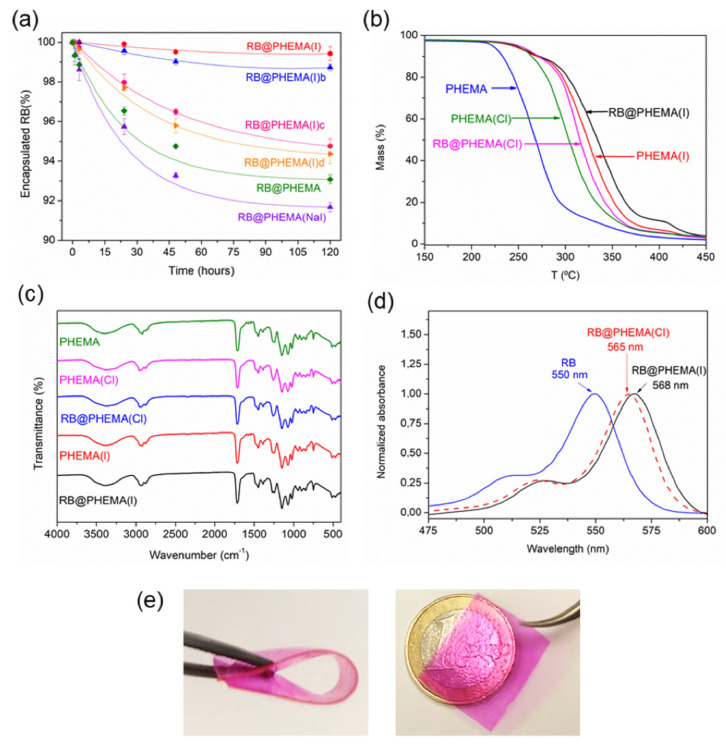
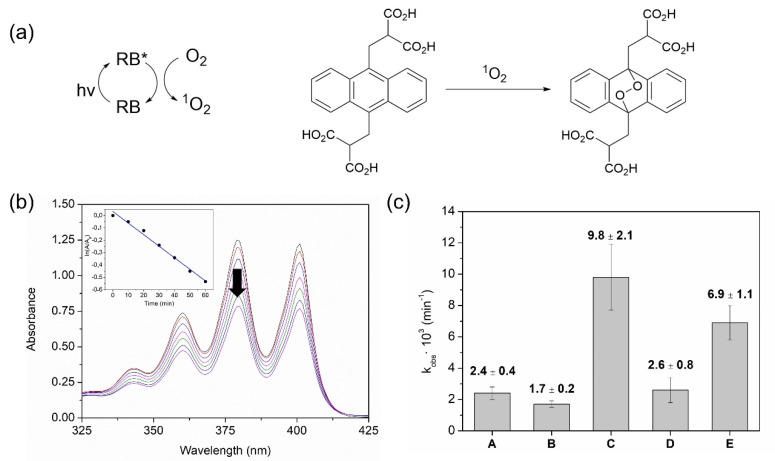
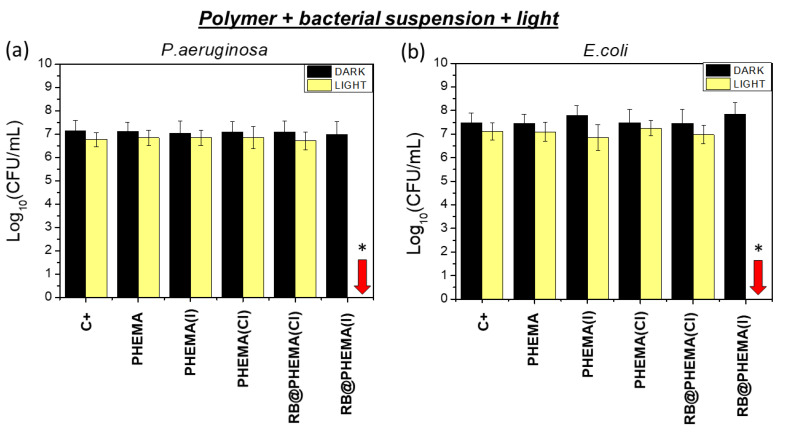
A series of poly(2-hydroxyethyl methacrylate) (PHEMA) thin films entrapping photosensitizer Rose Bengal (RB) and tetrabutylammonium iodide (TBAI) have been synthetized. The materials have been characterized by means of Thermogravimetric Analysis (TGA), Attenuated Total Reflectance Fourier Transform Infrared Spectroscopy (ATR-FTIR) and UV-vis Absorption spectroscopy. Irradiation of the materials with white light led to the generation of several bactericidal species, including singlet oxygen (O), triiodide anion (I) and hydrogen peroxide (HO). O production was demonstrated spectroscopically by reaction with the chemical trap 2,2'-(anthracene-9,10-diylbis(methylene))dimalonic acid (ABDA). In addition, the reaction of iodide anion with O yielded I inside the polymeric matrix. This reaction is accompanied by the formation of HO, which diffuses out the polymeric matrix. Generation of both I and HO was demonstrated spectroscopically (directly in the case of triiodide by the absorption at 360 nm and indirectly for HO using the xylenol orange test). A series of photodynamic inactivation assays were conducted with the synthesized polymers against Gram-negative bacteria and . Complete eradication (7 log CFU/mL) of both bacteria occurred after only 5 min of white light irradiation (400-700 nm; total energy dose 24 J/cm) of the polymer containing both RB and TBAI. The control polymer without embedded iodide (only RB) showed only marginal reductions of ca. 0.5 log CFU/mL. The main novelty of the present investigation is the generation of three bactericidal species (O, I and HO) at the same time using a single polymeric material containing all the elements needed to produce such a bactericidal cocktail, although the most relevant antimicrobial activity is shown by HO. This experimental approach avoids multistep protocols involving a final step of addition of I, as described previously for other assays in solution.
已合成了一系列包埋光敏剂玫瑰红(RB)和四丁基碘化铵(TBAI)的聚(2-羟乙基甲基丙烯酸酯)(PHEMA)薄膜。通过热重分析(TGA)、衰减全反射傅里叶变换红外光谱(ATR-FTIR)和紫外可见吸收光谱对材料进行了表征。用白光照射这些材料会产生几种杀菌物质,包括单线态氧(O)、三碘化物阴离子(I)和过氧化氢(HO)。通过与化学捕获剂 2,2'-(蒽-9,10-二基双(亚甲基))丙二酸(ABDA)反应,证明了 O 的产生具有光谱特征。此外,在聚合物基质中,I 与 O 反应生成 I。该反应伴随着 HO 的形成,HO 扩散出聚合物基质。通过光谱法(对于三碘化物,直接通过在 360nm 处的吸收,间接通过使用二甲苯酚橙测试 HO)证明了 I 和 HO 的生成。用合成聚合物对革兰氏阴性菌 和 进行了一系列光动力失活试验。仅在白光照射(400-700nm;总能量剂量 24J/cm) 5 分钟后,含 RB 和 TBAI 的聚合物就可完全消灭这两种细菌(7logCFU/mL)。不含嵌入碘化物的对照聚合物(仅含 RB)仅显示出约 0.5logCFU/mL 的微小减少。本研究的主要新颖之处在于使用含有产生这种杀菌鸡尾酒所需的所有元素的单一聚合物材料同时产生三种杀菌物质(O、I 和 HO),尽管最相关的抗菌活性是由 HO 表现出来的。这种实验方法避免了涉及最后一步添加 I 的多步方案,如前所述,在其他溶液中的试验。