Künz Tina, Hauswirth Alexander W, Hetzenauer Gabriele, Rudzki Jakob, Nachbaur David, Steiner Normann
Department of Internal Medicine V (Hematology and Medical Oncology), Medical University of Innsbruck, A-6020 Innsbruck, Austria.
Department of Medicine I, Division of Hematology and Hemostaseology, Medical University of Vienna, 1090 Vienna, Austria.
Cancers (Basel). 2022 Sep 1;14(17):4290. doi: 10.3390/cancers14174290.
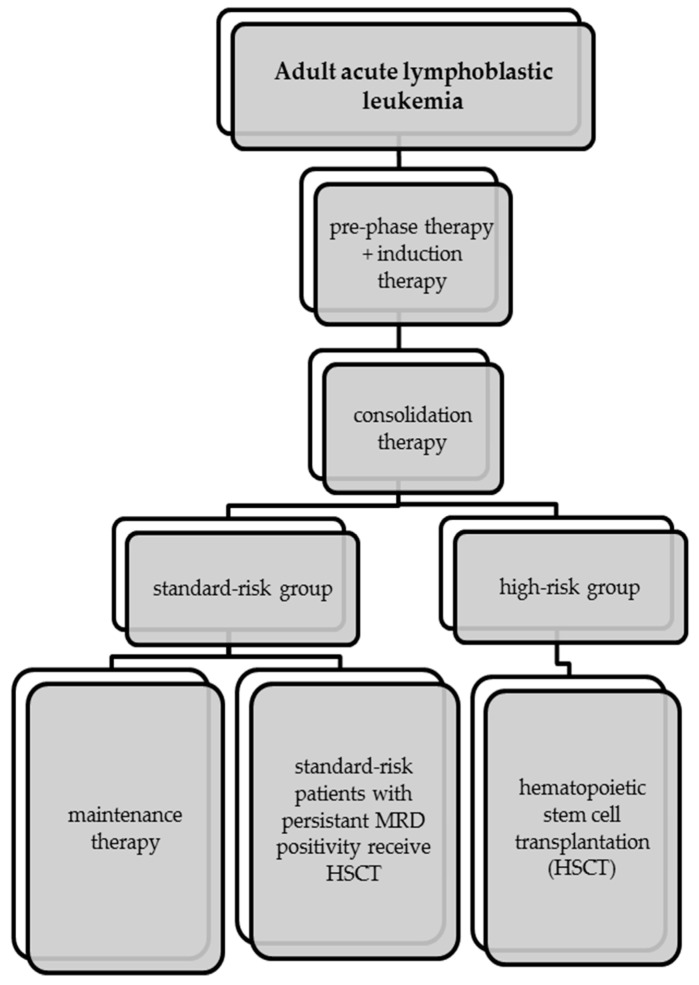
Acute lymphoblastic leukemia (ALL) is a rare hematological malignancy characterized by proliferation and accumulation of premature lymphoid blasts. Depending on risk factors, the survival of acute lymphoblastic leukemia has significantly improved over the last decades. During the last years, measurable residual disease (MRD) assessment has evolved into one of the most sensitive markers for prognosis and risk of relapse. For this reason, measurable residual disease detection and monitoring count as standard evaluation in patients with acute lymphoblastic leukemia. Allogeneic stem cell transplantation is still the recommended treatment option for patients with high and highest risk profiles as well as for relapsed or refractory settings. The increased understanding of the pathomechanism and heterogeneity of acute lymphoblastic leukemia has led to the development of several novel therapeutic opportunities such as tyrosine-kinase inhibitors, antibody-based therapies and CAR-T cells with the aim of improving clinical outcomes. Furthermore, the major advances in disease understanding of ALL have led to the identification of different subgroups and better disease stratification. Even though novel therapy targets are constantly developed, acute lymphoblastic leukemia remains a challenging and life-threatening disease. To improve the historically unsatisfying result in therapy of adult acute lymphoblastic leukemia many clinical trials have recently been initiated to determine the optimum combination regimens of novel and old agents for adult acute lymphoblastic leukemia.
急性淋巴细胞白血病(ALL)是一种罕见的血液系统恶性肿瘤,其特征是不成熟淋巴母细胞的增殖和积聚。根据风险因素,在过去几十年中,急性淋巴细胞白血病患者的生存率有了显著提高。在过去几年中,可测量残留病(MRD)评估已发展成为预后和复发风险最敏感的标志物之一。因此,可测量残留病的检测和监测被视为急性淋巴细胞白血病患者的标准评估。异基因干细胞移植仍然是高危和极高危患者以及复发或难治性患者的推荐治疗选择。对急性淋巴细胞白血病发病机制和异质性的深入了解导致了几种新型治疗方法的发展,如酪氨酸激酶抑制剂、基于抗体的疗法和嵌合抗原受体T细胞(CAR-T细胞),目的是改善临床结果。此外,对ALL疾病认识的重大进展导致了不同亚组的识别和更好的疾病分层。尽管不断开发新的治疗靶点,但急性淋巴细胞白血病仍然是一种具有挑战性和危及生命的疾病。为了改善成人急性淋巴细胞白血病治疗中历来不尽人意的结果,最近启动了许多临床试验,以确定成人急性淋巴细胞白血病新旧药物的最佳联合方案。