Division of Nursing Science, Graduate School of Biomedical and Health Sciences, Hiroshima University, Hiroshima 734-8553, Japan.
Department of Medicine for Integrated Approach to Social Inclusion, Graduate School of Biomedical and Health Sciences, Hiroshima University, Hiroshima 734-8553, Japan.
Int J Environ Res Public Health. 2022 Aug 27;19(17):10702. doi: 10.3390/ijerph191710702.
Improving the labor productivity of small and medium-sized enterprises (SMEs) is essential because of the aging population and predicted reduction in the labor force. Therefore, it is necessary to ensure that employees are in good health to work for long times. In this regard, the purpose of the study is to investigate the relationship between work engagement (WE) and related variables among SME employees.
A cross-sectional study was conducted using the baseline data of the prospective cohort study, which included 377 employees from three SMEs headquartered in Hiroshima Prefecture, Japan.
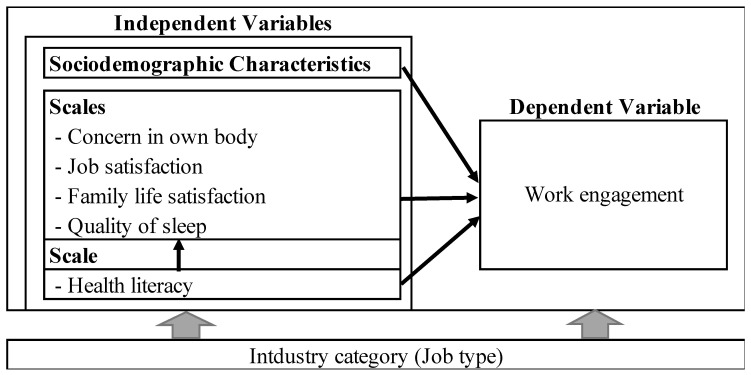
A multiple regression analysis was performed to see the associations between Utrecht Work Engagement Scale (UWES) scores and other variables. Significant associations were found with job satisfaction, age, health literacy (HL), and quality of sleep (all, < 0.05). Additionally, there was a statistically significant difference observed in WE, quality of sleep, concern for own body, job satisfaction, and family life satisfaction (all, < 0.001) with respect to high and low HL levels.
The results of this study reveal that while implementing health and productivity management in SMEs to increase WE, it is best to concentrate on raising HL, job satisfaction, and sleep quality. To increase generalizability, further research could be conducted with more SMEs companies.
由于人口老龄化和劳动力预计减少,提高中小企业(SMEs)的劳动生产率至关重要。因此,有必要确保员工身体健康,以便长时间工作。在这方面,本研究的目的是调查 SME 员工工作投入(WE)与相关变量之间的关系。
本研究采用前瞻性队列研究的基线数据进行横断面研究,共纳入日本广岛县 3 家中小企业的 377 名员工。
采用多元回归分析方法,观察 Utrecht 工作投入量表(UWES)评分与其他变量之间的关联。结果显示,工作满意度、年龄、健康素养(HL)和睡眠质量(均<0.05)与 UWES 评分显著相关。此外,HL 水平高和低的员工在 WE、睡眠质量、对自身健康的关注、工作满意度和家庭生活满意度方面存在统计学差异(均<0.001)。
本研究结果表明,在中小企业实施健康和生产力管理以提高 WE 时,最好集中提高 HL、工作满意度和睡眠质量。为了提高普遍性,可以进一步对更多的中小企业进行研究。