School of Sport Science, Beijing Sport University, Beijing 100084, China.
Int J Environ Res Public Health. 2022 Aug 31;19(17):10845. doi: 10.3390/ijerph191710845.
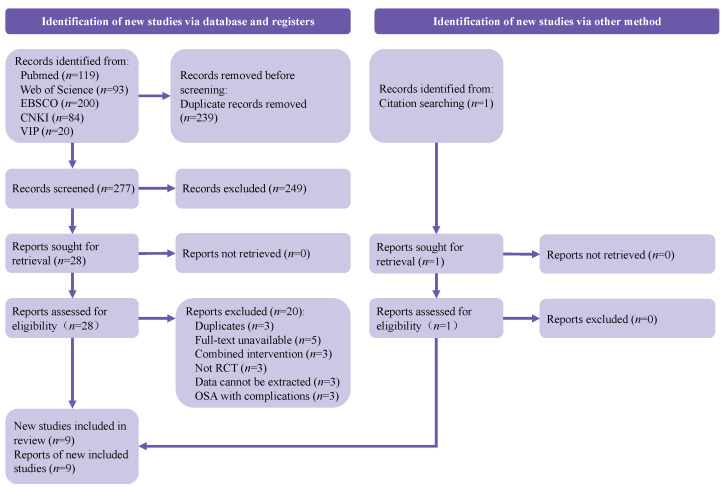
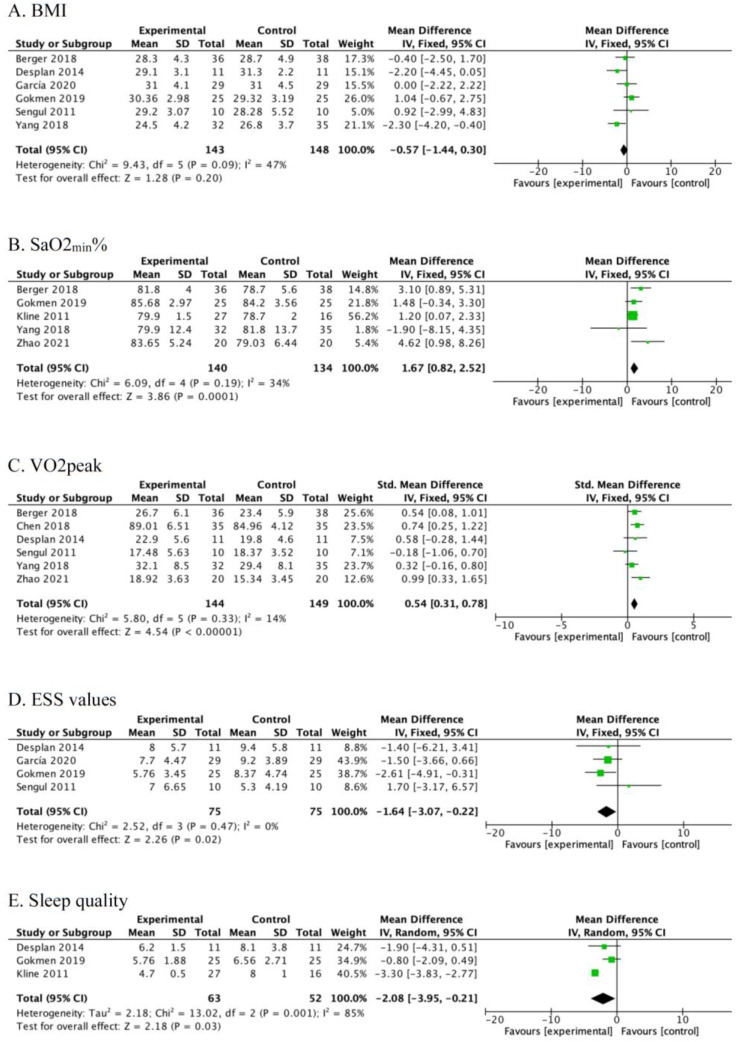
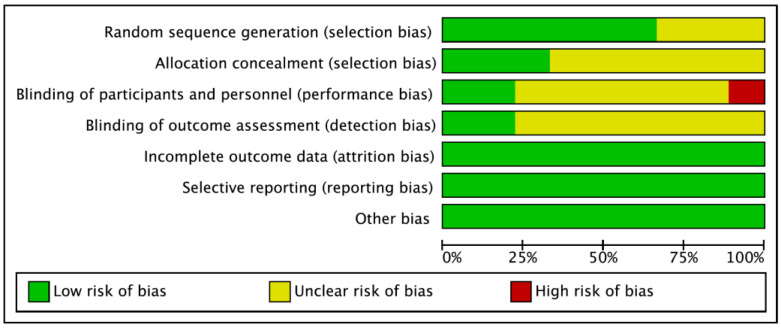
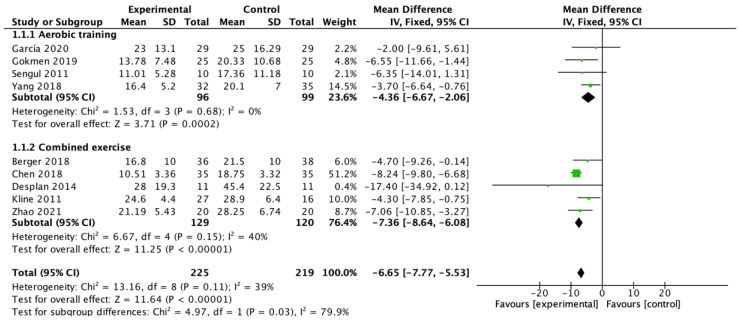
With exercise being more frequently utilized in treatment for obstructive sleep apnea (OSA), a systematic review of the intervention efficacy of exercise on OSA is necessary. PubMed, EBSCO, Web of Science, VIP, and CNKI databases were searched to collect randomized controlled trials (RCTs) of exercise applied to OSA from January 2000 to January 2022. The literature screening, data extraction, and risk of bias assessment of included studies were conducted independently by two reviewers. Meta-analysis was then performed using Rev Man 5.4 software. A total of 9 RCTs were included, including 444 patients. Compared with the control group, exercise made an improvement in apnea-hypopnea index (AHI) [MD = -6.65, 95% CI (-7.77, -5.53), < 0.00001], minimum oxygen saturation (SaO%) [MD = 1.67, 95% CI (0.82, 2.52), = 0.0001], peak oxygen uptake (VO) [SMD = 0.54, 95% CI (0.31, 0.78), < 0.00001], Pittsburgh sleep quality index (PSQI) [MD = -2.08, 95% CI (-3.95, -0.21), = 0.03], and Epworth Sleepiness Scale (ESS) values [MD = -1.64, 95% CI, (-3.07, -0.22), = 0.02]. However, there were no significant changes in body mass index (BMI). As for the results of subgroup analysis, aerobic exercise combined with resistance exercise [MD = -7.36, 95% CI (-8.64, -6.08), < 0.00001] had a better effect on AHI reduction than aerobic exercise alone [MD = -4.36, 95% CI (-6.67, -2.06), = 0.0002]. This systematic review demonstrates that exercise reduces the severity of OSA with no changes in BMI, and the effect of aerobic exercise combined with resistance training is better than aerobic exercise alone in AHI reduction. Exercise also improves cardiopulmonary fitness, sleep quality, and excessive daytime sleepiness.
随着运动在阻塞性睡眠呼吸暂停(OSA)治疗中的应用越来越频繁,有必要对运动干预治疗 OSA 的疗效进行系统评价。检索了 PubMed、EBSCO、Web of Science、VIP 和 CNKI 数据库,收集了 2000 年 1 月至 2022 年 1 月期间应用于 OSA 的运动的随机对照试验(RCT)。由两名评审员独立进行文献筛选、数据提取和纳入研究的偏倚风险评估。然后使用 RevMan 5.4 软件进行荟萃分析。共纳入 9 项 RCT,共 444 例患者。与对照组相比,运动使呼吸暂停低通气指数(AHI)[MD=-6.65,95%CI(-7.77,-5.53)]、最低氧饱和度(SaO%)[MD=1.67,95%CI(0.82,2.52)]、峰值摄氧量(VO)[SMD=0.54,95%CI(0.31,0.78)]、匹兹堡睡眠质量指数(PSQI)[MD=-2.08,95%CI(-3.95,-0.21)]和Epworth 嗜睡量表(ESS)值[MD=-1.64,95%CI(-3.07,-0.22)]均有改善,差异均有统计学意义(均 < 0.00001)。然而,体重指数(BMI)无明显变化。亚组分析结果显示,与单纯有氧运动相比,有氧运动联合抗阻运动[MD=-7.36,95%CI(-8.64,-6.08)]对 AHI 的降低效果更好[MD=-4.36,95%CI(-6.67,-2.06)],差异有统计学意义(均 < 0.00001)。本系统评价表明,运动可降低 OSA 的严重程度,不改变 BMI,有氧运动联合抗阻训练的效果优于单纯有氧运动在 AHI 降低方面。运动还可改善心肺功能、睡眠质量和日间嗜睡。