
12年间经导管主动脉瓣植入术的时间趋势:一项高容量单中心经验
Temporal Trends of Transcatheter Aortic Valve Implantation over 12 Years: A High-Volume Single-Center Experience.
作者信息
Frydman Shir, Zahler David, Merdler Ilan, Freund Ophir, Shacham Yacov, Banai Shmuel, Finkelstein Ariel, Steinvil Arie
机构信息
Department of Cardiology, Tel-Aviv Sourasky Medical Center, Sackler Faculty of Medicine, Tel-Aviv University, Tel-Aviv 6997801, Israel.
出版信息
J Clin Med. 2022 Aug 24;11(17):4962. doi: 10.3390/jcm11174962.
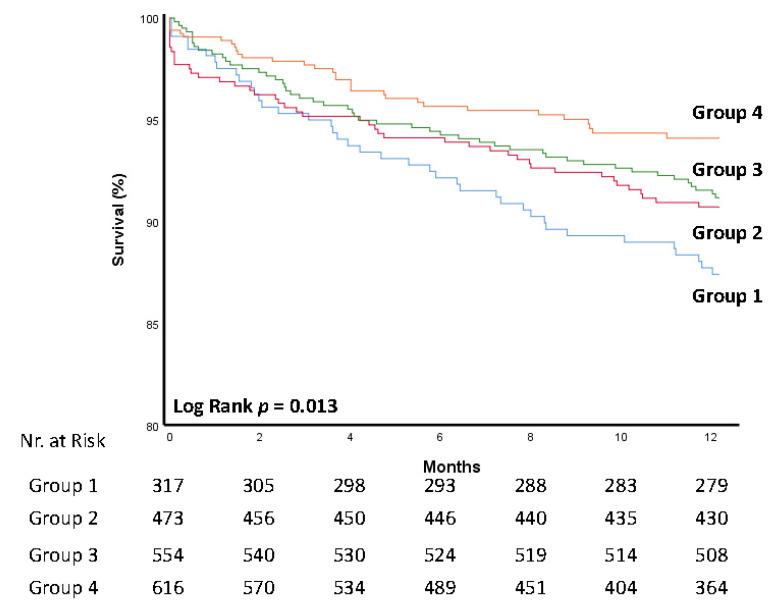
Transcatheter aortic valve replacement (TAVR) has become the mainstay of treatment for patients with severe AS. Since the TAVR population and patients’ outcomes have dramatically changed over the last decade, updated data regarding contemporary practice and trends are pertinent to clinical use. We performed a retrospective observational analysis of consecutive patient who underwent TAVR for symptomatic severe AS between the years 2009 and 2021 in a single high-volume center. Patients were divided into four equal time groups based on the procedure date (2009−2012, 2013−2015, 2016−2018 and 2019−2021). A total of 1988 patients were included in this study and divided into four groups, with 321, 482, 565 and 620 patients in groups 1−4, respectively. Significant trends were seen in baseline characteristics of a few parameters, including lower age, lower procedural risk and reduced rates of comorbidity (p for trend < 0.0001 for all factors mentioned above). A shift was seen in the procedural technique with lower balloon pre-dilatation and higher device success rates (p for trend < 0.0001). The post-procedural period changed over the years with fewer pacemaker placements (p < 0.0001) and reduced rates of AKI and post-procedural bleed (p value 0.02 and <0.0001, respectively). Furthermore, overall hospital stay was shortened from 7 ± 7.1 days to 2.3 ± 1.7 (p < 0.0001). Finally, patient follow up revealed reduced mortality rates at 30 days (p < 0.0001) and 1 year (p = 0.013). Multivariate regression revealed that a late implantation date was an independent protector from mortality (HR 0.84, p = 0.002). In conclusion, our study demonstrated that TAVR has become a safer practice over the years with reduced rates of morbidity and mortality.
经导管主动脉瓣置换术(TAVR)已成为重度主动脉瓣狭窄(AS)患者的主要治疗手段。由于在过去十年中,接受TAVR治疗的人群及患者预后发生了显著变化,因此有关当代治疗实践和趋势的最新数据对于临床应用具有重要意义。我们对2009年至2021年间在一家大型中心因症状性重度AS接受TAVR治疗的连续患者进行了回顾性观察分析。根据手术日期,将患者分为四个相等的时间段(2009 - 2012年、2013 - 2015年、2016 - 2018年和2019 - 2021年)。本研究共纳入1988例患者,分为四组,第1 - 4组分别有321例、482例、565例和620例患者。在一些参数的基线特征方面出现了显著趋势,包括年龄降低、手术风险降低和合并症发生率降低(上述所有因素的趋势p值均<0.0001)。手术技术也发生了转变,球囊预扩张减少,器械成功率提高(趋势p值<0.0001)。多年来,术后阶段也有所变化,起搏器植入减少(p<0.0001),急性肾损伤(AKI)和术后出血发生率降低(p值分别为0.02和<0.0001)。此外,总体住院时间从7±7.1天缩短至2.3±1.7天(p<0.0001)。最后,患者随访显示30天(p<0.0001)和1年(p = 0.013)的死亡率降低。多因素回归分析显示,较晚的植入日期是死亡率的独立保护因素(风险比[HR]为0.84,p = 0.002)。总之,我们的研究表明,多年来TAVR已成为一种更安全的治疗方法,发病率和死亡率均有所降低。

 Zotero 插件