Aprile Irene, Conte Carmela, Cruciani Arianna, Pecchioli Cristiano, Castelli Letizia, Insalaco Sabina, Germanotta Marco, Iacovelli Chiara
IRCCS Fondazione Don Carlo Gnocchi, 50143 Florence, Italy.
Laboratorio di Analisi del Movimento, Policlinico Italia Piazza del Campidano 6, 00162 Rome, Italy.
J Clin Med. 2022 Aug 31;11(17):5162. doi: 10.3390/jcm11175162.
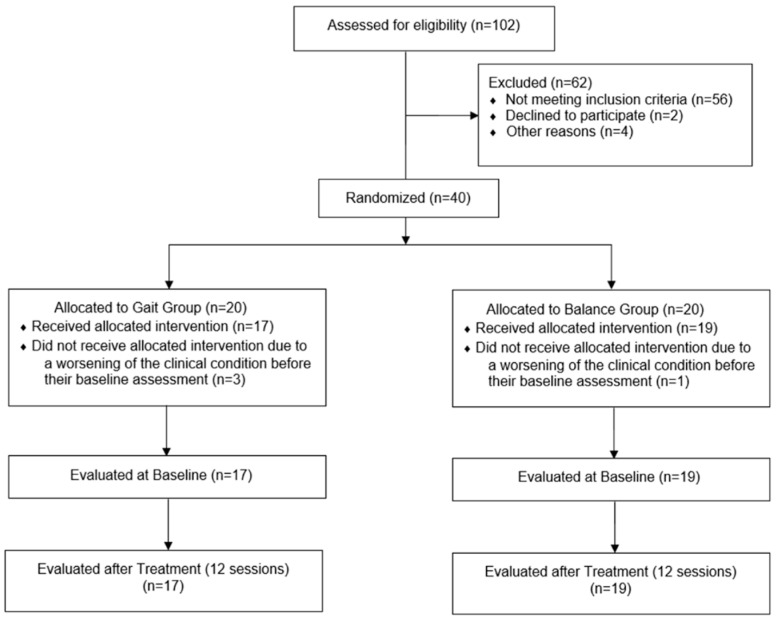
Recently, the use of robotic technology in gait and balance rehabilitation of stroke patients has been introduced, with positive results. The purpose of this study was to evaluate the effectiveness of robotic gait and trunk rehabilitation compared to robotic gait training alone on balance, activities, and participation measures in patients with subacute stroke. The study was a randomized, controlled, single blind, parallel group clinical trial. Thirty-six patients with first ischemic or hemorrhagic stroke event were enrolled, and they were randomized in two groups: Gait Group (GG), where they received only robotic treatment for gait rehabilitation through an end-effector system, and Gait/Trunk Group (GTG) where they performed end-effector gait rehabilitation and balance with a robotic platform, 3 times/week for 12 sessions/month. At the end of the study, there was an improvement in balance ability in both groups. Instead, the lower limb muscle strength and muscle tone significantly improved only in the GTG group, where we found a significant reduction in the trunk oscillations and displacement during dynamic exercises more than the GG group. The robotic platform which was added to the gait robotic treatment offers more intense and controlled training of the trunk that positively influences the tone and strength of lower limb muscles.
最近,机器人技术已被引入中风患者的步态和平衡康复治疗中,并取得了积极成果。本研究的目的是评估与单纯机器人步态训练相比,机器人步态和躯干康复对亚急性中风患者平衡、活动和参与度指标的有效性。该研究是一项随机、对照、单盲、平行组临床试验。招募了36例首次发生缺血性或出血性中风事件的患者,并将他们随机分为两组:步态组(GG),他们仅通过末端执行器系统接受机器人步态康复治疗;步态/躯干组(GTG),他们使用机器人平台进行末端执行器步态康复和平衡训练,每周3次,每月12次。在研究结束时,两组的平衡能力均有所改善。相反,仅在GTG组中,下肢肌肉力量和肌张力有显著改善,我们发现与GG组相比,动态运动期间躯干摆动和位移显著减少。添加到步态机器人治疗中的机器人平台提供了更强化且可控的躯干训练,对下肢肌肉的张力和力量产生积极影响。