Râpă Maria, Spurcaciu Bogdan Norocel, Ion Rodica-Mariana, Grigorescu Ramona Marina, Darie-Niță Raluca Nicoleta, Iancu Lorena, Nicolae Cristian-Andi, Gabor Augusta Raluca, Matei Ecaterina, Predescu Cristian
Faculty of Materials Science and Engineering, University Politehnica of Bucharest, 313 Splaiul Independentei, 060042 Bucharest, Romania.
National Institute for Research & Development in Chemistry and Petrochemistry (ICECHIM), 202 Splaiul Independentei, 060021 Bucharest, Romania.
Materials (Basel). 2022 Aug 29;15(17):5978. doi: 10.3390/ma15175978.
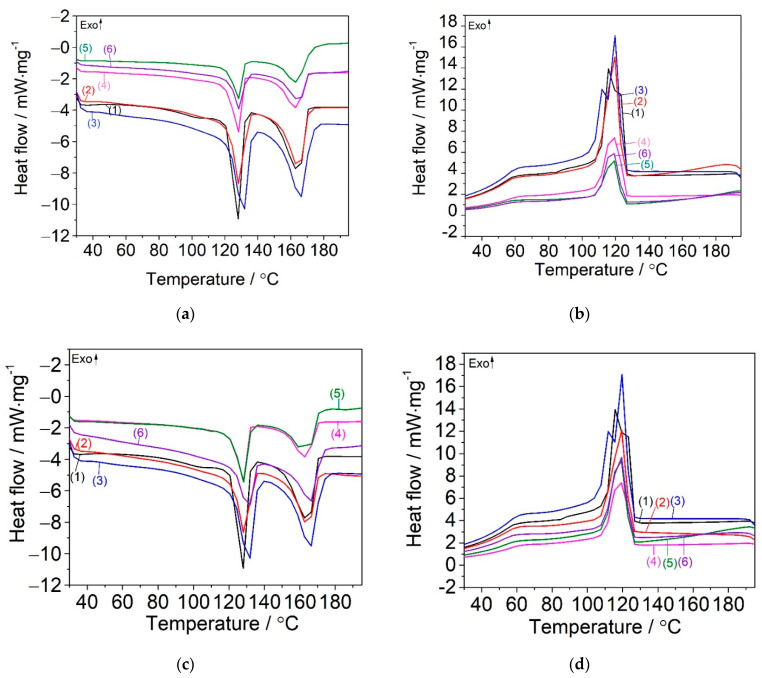
Innovative composites based on polypropylene waste impurified cu HDPE (PPW) combined with two thermoplastic block-copolymers, namely styrene-butadiene-styrene (SBSBC) and styrene-isoprene-styrene (SISBC) block-copolymers, and up to 10 wt% nano-clay, were obtained by melt blending. SBSBC and SISBC with almost the same content of polystyrene (30 wt%) were synthesized by anionic sequential polymerization and used as compatibilizers for PPW. Optical microscopy evaluation of the PPW composites showed that the n-clay was encapsulated into the elastomer. Addition of n-clay, together with SBSBC or SISBC, increased the interphase surface of the components in the PPW composites and enhanced the superficial area/volume ratio, which led to a recycled material with improved performance. The data resulting from differential scanning calorimetry (DSC), thermogravimetric analysis (TGA), mechanical evaluation, and dynamic mechanical analysis (DMA) revealed that PPW reinforcement with n-clay and styrene-diene block-copolymers allows the obtaining of composites with favorable mechanical and thermal properties, and excellent impact strength for potential engineering applications.
通过熔融共混制备了基于聚丙烯废料(PPW)、两种热塑性嵌段共聚物(即苯乙烯-丁二烯-苯乙烯(SBSBC)和苯乙烯-异戊二烯-苯乙烯(SISBC)嵌段共聚物)以及含量高达10 wt%纳米粘土的创新复合材料。通过阴离子顺序聚合合成了聚苯乙烯含量几乎相同(30 wt%)的SBSBC和SISBC,并将其用作PPW的增容剂。PPW复合材料的光学显微镜评估表明,纳米粘土被包裹在弹性体中。添加纳米粘土以及SBSBC或SISBC,增加了PPW复合材料中各组分的界面面积,提高了表面积/体积比,从而得到了性能改进的回收材料。差示扫描量热法(DSC)、热重分析(TGA)、力学评估和动态力学分析(DMA)所得数据表明,用纳米粘土和苯乙烯-二烯嵌段共聚物增强PPW可得到具有良好力学和热性能以及优异冲击强度的复合材料,适用于潜在的工程应用。