School of Public Health, University of Haifa, Haifa 3498838, Israel.
Department of Gastroenterology Tel-Aviv Medical Center, Tel Aviv 6423906, Israel.
Nutrients. 2022 Aug 27;14(17):3533. doi: 10.3390/nu14173533.
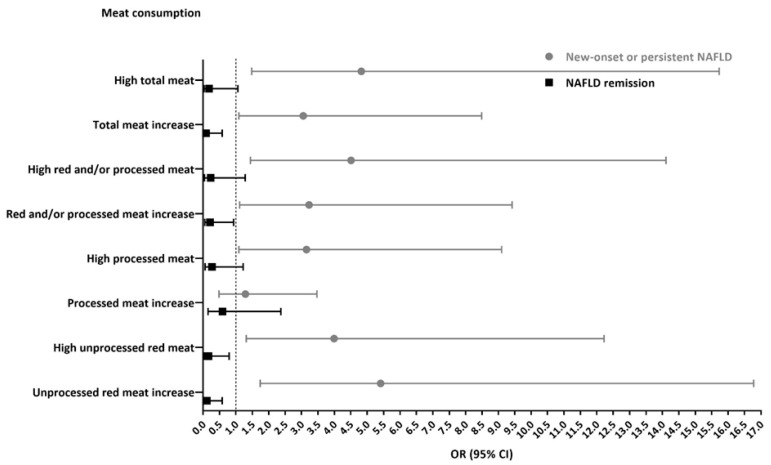
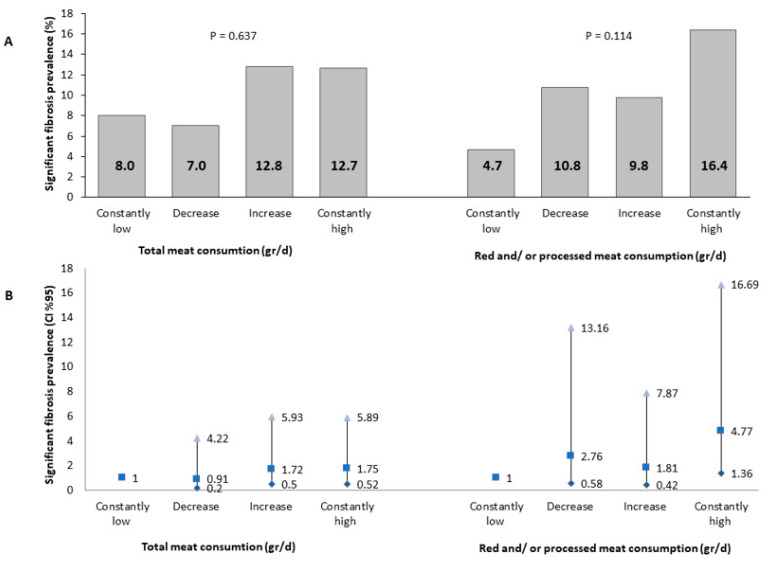
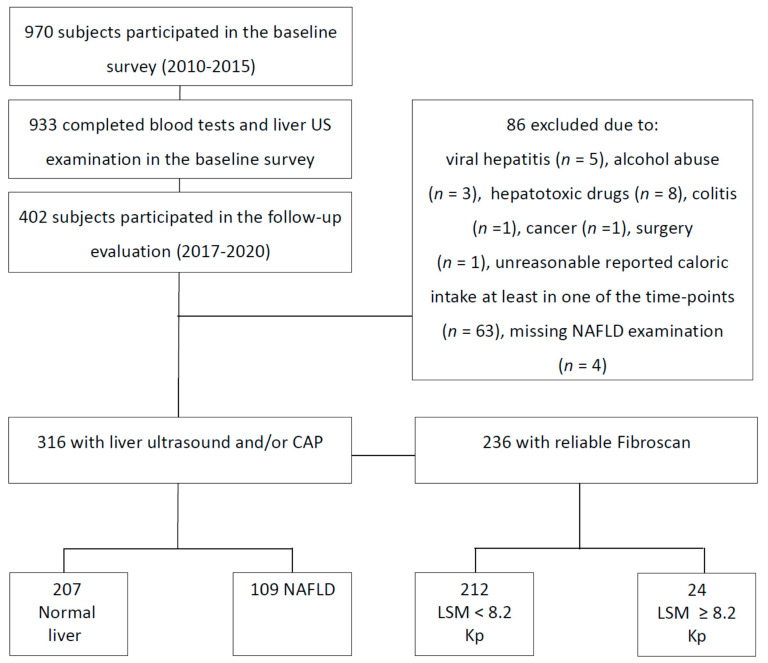
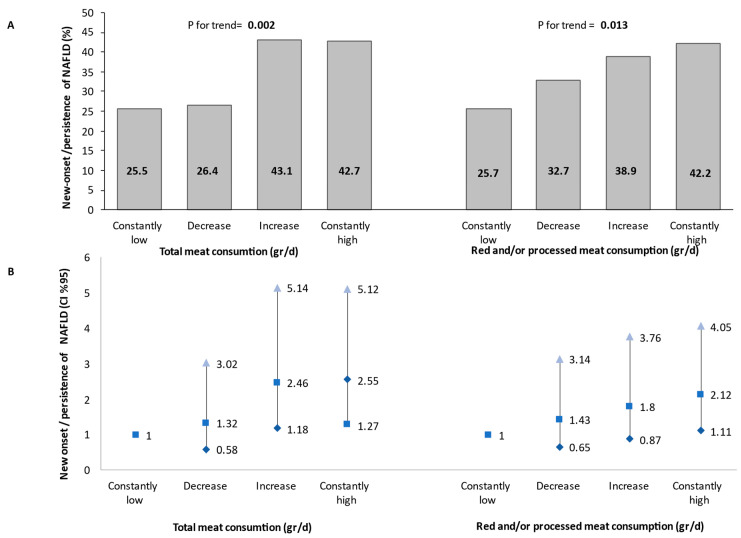
Non-alcoholic fatty liver disease (NAFLD) has been associated with meat consumption in cross-sectional studies. However, only a few prospective studies have been conducted, and they did not test for liver fibrosis. We aimed to assess the association between meat consumption changes and the incidence and remission of NAFLD and significant liver fibrosis. We used a prospective cohort study design, including 316 subjects aged 40-70 years, participating in baseline and follow-up evaluations at Tel-Aviv Medical Center. NAFLD was determined by liver ultrasound or controlled attenuation parameter (CAP), and liver fibrosis was determined by FibroScan. Meat consumption (g/day) was assessed by a food frequency questionnaire (FFQ). In multivariable-adjusted analyses, high consumption of red and/or processed meat (≥gender-specific median) was associated with a higher risk of NAFLD with elevated alanine aminotransferase (ALT) (OR = 3.75, 1.21-11.62, = 0.022). Consistently high (in both baseline and follow-up evaluations) total meat consumption was associated with 2.55-fold (95% CI 1.27-5.12, = 0.009) greater odds for new onset and/or persistence of NAFLD compared to consistently low meat consumption. A similar association was shown for consistently high consumption of red and/or processed meat (OR = 2.12, 95% CI 1.11-4.05, = 0.022). Consistently high red and/or processed meat consumption was associated with 4.77-fold (95% CI 1.36-16.69, = 0.014) greater odds for significant fibrosis compared to consistently low consumption. Minimizing the consumption of red and/or processed meat may help prevent NAFLD and significant fibrosis.
非酒精性脂肪性肝病 (NAFLD) 与横断面研究中的肉类消费有关。然而,仅有少数前瞻性研究进行了研究,并且它们没有检测肝纤维化。我们旨在评估肉类消费变化与 NAFLD 和显著肝纤维化的发生和缓解之间的关联。我们使用了一项前瞻性队列研究设计,包括 316 名年龄在 40-70 岁之间的参与者,他们在特拉维夫医疗中心参加了基线和随访评估。通过肝脏超声或受控衰减参数 (CAP) 确定 NAFLD,通过 FibroScan 确定肝纤维化。通过食物频率问卷 (FFQ) 评估肉类消费 (g/天)。在多变量调整分析中,高消费红肉类和/或加工肉类 (≥性别特异性中位数) 与 ALT 升高的 NAFLD 风险增加相关 (OR = 3.75,1.21-11.62, = 0.022)。始终高 (在基线和随访评估中) 的总肉类消费与新发生和/或持续存在的 NAFLD 的几率增加 2.55 倍 (95%CI 1.27-5.12, = 0.009) 相比,始终低肉类消费。始终高消费红肉类和/或加工肉类也显示出类似的关联 (OR = 2.12,95%CI 1.11-4.05, = 0.022)。始终高消费红肉类和/或加工肉类与显著纤维化的几率增加 4.77 倍 (95%CI 1.36-16.69, = 0.014) 相关,而始终低消费则相反。尽量减少红肉类和/或加工肉类的消费可能有助于预防 NAFLD 和显著纤维化。