Département de Chimie, Biochimie et Physique, Université du Québec à Trois-Rivières, Trois-Rivières, QC G8Z 4M3, Canada.
Département de Biologie Médicale, Université du Québec à Trois-Rivières, Trois-Rivières, QC G8Z 4M3, Canada.
Molecules. 2022 Aug 31;27(17):5621. doi: 10.3390/molecules27175621.
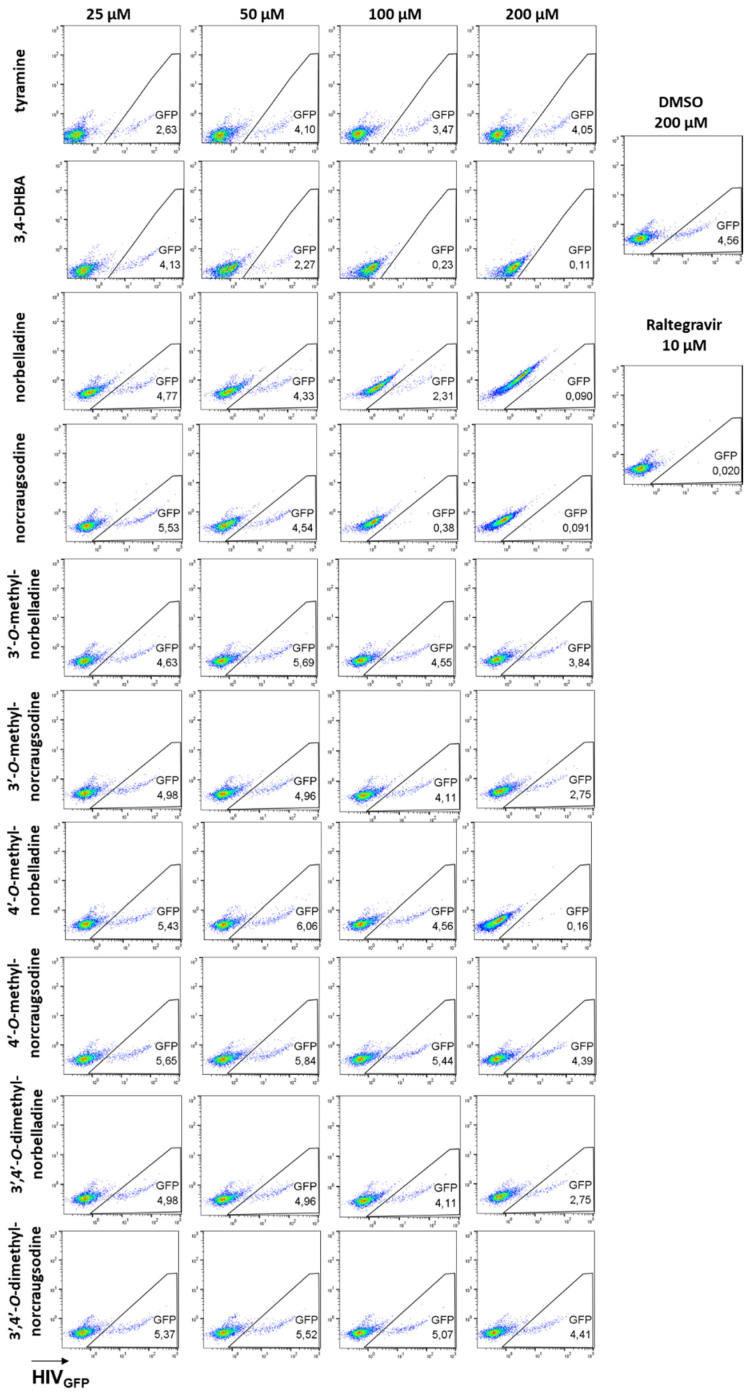
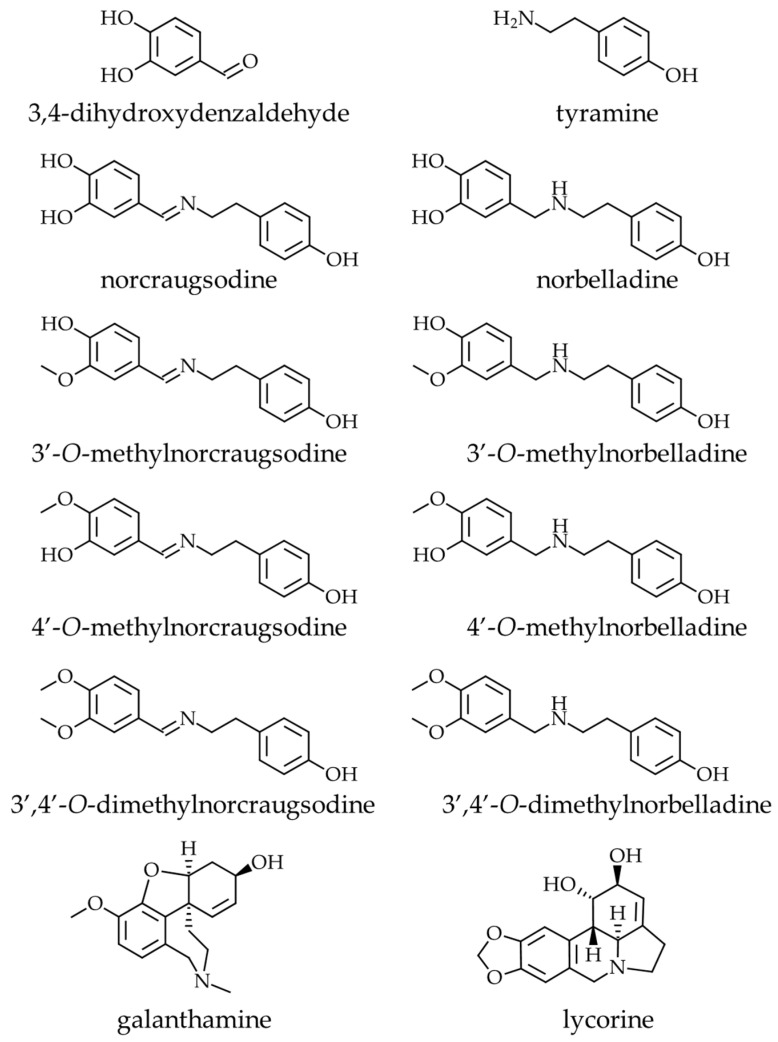
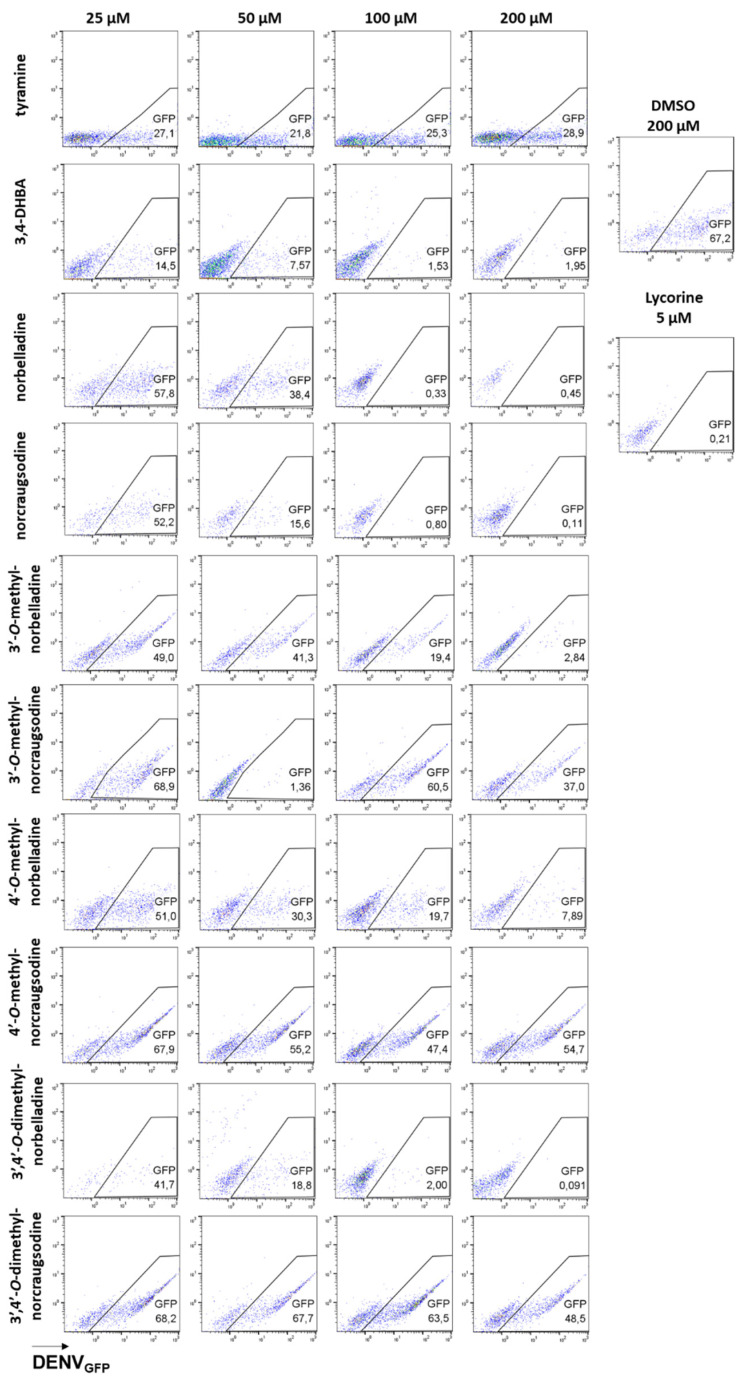
Amaryllidaceae alkaloids (AAs) are a structurally diverse family of alkaloids recognized for their many therapeutic properties, such as antiviral, anti-cholinesterase, and anticancer properties. Norbelladine and its derivatives, whose biological properties are poorly studied, are key intermediates required for the biosynthesis of all ~650 reported AAs. To gain insight into their therapeutic potential, we synthesized a series of O-methylated norbelladine-type alkaloids and evaluated their cytotoxic effects on two types of cancer cell lines, their antiviral effects against the dengue virus (DENV) and the human immunodeficiency virus 1 (HIV-1), and their anti-Alzheimer’s disease (anti-cholinesterase and -prolyl oligopeptidase) properties. In monocytic leukemia cells, norcraugsodine was highly cytotoxic (CC50 = 27.0 μM), while norbelladine was the most cytotoxic to hepatocarcinoma cells (CC50 = 72.6 μM). HIV-1 infection was impaired only at cytotoxic concentrations of the compounds. The 3,4-dihydroxybenzaldehyde (selectivity index (SI) = 7.2), 3′,4′-O-dimethylnorbelladine (SI = 4.8), 4′-O-methylnorbelladine (SI > 4.9), 3′-O-methylnorbelladine (SI > 4.5), and norcraugsodine (SI = 3.2) reduced the number of DENV-infected cells with EC50 values ranging from 24.1 to 44.9 μM. The O-methylation of norcraugsodine abolished its anti-DENV potential. Norbelladine and its O-methylated forms also displayed butyrylcholinesterase-inhibition properties (IC50 values ranging from 26.1 to 91.6 μM). Altogether, the results provided hints of the structure−activity relationship of norbelladine-type alkaloids, which is important knowledge for the development of new inhibitors of DENV and butyrylcholinesterase.
石蒜科生物碱(AAs)是一类结构多样的生物碱,因其具有多种治疗特性而受到关注,如抗病毒、抗胆碱酯酶和抗癌特性。紫堇属生物碱及其生物合成所需的关键中间体衍生物,其生物学特性研究甚少,是所有报道的约 650 种 AAs 的生物合成所必需的。为了深入了解它们的治疗潜力,我们合成了一系列 O-甲基化的紫堇属生物碱,并评估了它们对两种类型的癌细胞系的细胞毒性作用、对登革热病毒(DENV)和人类免疫缺陷病毒 1(HIV-1)的抗病毒作用,以及对阿尔茨海默病(抗胆碱酯酶和脯氨酰寡肽酶)的作用。在单核细胞白血病细胞中,去甲紫堇碱具有很高的细胞毒性(CC50 = 27.0 μM),而紫堇碱对肝癌细胞的细胞毒性最强(CC50 = 72.6 μM)。只有在化合物的细胞毒性浓度下,HIV-1 感染才会受到抑制。3,4-二羟基苯甲醛(选择性指数(SI)= 7.2)、3′,4′-O-二甲基金紫堇碱(SI = 4.8)、4′-O-甲基紫堇碱(SI > 4.9)、3′-O-甲基紫堇碱(SI > 4.5)和去甲紫堇碱(SI = 3.2)降低了 DENV 感染细胞的数量,EC50 值范围为 24.1 至 44.9 μM。去甲紫堇碱的 O-甲基化使其抗 DENV 的潜力丧失。紫堇碱及其 O-甲基化形式也表现出丁酰胆碱酯酶抑制特性(IC50 值范围为 26.1 至 91.6 μM)。总的来说,这些结果为紫堇属生物碱的结构-活性关系提供了线索,这对于开发新的 DENV 和丁酰胆碱酯酶抑制剂具有重要意义。