Department of Health Sciences/Public Health, Institute and Policlinic for Occupational and Social Medicine, Faculty of Medicine "Carl Gustav Carus", TU Dresden, Dresden, Germany.
Center for Evidence-based Healthcare, University Hospital and Faculty of Medicine "Carl Gustav Carus", TU Dresden, Dresden, Germany.
PLoS One. 2022 Sep 9;17(9):e0274117. doi: 10.1371/journal.pone.0274117. eCollection 2022.
An increasing number of children and adolescents worldwide suffer from inflammatory bowel disease (IBD) such as Crohn's disease (CD) and ulcerative colitis (UC). The present work aims to investigate the incidence, prevalence and future trends of IBD in children and adolescents in Saxony, Germany.
The Saxon Pediatric IBD Registry collected data on patients up to 15 years of age from all 31 pediatric hospitals and pediatric gastroenterologists in Saxony over a 15-year period (2000-2014). In 2019, an independent survey estimated a registry completeness of 95.7%. Age-standardized incidence rates (ASR) per 100,000 person-years (PY) and prevalence per 100,000 children and adolescents were calculated. Evaluation was also been performed in sex and age subgroups. Joinpoint and Poisson regression were used for trend analyses and projections.
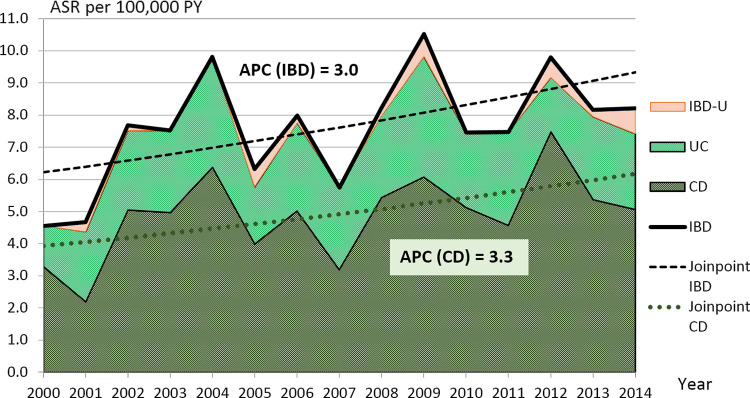
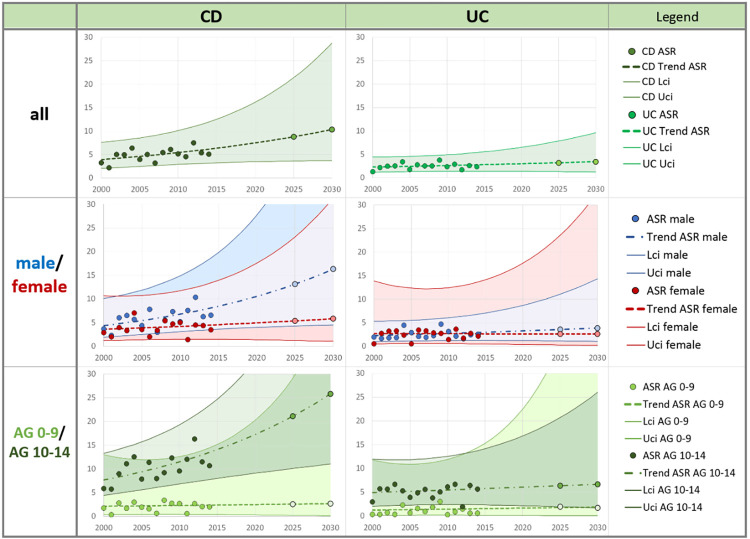
532 patients with confirmed IBD during 2000-2014 were included in the epidemiological evaluation. 63.5% (n = 338) patients had CD, 33.1% (n = 176) had UC and 3.4% (n = 18) had unclassified IBD (IBD-U). The 15-year IBD prevalence was 111.8 [95%-CI: 102.3-121.3] per 100,000. The incidence ASR of IBD per 100,000 PY over the whole observation period was 7.5 [6.9-8.1]. ASR for the subtypes were 4.8 [4.3-5.3] for CD, 2.5 [2.1-2.9] for UC and 0.3 [0.1-0.4] for IBD-U. The trend analysis of ASR using the joinpoint regression confirmed a significant increase for incidence of IBD as well as CD. For IBD, the ASR per 100,000 PY increased from 4.6 [2.8-6.3] in 2000 to 8.2 [7.5-13.6] in 2014; projected incidence rates for IBD in Germany are 12.9 [6.5-25.5] in the year 2025 and 14.9 [6.7-32.8] in 2030, respectively. Thus, the number of new IBD diagnoses in Germany would more than triple (325%) in 2030 compared to 2000. The increase is expected to be faster in CD than UC, and be more in males than in females. The expected number of newly diagnosed children with IBD in Germany is projected to rise to about 1,584 [1,512-1,655] in 2025, and to about 1,918 [1,807-2,29] in 2030.
The incidence of IBD in children and adolescents in Saxony increased at a similar rate as in other developed countries during the observation period. Given this trend, the health care system must provide adequate resources for the care of these young patients in the future.
全世界越来越多的儿童和青少年患有炎症性肠病(IBD),如克罗恩病(CD)和溃疡性结肠炎(UC)。本研究旨在调查德国萨克森州儿童和青少年 IBD 的发病率、患病率和未来趋势。
萨克森儿科 IBD 登记处从萨克森州的 31 家儿科医院和儿科胃肠病学家那里收集了 15 岁以下患者的数据,时间跨度为 15 年(2000-2014 年)。2019 年,一项独立调查估计登记处的完整性为 95.7%。每 10 万人年(PY)的年龄标准化发病率(ASR)和每 10 万儿童和青少年的患病率均进行了计算。还对性别和年龄亚组进行了评估。使用 Joinpoint 和 Poisson 回归进行趋势分析和预测。
2000-2014 年期间,共有 532 名确诊为 IBD 的患者纳入流行病学评估。63.5%(n=338)的患者患有 CD,33.1%(n=176)患有 UC,3.4%(n=18)患有未分类 IBD(IBD-U)。15 年 IBD 患病率为 111.8 [95%-CI:102.3-121.3] / 10 万。整个观察期内,每 10 万 PY 的 IBD 发病率 ASR 为 7.5 [6.9-8.1]。各亚型的 ASR 分别为 CD 4.8 [4.3-5.3]、UC 2.5 [2.1-2.9]和 IBD-U 0.3 [0.1-0.4]。使用 Joinpoint 回归进行的 ASR 趋势分析证实,IBD 以及 CD 的发病率均呈显著上升趋势。对于 IBD,每 10 万 PY 的 ASR 从 2000 年的 4.6 [2.8-6.3]增加到 2014 年的 8.2 [7.5-13.6];预计德国 2025 年 IBD 的发病率为 12.9 [6.5-25.5],2030 年为 14.9 [6.7-32.8]。因此,与 2000 年相比,德国 2030 年新增 IBD 诊断病例数将增加 325%以上。预计 CD 的增长速度将快于 UC,男性的增长速度将快于女性。预计德国新诊断为 IBD 的儿童人数将从 2025 年的约 1584 人[1512-1555]增加到 2030 年的约 1918 人[1807-229]。
萨克森州儿童和青少年 IBD 的发病率在观察期间与其他发达国家的发病率增长速度相似。鉴于这种趋势,医疗保健系统必须在未来为这些年轻患者的护理提供足够的资源。