Factor-Inwentash Faculty of Social Work, University of Toronto, 246 Bloor Street W, Toronto, ON, M5S 1V4, Canada.
School of Psychology, The University of Sydney, Sydney, NSW, Australia.
Eat Weight Disord. 2022 Dec;27(8):3759-3765. doi: 10.1007/s40519-022-01470-y. Epub 2022 Sep 9.
First, to characterize the prevalence and incidence of "bulk" and "cut" cycles among Canadian adolescents and young adults. Second, to determine the associations between bulk and cut cycle engagement and drive for muscularity and eating disorder and muscle dysmorphia psychopathology.
Data were from the Canadian Study of Adolescent Health Behaviors (2021; N = 2762), a national study of Canadian adolescents and young adults aged 16-30 years (M = 22.9, SD = 3.9). Prevalence and mean incidence of bulk and cut cycles in both the past 12 months and 30 days were estimated. Modified Poisson regressions were estimated to determine the associations between bulk and cut cycle engagement and levels of drive for muscularity and eating disorder and muscle dysmorphia psychopathology.
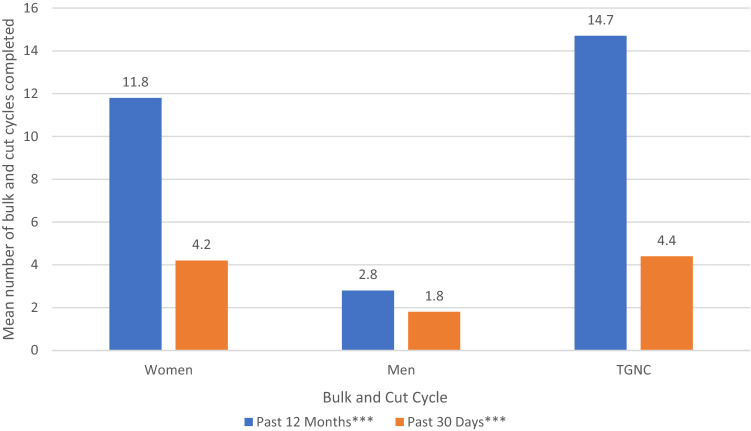
The sample comprised of 53.5% women, 38.4% men, and 8.1% transgender/gender non-conforming (TGNC) individuals. Nearly half (48.9%) of men and one in five women (21.2%) and TGNC (21.9%) participants reported bulk and cut cycles in the past 12 months. TGNC participants and women reported a greater mean number of bulk and cut cycles completed compared to men. Engagement in bulk and cut cycles was associated with stronger drive for muscularity across the sample, and more severe eating disorder and muscle dysmorphia psychopathology among men and women.
Findings underscore the common incidence and accompanying psychopathology of bulk and cut cycles among a community sample of adolescents and young adults in Canada, indicating the need for future research, as well as clinical and public health efforts.
Level V, cross-sectional descriptive study.
首先,描述加拿大青少年和年轻人中“增肌”和“减脂”循环的流行率和发生率。其次,确定“增肌”和“减脂”循环参与情况与追求肌肉发达、饮食障碍和肌肉变形障碍心理病理之间的关系。
数据来自加拿大青少年健康行为研究(2021 年;N=2762),这是一项对 16-30 岁加拿大青少年和年轻人的全国性研究(M=22.9,SD=3.9)。估计了过去 12 个月和 30 天内“增肌”和“减脂”循环的流行率和平均发生率。采用修正泊松回归来确定“增肌”和“减脂”循环参与情况与追求肌肉发达、饮食障碍和肌肉变形障碍心理病理水平之间的关系。
样本包括 53.5%的女性、38.4%的男性和 8.1%的跨性别/非传统性别(TGNC)个体。近一半(48.9%)的男性、五分之一的女性(21.2%)和 TGNC (21.9%)参与者在过去 12 个月内报告了“增肌”和“减脂”循环。与男性相比,TGNC 参与者和女性报告完成的“增肌”和“减脂”循环次数更多。在整个样本中,“增肌”和“减脂”循环的参与与更强的追求肌肉发达有关,与男性和女性更严重的饮食障碍和肌肉变形障碍心理病理有关。
研究结果强调了加拿大青少年和年轻人社区样本中“增肌”和“减脂”循环的常见发生率和伴随的心理病理,表明需要进一步研究以及临床和公共卫生方面的努力。
五级,横断面描述性研究。