Department of Environmental Medicine and Public Health, Icahn School of Medicine at Mount Sinai, New York, NY, USA.
Department of Environmental Health Sciences, Yale University School of Public Health, New Haven, CT, USA.
J Expo Sci Environ Epidemiol. 2022 Nov;32(6):917-925. doi: 10.1038/s41370-022-00471-4. Epub 2022 Sep 10.
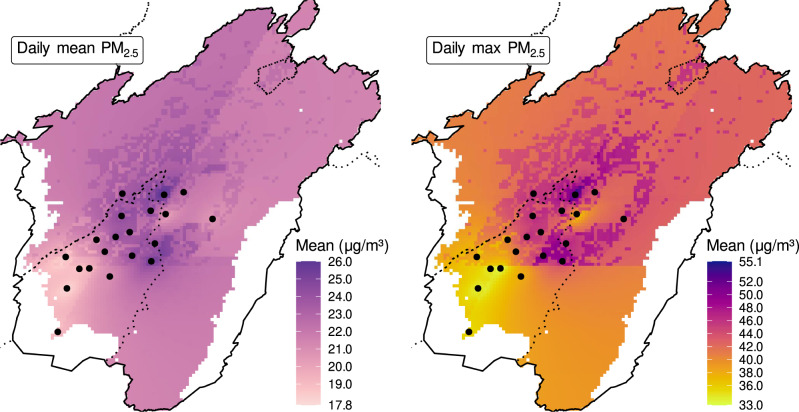
Machine-learning algorithms are becoming popular techniques to predict ambient air PM concentrations at high spatial resolutions (1 × 1 km) using satellite-based aerosol optical depth (AOD). Most machine-learning models have aimed to predict 24 h-averaged PM concentrations (mean PM) in high-income regions. Over Mexico, none have been developed to predict subdaily peak levels, such as the maximum daily 1-h concentration (max PM).
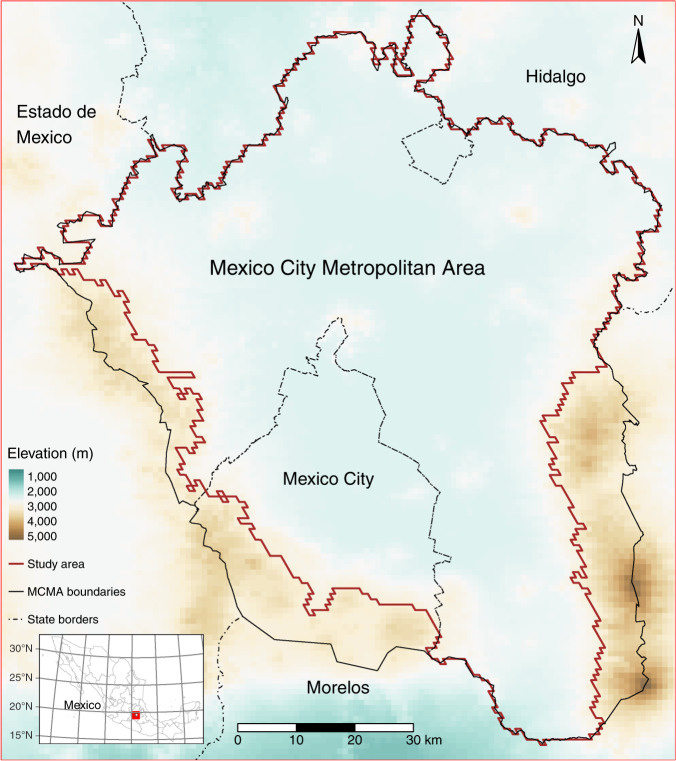
Our goal was to develop a machine-learning model to predict mean PM and max PM concentrations in the Mexico City Metropolitan Area from 2004 through 2019.
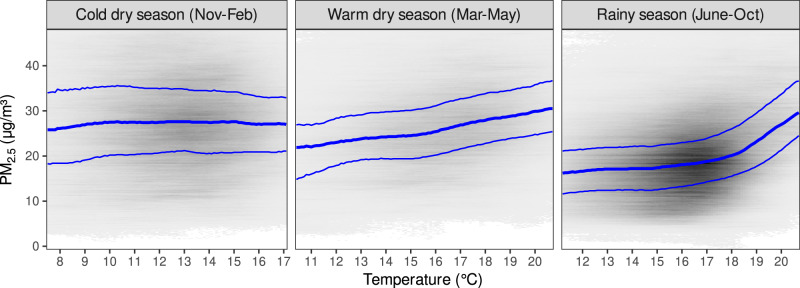
We present a new modeling approach based on extreme gradient boosting (XGBoost) and inverse-distance weighting that uses AOD, meteorology, and land-use variables. We also investigated applications of our mean PM predictions that can aid local authorities in air-quality management and public-health surveillance, such as the co-occurrence of high PM and heat, compliance with local air-quality standards, and the relationship of PM exposure with social marginalization.
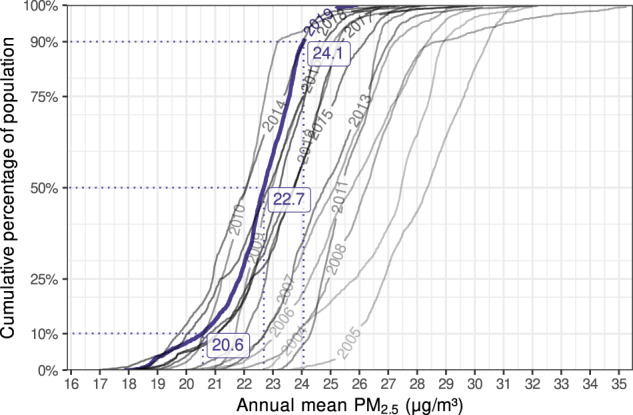
Our models for mean and max PM exhibited good performance, with overall cross-validated mean absolute errors (MAE) of 3.68 and 9.20 μg/m, respectively, compared to mean absolute deviations from the median (MAD) of 8.55 and 15.64 μg/m. In 2010, everybody in the study region was exposed to unhealthy levels of PM. Hotter days had greater PM concentrations. Finally, we found similar exposure to PM across levels of social marginalization.
Machine learning algorithms can be used to predict highly spatiotemporally resolved PM concentrations even in regions with sparse monitoring.
Our PM predictions can aid local authorities in air-quality management and public-health surveillance, and they can advance epidemiological research in Central Mexico with state-of-the-art exposure assessment methods.
机器学习算法正成为一种热门技术,可利用卫星气溶胶光学深度(AOD)来预测高空间分辨率(1×1km)的环境空气 PM 浓度。大多数机器学习模型旨在预测高收入地区的 24 小时平均 PM 浓度(均值 PM)。在墨西哥,尚无模型可用于预测亚日峰值水平,例如最大日 1 小时浓度(峰值 PM)。
我们的目标是开发一种机器学习模型,用于预测 2004 年至 2019 年墨西哥城大都市区的均值 PM 和峰值 PM 浓度。
我们提出了一种新的建模方法,该方法基于极端梯度增强(XGBoost)和反距离加权,使用 AOD、气象和土地利用变量。我们还研究了均值 PM 预测的应用,这些应用可以帮助地方当局进行空气质量管理和公共卫生监测,例如高 PM 和高温的同时出现、遵守地方空气质量标准以及 PM 暴露与社会边缘化之间的关系。
我们的均值和峰值 PM 模型表现出良好的性能,与中位数平均绝对偏差(MAD)相比,交叉验证的总体平均绝对误差(MAE)分别为 3.68μg/m 和 9.20μg/m。2010 年,研究区域内的每个人都暴露在不健康的 PM 水平下。较热的天气 PM 浓度更高。最后,我们发现社会边缘化程度不同的人群暴露于 PM 的情况相似。
即使在监测稀疏的地区,机器学习算法也可用于预测高时空分辨率的 PM 浓度。
我们的 PM 预测可以帮助地方当局进行空气质量管理和公共卫生监测,并通过最先进的暴露评估方法推进墨西哥中部的流行病学研究。