Department of Cardiology, University Medical Center Groningen, Groningen, The Netherlands.
Stavanger University Hospital, University of Bergen, Bergen, Norway.
ESC Heart Fail. 2022 Dec;9(6):4167-4176. doi: 10.1002/ehf2.14120. Epub 2022 Sep 11.
Insulin like growth factor binding protein 7 (IGFBP7) is a marker of senescence secretome and a novel biomarker in patients with heart failure (HF). We evaluated the prognostic value of IGFBP7 in patients with heart failure and examined associations to uncover potential new pathophysiological pathways related to increased plasma IGFBP7 concentrations.
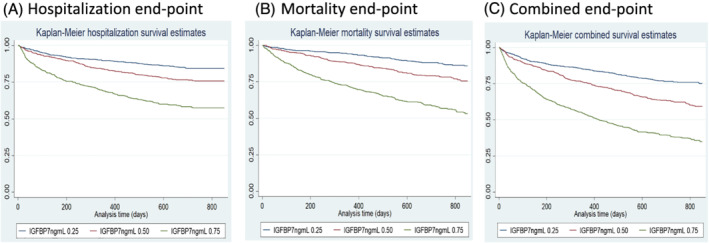
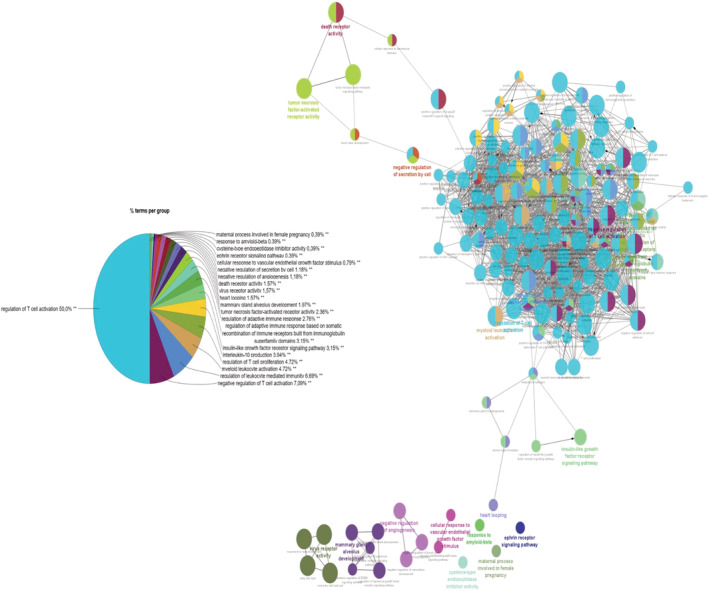
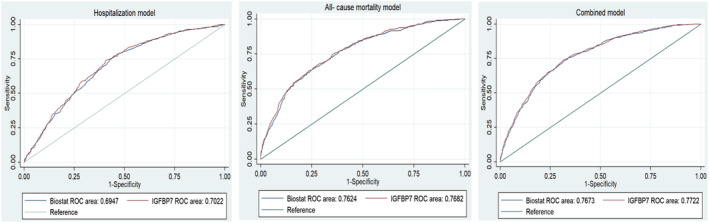
We have measured plasma IGFBP7 concentrations in 2250 subjects with new-onset or worsening heart failure (BIOSTAT-CHF cohort). Higher IGFBP7 plasma concentrations were found in older subjects, those with worse kidney function, history of atrial fibrillation, and diabetes mellitus type 2, and in subjects with higher number of HF hospitalizations. Higher IGFBP7 levels also correlate with the levels of several circulating biomarkers, including higher NT-proBNP, hsTnT, and urea levels. Cox regression analyses showed that higher plasma IGFBP7 concentrations were strongly associated with increased risk of all three main endpoints (hospitalization, all-cause mortality, and combined hospitalization and mortality) (HR 1.75, 95% CI 1.25-2.46; HR 1.71, 95% CI 1.39-2.11; and HR 1.44, 95% CI 1.23-1.70, respectively). IGFBP7 remained a significant predictor of these endpoints in patients with both reduced and preserved ejection fraction. Likelihood ratio test showed significant improvement of all three risk prediction models, after adding IGFBP7 (P < 0.001). A biomarker network analysis showed that IGFBP7 levels activate different pathways involved in the regulation of the immune system. Results were externally validated in BIOSTAT-CHF validation cohort.
IGFPB7 presents as an independent and robust prognostic biomarker in patients with HF, with both reduced and preserved ejection fraction. We validate the previously published data showing IGFBP7 has correlations with a number of echocardiographic markers. Lastly, IGFBP7 pathways are involved in different stages of immune system regulation, linking heart failure to senescence pathways.
胰岛素样生长因子结合蛋白 7(IGFBP7)是衰老分泌组的标志物,也是心力衰竭(HF)患者的新型生物标志物。我们评估了 IGFBP7 在心力衰竭患者中的预后价值,并研究了其相关性,以揭示与血浆 IGFBP7 浓度升高相关的潜在新的病理生理途径。
我们测量了 2250 例新发或恶化心力衰竭患者(BIOSTAT-CHF 队列)的血浆 IGFBP7 浓度。在年龄较大、肾功能较差、有房颤和 2 型糖尿病病史以及 HF 住院次数较多的患者中,发现 IGFBP7 血浆浓度较高。IGFBP7 水平也与几种循环生物标志物的水平相关,包括较高的 NT-proBNP、hsTnT 和尿素水平。Cox 回归分析表明,较高的血浆 IGFBP7 浓度与所有三个主要终点(住院、全因死亡率和住院和死亡率的联合终点)的风险增加密切相关(HR 1.75,95%CI 1.25-2.46;HR 1.71,95%CI 1.39-2.11;HR 1.44,95%CI 1.23-1.70)。在射血分数降低和保留的心力衰竭患者中,IGFBP7 仍然是这些终点的显著预测因子。似然比检验显示,在添加 IGFBP7 后,所有三个风险预测模型均有显著改善(P<0.001)。生物标志物网络分析表明,IGFBP7 水平激活了参与免疫系统调节的不同途径。结果在 BIOSTAT-CHF 验证队列中得到了外部验证。
IGFBP7 是心力衰竭患者的独立且强大的预后生物标志物,适用于射血分数降低和保留的心力衰竭患者。我们验证了之前发表的数据,表明 IGFBP7 与许多超声心动图标志物相关。最后,IGFBP7 途径参与了免疫系统调节的不同阶段,将心力衰竭与衰老途径联系起来。