The University of Auckland, Auckland, New Zealand.
Institute at Brown for Environment and Society, Providence, RI, USA.
Philos Trans A Math Phys Eng Sci. 2022 Oct 31;380(2235):20210252. doi: 10.1098/rsta.2021.0252. Epub 2022 Sep 12.
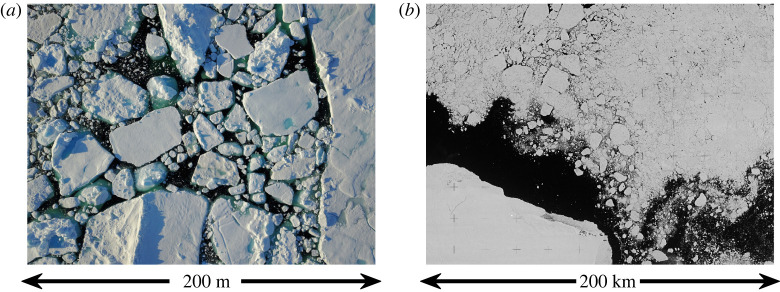
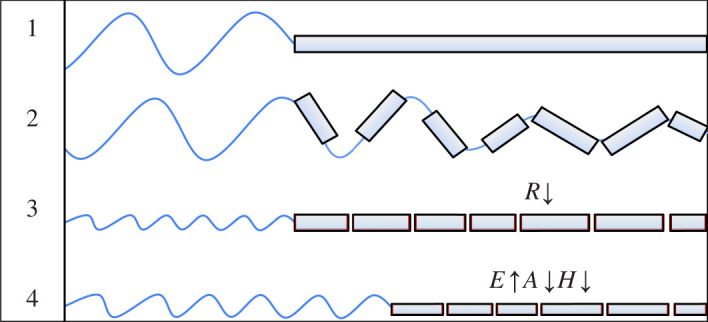
Marginal ice zones (MIZs) are qualitatively distinct sea-ice-covered areas that play a critical role in the interaction between the polar oceans and the broader Earth system. MIZ regions have high spatial and temporal variability in oceanic, atmospheric and ecological conditions. The salient qualitative feature of MIZs is their composition as a mosaic of individual floes that range in horizontal extent from centimetres to tens of kilometres. Thus the floe size distribution (FSD) can be used to quantitatively identify and describe them. Here, the history of FSD observations and theory, and the processes (particularly the impact of ocean waves) that determine floe sizes and size distribution, are reviewed. Coupled wave-FSD feedbacks are explored using a stochastic model for thermodynamic wave-sea-ice interactions in the MIZ, and some of the key open questions in this rapidly growing field are discussed. This article is part of the theme issue 'Theory, modelling and observations of marginal ice zone dynamics: multidisciplinary perspectives and outlooks'.
边缘冰区(MIZ)是性质独特的被海冰覆盖的区域,在极地海洋与更广泛的地球系统相互作用中起着关键作用。MIZ 区域的海洋、大气和生态条件具有高度的时空可变性。MIZ 的显著定性特征是其作为由个体浮冰块组成的镶嵌体,其水平范围从厘米到数十公里不等。因此,可以使用浮冰块大小分布(FSD)来定量识别和描述它们。本文回顾了 FSD 观测和理论的历史,以及决定浮冰块大小和分布的过程(特别是海洋波的影响)。通过在 MIZ 中使用热力学波-海冰相互作用的随机模型来探索波-FSD 反馈,讨论了这个快速发展领域中的一些关键问题。本文是主题为“边缘冰区动力学的理论、建模和观测:多学科视角和展望”的一部分。