Madi Nada, Safar Hussain A, Mustafa Abu Salim, Chehadeh Wassim, Asadzadeh Mohammad, Sadeq Mohammed, Alawadhi Ebaa, Al-Muhaini Ali, Benthani Fahad A
Department of Microbiology, Faculty of Medicine, Kuwait University, Kuwait, Kuwait.
OMICS Research Unit, Faculty of Medicine, Kuwait University, Kuwait, Kuwait.
Front Microbiol. 2022 Aug 26;13:858770. doi: 10.3389/fmicb.2022.858770. eCollection 2022.
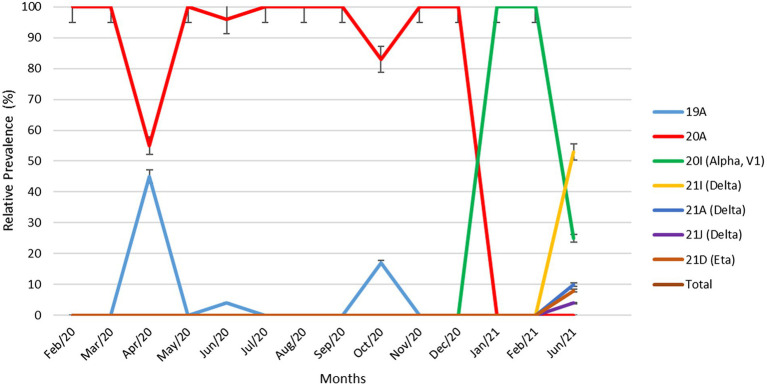
Severe acute respiratory syndrome coronavirus-2 (SARS-CoV-2) has been fatal to human health, affecting almost the entire world. Here we reported, for the first time, characterization of the genetic variants of SARS-CoV-2 circulating in Kuwait to understand their genetic diversity and monitor the accumulation of mutations over time. This study randomly enrolled 209 COVID-19 patients whose nasopharyngeal swabs were positive for SARS-CoV-2 between February 2020 and June 2021 using RT-PCR. The whole genomes of SARS-CoV-2 from the nasopharyngeal swabs were sequenced using the Oxford Nanopore sequencing technology following the ARTIC network protocol. Whole-genome sequencing has identified different clades/sub-clades circulating in Kuwait, mimicking the virus's global spread. Clade 20A was dominant from February 2020 until January 2021, and then clade 20I (Alpha, V1) emerged and dominated. In June 2021, the number of cases infected with clades 21I, 21A, and 21 J (Delta) increased and dominated. We detected several known clade-defining missense and synonymous mutations and other missense mutations in the genes encoding important viral proteins, including ORF1a, S, ORF3a, ORF8 regions and a novel mutation in the N region. ORF1ab region harbored more mutations and deletions ( = 62, 49.2%) compared to the other 12 gene regions, and the most prevalent missense mutations were P314L (97%) in ORF1b and D614G (97%) in the S glycoprotein regions. Detecting and analyzing mutations and monitoring the evolution of SARS-CoV-2 over time is essential to help better understand the spread of various clades/strains of SARS-CoV-2 and their implications for pathogenesis. In addition, knowledge of the circulating variants and genome sequence variability of SARS-CoV-2 may potentially influence the development of vaccines and antiviral drugs to control the COVID-19 pandemic.
严重急性呼吸综合征冠状病毒2(SARS-CoV-2)对人类健康造成了致命影响,几乎波及全球。在此,我们首次报告了科威特境内传播的SARS-CoV-2基因变体的特征,以了解其遗传多样性并监测随时间推移突变的积累情况。本研究随机招募了209名COVID-19患者,他们在2020年2月至2021年6月期间经逆转录聚合酶链反应(RT-PCR)检测,鼻咽拭子中SARS-CoV-2呈阳性。按照ARTIC网络协议,使用牛津纳米孔测序技术对鼻咽拭子中的SARS-CoV-2全基因组进行测序。全基因组测序已识别出科威特境内传播的不同进化枝/亚进化枝,这与该病毒在全球的传播情况相似。20A进化枝在2020年2月至2021年1月期间占主导地位,随后20I进化枝(阿尔法毒株,V1)出现并占据主导。2021年6月,感染21I、21A和21J进化枝(德尔塔毒株)的病例数量增加并占据主导。我们在编码重要病毒蛋白的基因中检测到了几个已知的进化枝定义错义突变和同义突变以及其他错义突变,包括开放阅读框1a(ORF1a)、刺突蛋白(S)、开放阅读框3a(ORF3a)、开放阅读框8(ORF8)区域以及核衣壳蛋白(N)区域的一个新突变。与其他12个基因区域相比,开放阅读框1ab(ORF1ab)区域存在更多的突变和缺失(共62个,占49.2%),最常见的错义突变是ORF1b中的P314L(97%)和刺突糖蛋白区域中的D614G(97%)。检测和分析突变并监测SARS-CoV-2随时间的演变对于更好地了解SARS-CoV-2各种进化枝/毒株的传播及其对发病机制的影响至关重要。此外,了解SARS-CoV-2的流行变体和基因组序列变异性可能会对控制COVID-19大流行的疫苗和抗病毒药物的研发产生潜在影响。