Yu Deyue
College of Optometry, The Ohio State University, Columbus, OH, United States.
Front Neurosci. 2022 Aug 24;16:916447. doi: 10.3389/fnins.2022.916447. eCollection 2022.
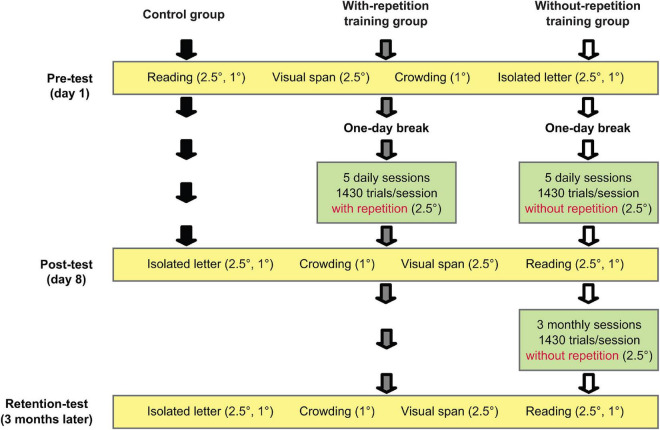
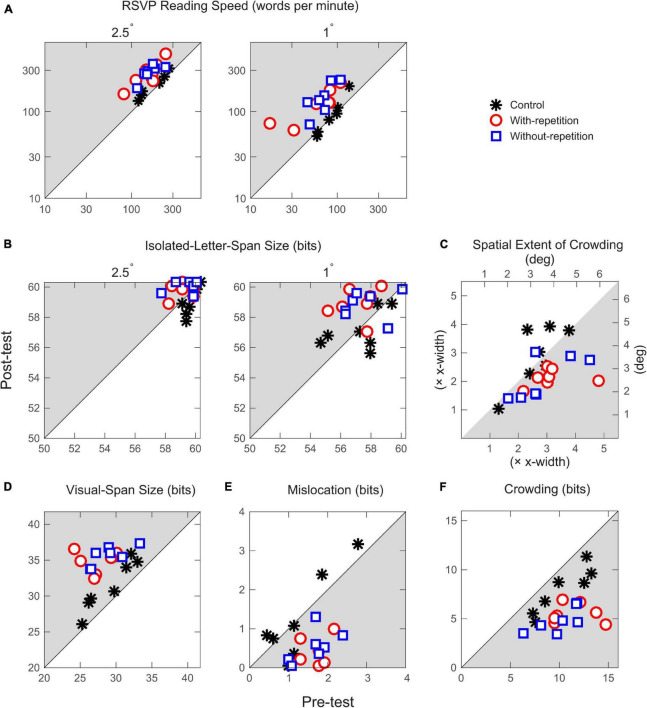
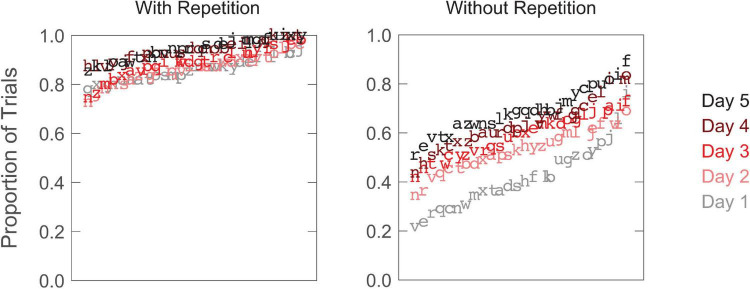
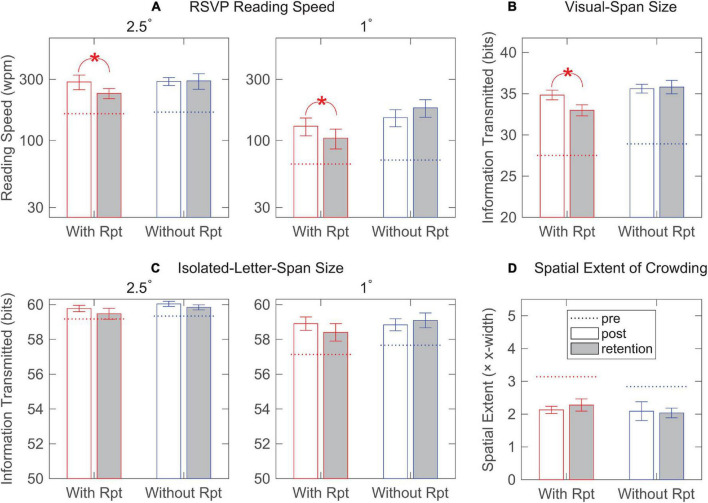
Reading in the periphery can be improved with perceptual learning. A conventional training paradigm involves repeated practice on a character-based task (e.g., recognizing random letters/words). While the training is effective, the hours of strenuous effort required from the trainees makes it difficult to implement the training in low-vision patients. Here, we developed a training paradigm utilizing stimulus exposure and identity priming to minimize training effort and improve training accessibility while maintaining the active engagement of observers through a stimulus visibility task. Twenty-one normally sighted young adults were randomly assigned to three groups: a control group, a with-repetition training group, and a without-repetition training group. All observers received a pre-test and a post-test scheduled 1 week apart. Each test consisted of measurements of reading speed, visual-span profile, the spatial extent of crowding, and isolated-letter profiles at 10° eccentricity in the lower visual field. Training consists of five daily sessions (a total of 7,150 trials) of viewing trigram stimuli (strings of three letters) with identity priming (prior knowledge of target letter identity). The with-repetition group was given the option to replay each stimulus (averaged 0.4 times). In comparison to the control group, both training groups showed significant improvements in all four performance measures. Stimulus replay did not yield a measurable benefit on learning. Learning transferred to various untrained tasks and conditions, such as the reading task and untrained letter size. Reduction in crowding was the main basis of the training-related improvement in reading. We also found that the learning can be partially retained for a minimum of 3 months and that complete retention is attainable with additional monthly training. Our findings suggest that conventional training task that requires recognizing random letters or words is dispensable for improving peripheral reading. Utilizing stimulus exposure and identity priming accompanied by a stimulus visibility task, our novel training procedure offers effective intervention, simple implementation, capability for remote and self-administration, and an easy translation into low-vision reading rehabilitation.
通过知觉学习可以改善周边视觉阅读能力。传统的训练范式是在基于字符的任务(例如识别随机字母/单词)上进行重复练习。虽然这种训练是有效的,但学员需要付出大量的艰苦努力,这使得在低视力患者中实施该训练变得困难。在此,我们开发了一种训练范式,利用刺激暴露和身份启动来最小化训练工作量并提高训练的可及性,同时通过刺激可见性任务保持观察者的积极参与。21名视力正常的年轻人被随机分为三组:对照组、有重复训练组和无重复训练组。所有观察者都接受了间隔1周的前测和后测。每次测试包括对阅读速度、视觉跨度轮廓、拥挤的空间范围以及在下视野10°离心率处的孤立字母轮廓的测量。训练包括每天进行五节课程(总共7150次试验),观看带有身份启动(目标字母身份的先验知识)的三字母组刺激(三个字母的字符串)。有重复组可以选择重放每个刺激(平均0.4次)。与对照组相比,两个训练组在所有四项性能指标上都有显著提高。刺激重放在学习上没有产生可测量的益处。学习转移到了各种未训练的任务和条件,如阅读任务和未训练的字母大小。拥挤程度的降低是训练相关阅读改善的主要基础。我们还发现,学习可以至少部分保留3个月,并且通过每月额外训练可以实现完全保留。我们的研究结果表明,可以摒弃传统的需要识别随机字母或单词的训练任务来改善周边视觉阅读。利用刺激暴露和身份启动并辅以刺激可见性任务,我们的新型训练程序提供了有效的干预、简单的实施方式、远程和自我管理的能力,并且易于转化为低视力阅读康复训练。