Kim Ahyoung, Lim Soo Yeon, Park Jung Hyun, Chung Jin-Seok, Cheong Hyeonsik, Ko Changhyun, Yoon Jong-Gul, Yang Sang Mo
Department of Physics, Sogang University Seoul 04107 Korea
Department of Physics, Soongsil University Seoul 07027 Korea.
RSC Adv. 2022 Aug 16;12(36):23039-23047. doi: 10.1039/d2ra02803d.
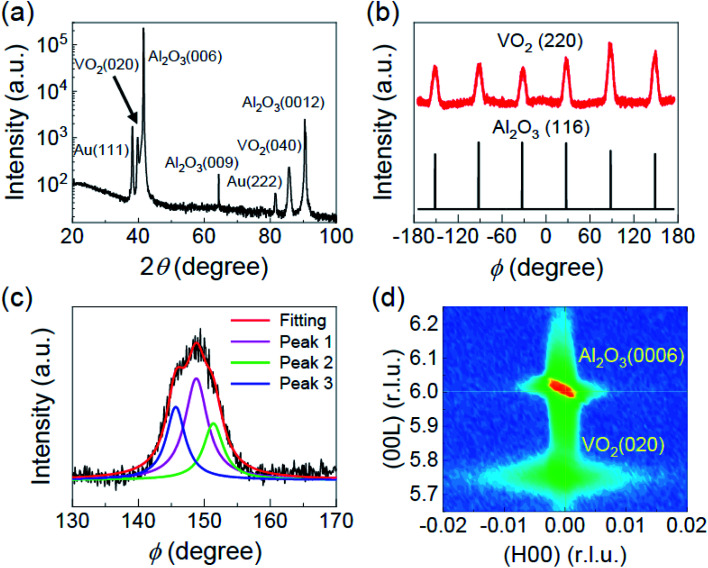
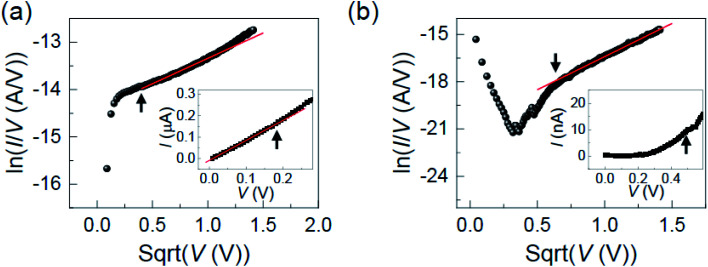
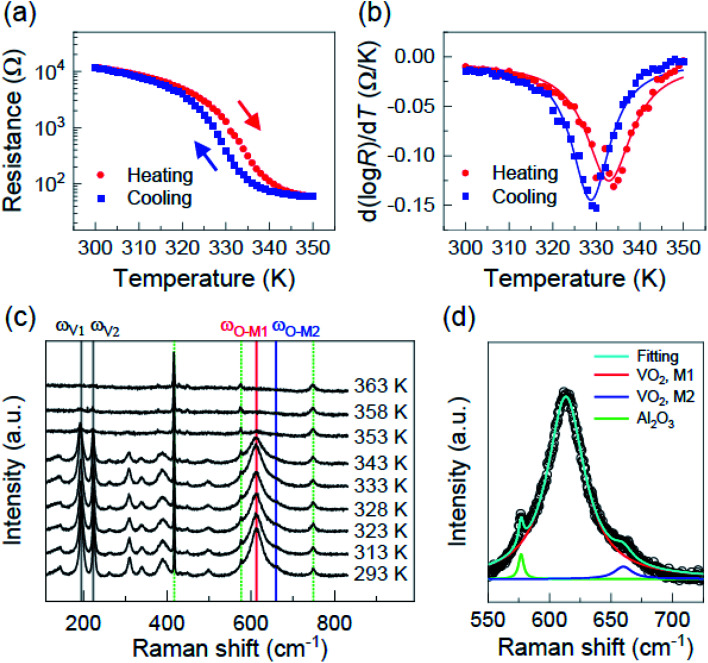
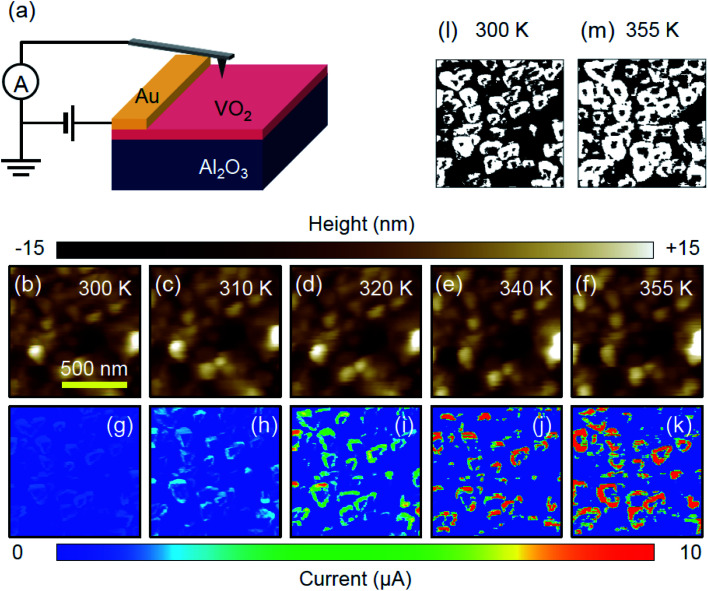
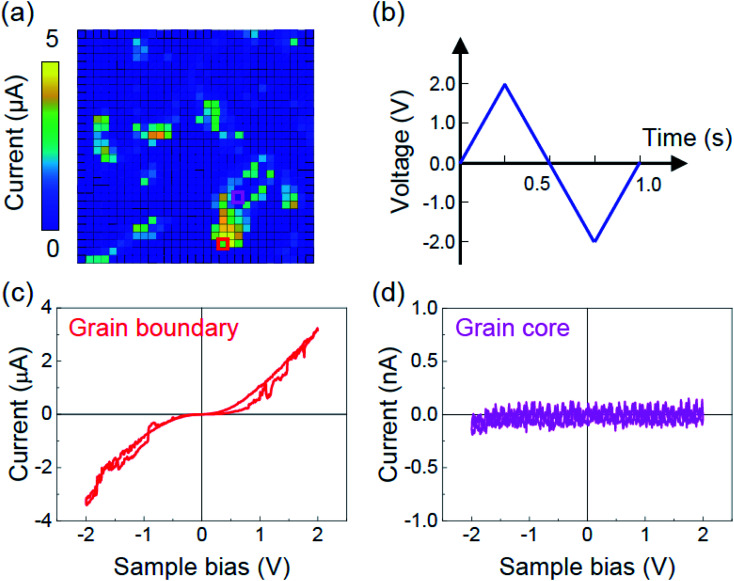
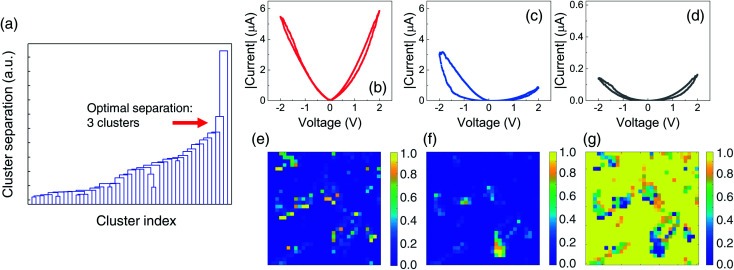
Vanadium dioxide (VO) is one of the extensively studied strongly correlated oxides due to its intriguing insulator-metal transition near room temperature. In this work, we investigated temperature-dependent nanoscale conduction in an epitaxial VO film grown on an AlO substrate using conductive-atomic force microscopy (C-AFM). We observed that only the regions near the grain boundaries are conductive, producing intriguing donut patterns in C-AFM images. Such donut patterns were observed in the entire measured temperature range (300-355 K). The current values near the grain boundaries increased by approximately two orders of magnitude with an increase in the temperature, which is consistent with the macroscopic transport data. The spatially-varied conduction behavior is ascribed to the coexistence of different monoclinic phases, , M1 and M2 phases, based on the results of temperature-dependent Raman spectroscopy. Furthermore, we investigated the conduction mechanism in the relatively conductive M1 phase regions at room temperature using current-voltage (-) spectroscopy and deep data analysis. Bayesian linear unmixing and -means clustering showed three distinct types of conduction behavior, which classical C-AFM cannot resolve. We found that the conduction in the M1 phase regions can be explained by the Poole-Frenkel mechanism. This work provides deep insight into IMT behavior in the epitaxial VO thin film at the nanoscale, especially the coexistence and evolution of the M1 and M2 phases. This work also highlights that - spectroscopy combined with deep data analysis is very powerful in investigating local transport in complex oxides and various material systems.
二氧化钒(VO₂)是一种因在室温附近具有引人入胜的绝缘体-金属转变而被广泛研究的强关联氧化物。在这项工作中,我们使用导电原子力显微镜(C-AFM)研究了生长在Al₂O₃衬底上的外延VO₂薄膜中与温度相关的纳米级传导。我们观察到只有晶界附近的区域是导电的,在C-AFM图像中产生了有趣的甜甜圈图案。在整个测量温度范围(300 - 355 K)内都观察到了这种甜甜圈图案。随着温度升高,晶界附近的电流值增加了大约两个数量级,这与宏观传输数据一致。基于温度相关拉曼光谱的结果,空间变化的传导行为归因于不同单斜相,即M1和M2相的共存。此外,我们在室温下使用电流-电压(I-V)光谱和深度数据分析研究了相对导电的M1相区域中的传导机制。贝叶斯线性解混和K均值聚类显示出三种不同类型的传导行为,这是传统C-AFM无法分辨的。我们发现M1相区域中的传导可以用普尔-弗伦克尔机制来解释。这项工作深入洞察了外延VO₂薄膜在纳米尺度上的绝缘体-金属转变行为,特别是M1和M2相的共存和演化。这项工作还强调了I-V光谱与深度数据分析相结合在研究复杂氧化物和各种材料系统中的局部传输方面非常强大。