He Zhen, Yang Xiuli, Ma Tianjiang, Yang Qiumin, Zhang Chenghui, Chen Yunfang, Wang Pengyuan, D'Incecco Armida, Metro Giulio, Uematsu Shugo, Wang Qiming
Department of Internal Medicine, Henan Cancer Hospital, Affiliated Cancer Hospital of Zhengzhou University, Zhengzhou, China.
Department of Oncology, The First Affiliated Hospital of Nanyang Medical College, Nanyang, China.
Transl Lung Cancer Res. 2022 Aug;11(8):1657-1666. doi: 10.21037/tlcr-22-558.
The efficacy and safety of chemotherapy strategies combining the multi-target receptor tyrosine kinase inhibitor in patients with advanced wild-type non-squamous non-small-cell lung cancer (nsq-NSCLC) are undetermined. We aimed to investigate the efficacy and safety of anlotinib combined with carboplatin/pemetrexed-based chemotherapy followed by maintenance therapy (anlotinib plus pemetrexed) in advanced wild-type nsq-NSCLC.
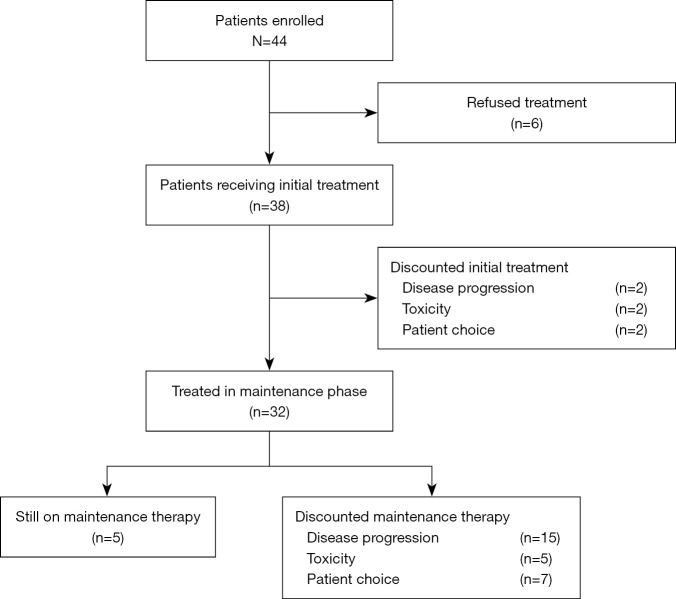
Eligible patients with wild-type advanced nsq-NSCLC who received first-line therapy in Henan Province from March 2019 to February 2021 were recruited. All patients were treated with anlotinib in combination with carboplatin/pemetrexed-based chemotherapy, followed by maintenance therapy (anlotinib plus pemetrexed). The primary endpoint was progression-free survival (PFS). The secondary endpoints included overall survival (OS), disease control rate (DCR), objective response rate (ORR), and adverse events (AEs). Response and AEs were assessed based on the Response Evaluation Criteria in Solid Tumors (1.1) and National Cancer Institute - Common Terminology Criteria for Adverse Events v.4.0.3, respectively. The follow-up interval for survival was 6 weeks and the safety follow-up was performed until the end of treatment. Kaplan-Meier analysis was used to calculate the median PFS and OS.
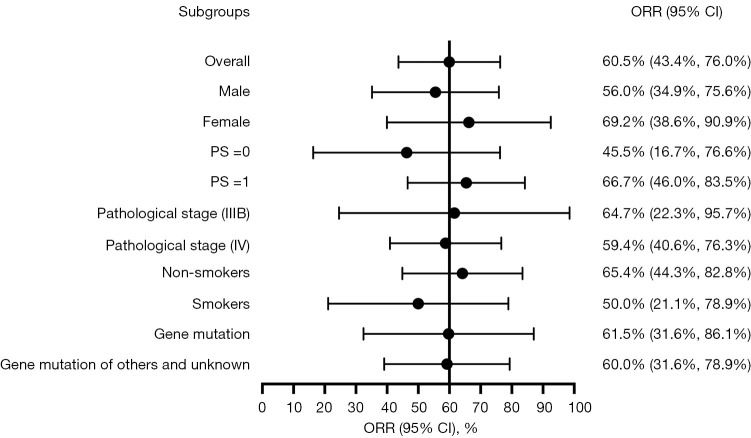
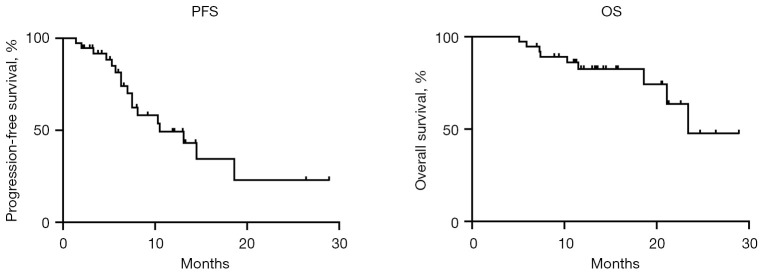
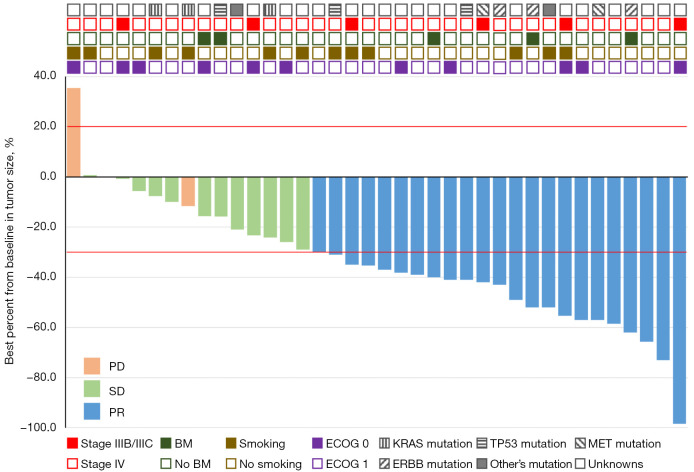
Thirty-eight participants with median age of 62 (range, 33-75) years were evaluated. Five participants were still on maintenance therapy until the end of the study. The majority were non-smokers (68.4%). The median follow-up was 13.6 (range, 12.3-14.9) months. The median PFS (mPFS) was 10.5 (95% CI: 4.1, 17.0) months, and the median OS was 23.4 [95% CI: not evaluable (NE), NE] months. The DCR and ORR were 94.7% and 60.5%, respectively. Grade 3 and above treatment-related adverse events (TRAEs) happened to 12 participants. The most common TRAEs were hypertension (23.7%), neutropenia (19.4%), and bone marrow toxicity (10.5%). Seven patients discontinued treatment, including two patients during induction and five patients during maintenance treatment. No grade 5 TRAE was reported. In the non-smoker participants, the mPFS was 14.5 (95% CI: 4.0-25.0) months.
Anlotinib in combination with carboplatin/pemetrexed-based chemotherapy followed by anlotinib plus pemetrexed as maintenance therapy might be an effective choice in treating patients with wild-type advanced nsq-NSCLC.
在晚期野生型非鳞状非小细胞肺癌(nsq-NSCLC)患者中,联合使用多靶点受体酪氨酸激酶抑制剂的化疗策略的疗效和安全性尚未确定。我们旨在研究安罗替尼联合以卡铂/培美曲塞为基础的化疗,随后进行维持治疗(安罗替尼加培美曲塞)在晚期野生型nsq-NSCLC中的疗效和安全性。
招募了2019年3月至2021年2月在河南省接受一线治疗的符合条件的野生型晚期nsq-NSCLC患者。所有患者均接受安罗替尼联合以卡铂/培美曲塞为基础的化疗,随后进行维持治疗(安罗替尼加培美曲塞)。主要终点是无进展生存期(PFS)。次要终点包括总生存期(OS)、疾病控制率(DCR)、客观缓解率(ORR)和不良事件(AE)。分别根据实体瘤疗效评价标准(1.1版)和美国国立癌症研究所不良事件通用术语标准第4.0.3版评估缓解情况和不良事件。生存随访间隔为6周,安全性随访持续至治疗结束。采用Kaplan-Meier分析计算中位PFS和OS。
评估了38名参与者,中位年龄为62岁(范围33 - 75岁)。5名参与者在研究结束时仍在接受维持治疗。大多数为非吸烟者(68.4%)。中位随访时间为13.6个月(范围12.3 - 14.9个月)。中位PFS(mPFS)为10.5个月(95%CI:4.1,17.0),中位OS为23.4个月[95%CI:不可评估(NE),NE]。DCR和ORR分别为94.7%和60.5%。12名参与者发生了3级及以上治疗相关不良事件(TRAEs)。最常见的TRAEs是高血压(23.7%)、中性粒细胞减少(19.4%)和骨髓毒性(10.5%)。7名患者停止治疗,其中2名在诱导期,5名在维持治疗期。未报告5级TRAEs。在非吸烟参与者中,mPFS为14.5个月(95%CI:4.0 - 25.0)。
安罗替尼联合以卡铂/培美曲塞为基础的化疗,随后以安罗替尼加培美曲塞作为维持治疗,可能是治疗野生型晚期nsq-NSCLC患者的有效选择。