Li Yao-Tsun, Polotan Francisco Gerardo M, Sotelo Gerald Ivan S, Alpino Anne Pauline A, Dolor Ardiane Ysabelle M, Tujan Ma Angelica A, Gomez Ma Ricci R, Onza Othoniel Jan T, Chang Angela Kae T, Bautista Criselda T, Carandang June C, Yangzon Maria Sofia L, Pangilinan Elcid Aaron R, Mantaring Renato Jacinto, Telles Alyssa Joyce E, Egana John Michael C, Endozo Joshua Jose S, Cruz Rianna Patricia S, Tablizo Francis A, Yap Jan Michael C, Maralit Benedict A, Ayes Marc Edsel C, de la Paz Eva Marie C, Saloma Cynthia P, Lim Dodge R, Dancel Lei Lanna M, Uy-Lumandas Mayan, Medado Inez Andrea P, Dizon Timothy John R, Hampson Katie, Daldry Simon, Hughes Joseph, Brunker Kirstyn
Institute of Biodiversity, Animal Health and Comparative Medicine, University of Glasgow, Glasgow G12 8QQ, UK.
Research Institute for Tropical Medicine, 9002 Research Drive, Filinvest Corporate City, Alabang, Muntinlupa, Metro Manila 1781, Philippines.
Virus Evol. 2022 Aug 19;8(2):veac078. doi: 10.1093/ve/veac078. eCollection 2022.
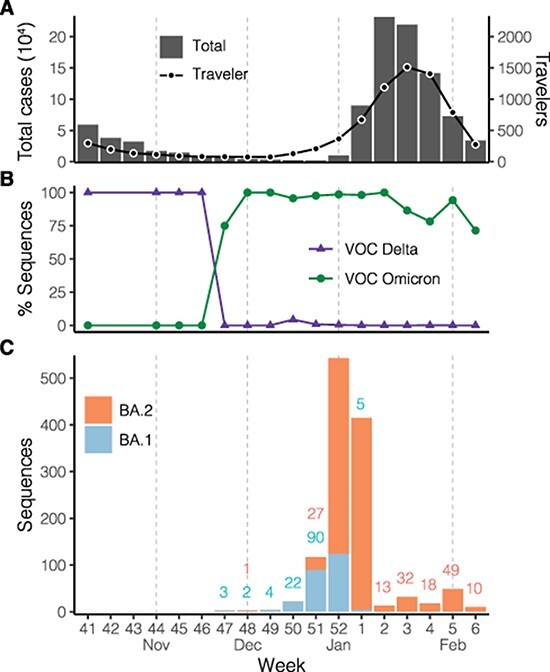
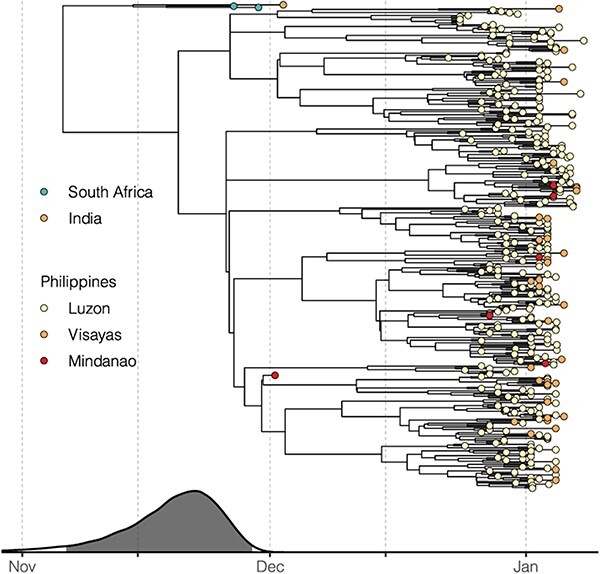
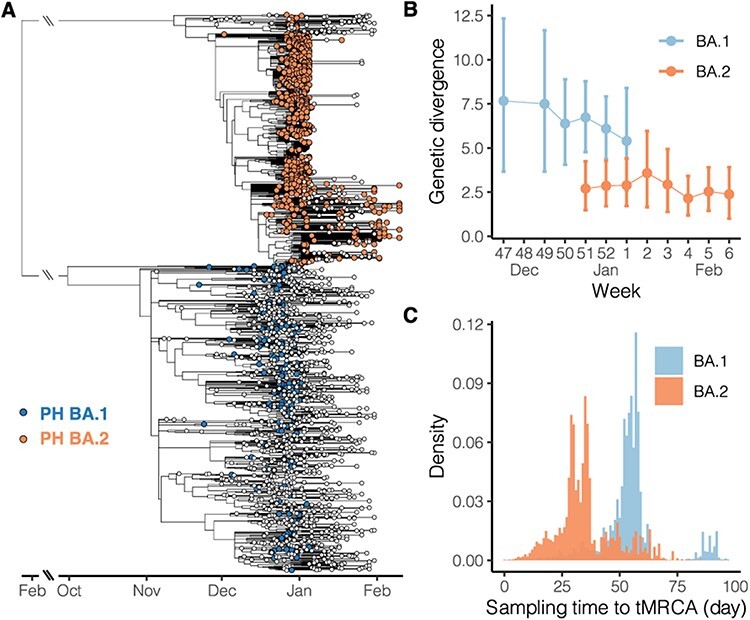
The Omicron severe acute respiratory syndrome coronavirus 2 (SARS-CoV-2) variant led to a dramatic global epidemic wave following detection in South Africa in November 2021. The BA.1 Omicron lineage was dominant and responsible for most SARS-CoV-2 outbreaks in countries around the world during December 2021-January 2022, while other Omicron lineages, including BA.2, accounted for the minority of global isolates. Here, we describe the Omicron wave in the Philippines by analysing genomic data. Our results identify the presence of both BA.1 and BA.2 lineages in the Philippines in December 2021, before cases surged in January 2022. We infer that only the BA.2 lineage underwent sustained transmission in the country, with an estimated emergence around 18 November 2021 (95 per cent highest posterior density: 6-28 November), while despite multiple introductions, BA.1 transmission remained limited. These results suggest that the Philippines was one of the earliest areas affected by BA.2 and reiterate the importance of whole genome sequencing for monitoring outbreaks.
2021年11月在南非被发现后,奥密克戎严重急性呼吸综合征冠状病毒2(SARS-CoV-2)变种引发了全球范围内的疫情大流行。BA.1奥密克戎谱系在2021年12月至2022年1月期间占据主导地位,导致了全球多个国家的大多数SARS-CoV-2疫情爆发,而包括BA.2在内的其他奥密克戎谱系仅占全球分离株的少数。在此,我们通过分析基因组数据来描述菲律宾的奥密克戎疫情。我们的结果表明,在2022年1月病例激增之前,菲律宾于2021年12月就已出现BA.1和BA.2谱系。我们推断,只有BA.2谱系在该国持续传播,估计于2021年11月18日左右出现(95%最高后验密度:11月6日至28日),而尽管有多次输入,但BA.1的传播仍然有限。这些结果表明菲律宾是最早受到BA.2影响的地区之一,并重申了全基因组测序在监测疫情中的重要性。