Papaconstantinou Dimitrios, Tsilimigras Diamantis I, Pawlik Timothy M
Third Department of Surgery, Attikon University Hospital, National and Kapodistrian University of Athens, Athens, Greece.
Department of Surgery, Division of Surgical Oncology, The Ohio State University Wexner Medical Center and James Comprehensive Cancer Center, Columbus, Ohio, USA.
J Hepatocell Carcinoma. 2022 Sep 3;9:947-957. doi: 10.2147/JHC.S342266. eCollection 2022.
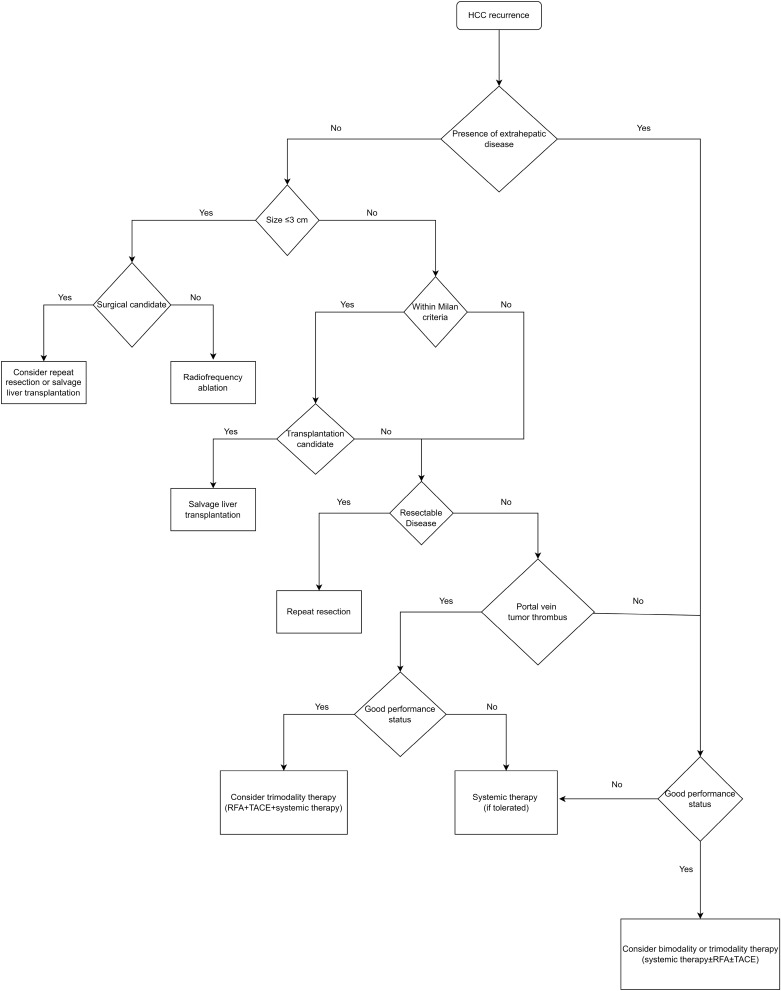
Hepatocellular carcinoma (HCC) is the third most common cause of cancer-related deaths worldwide with the incidence of recurrence being as high as 88% even among patients who have undergone curative-intent treatment. Despite improvements in overall survival, recurrence remains a challenge necessitating accurate reappraisal of patient and disease status. To that end, accurate staging of recurrent HCC is a necessity to provide better care for these patients. Risk factors for poor survival after HCC recurrence have been identified and include characteristics of the primary disease, such as tumor multifocality, large size (≥5 cm), macroscopic vascular or microscopic lymphovascular invasion, preoperative a-fetoprotein (AFP) levels, R0 resection, and the presence of impaired liver function. Close surveillance with imaging is warranted following curative-intent therapy, with magnetic resonance imaging (MRI) being the preferred approach to identify small, early recurrent HCCs. Treatment decisions at the time of recurrence involve ruling out extrahepatic disease and identifying candidates for potentially curative-intent repeat treatment options. Patients with recurrent disease are, however, very diverse in terms of tumor morphology and biologic behavior, as well as residual hepatic functional reserve. Patients with preserved liver function may benefit from repeat liver resection or ablation. Patients with recurrence within the Milan criteria may even be candidates for salvage liver transplantation, while multimodality treatment with combination of liver-directed therapies appears to enhance oncologic outcomes for individuals with advanced recurrent disease. A "one-size-fits-all" approach in staging recurrent HCC does not exist. Rather, individualized and evidence-based decision-making is necessary in order to optimize outcomes for patients with recurrent HCC.
肝细胞癌(HCC)是全球癌症相关死亡的第三大常见原因,即使在接受了根治性治疗的患者中,复发率也高达88%。尽管总体生存率有所提高,但复发仍然是一个挑战,需要对患者和疾病状况进行准确的重新评估。为此,准确分期复发性HCC对于为这些患者提供更好的治疗至关重要。已确定HCC复发后生存不良的风险因素,包括原发性疾病的特征,如肿瘤多灶性、大尺寸(≥5 cm)、宏观血管或微观淋巴管侵犯、术前甲胎蛋白(AFP)水平、R0切除以及肝功能受损情况。根治性治疗后,有必要通过影像学进行密切监测,磁共振成像(MRI)是识别小的、早期复发性HCC的首选方法。复发时的治疗决策包括排除肝外疾病,并确定可能适合进行根治性重复治疗的候选者。然而,复发患者在肿瘤形态、生物学行为以及残余肝功能储备方面差异很大。肝功能良好的患者可能从再次肝切除或消融中获益。符合米兰标准的复发患者甚至可能是挽救性肝移植的候选者,而对于晚期复发患者,采用肝靶向治疗联合的多模式治疗似乎能提高肿瘤学疗效。不存在一种适用于所有复发性HCC分期的“一刀切”方法。相反,为了优化复发性HCC患者的治疗效果,需要进行个体化且基于证据的决策。