Erasmus MC Cancer Institute, Department of Surgery, University Medical Center Rotterdam, Rotterdam, Netherlands.
Laboratory of Medical Immunology, Department of Immunology, Erasmus MC, University Medical Center Rotterdam, Rotterdam, Netherlands.
Front Immunol. 2022 Aug 25;13:898498. doi: 10.3389/fimmu.2022.898498. eCollection 2022.
Biomarkers predicting treatment response may be used to stratify patients with pancreatic ductal adenocarcinoma (PDAC) for available therapies. The aim of this study was to evaluate the association of circulating cytokines with FOLFIRINOX response and with overall survival (OS).
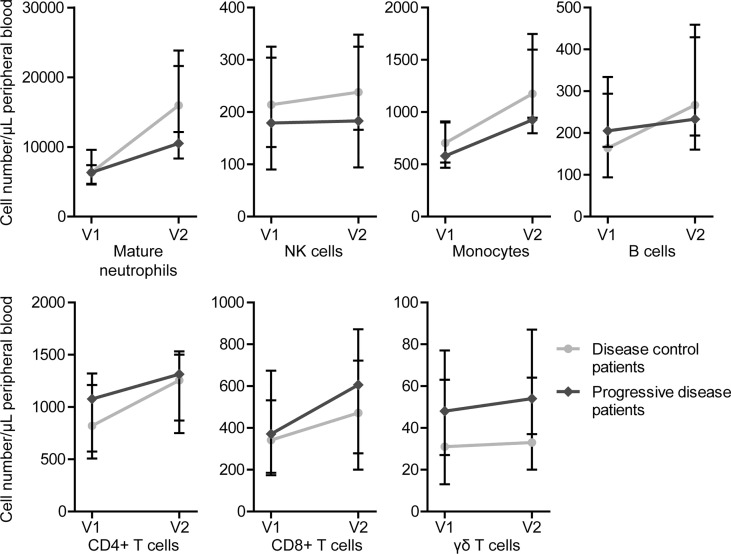
Serum samples were collected before start and after the first cycle of FOLFIRINOX from patients with PDAC (=83) of all disease stages. Overall, 34 circulating cytokines were analyzed with a multiplex immunoassay. In addition, changes in peripheral blood immune cell counts were determined by flow cytometry to correlate with differences in cytokine levels. Chemotherapy response was determined by CT scans with the RECIST 1.1 criteria, as disease control (=64) or progressive disease (=19) within eight cycles of FOLFIRINOX.
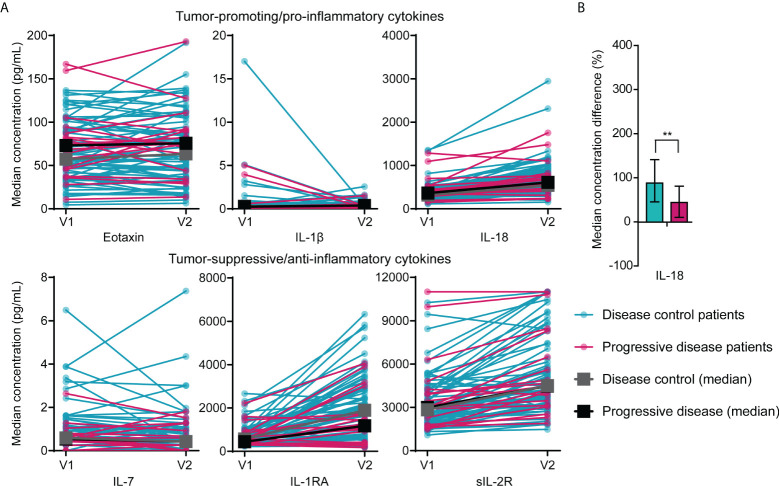
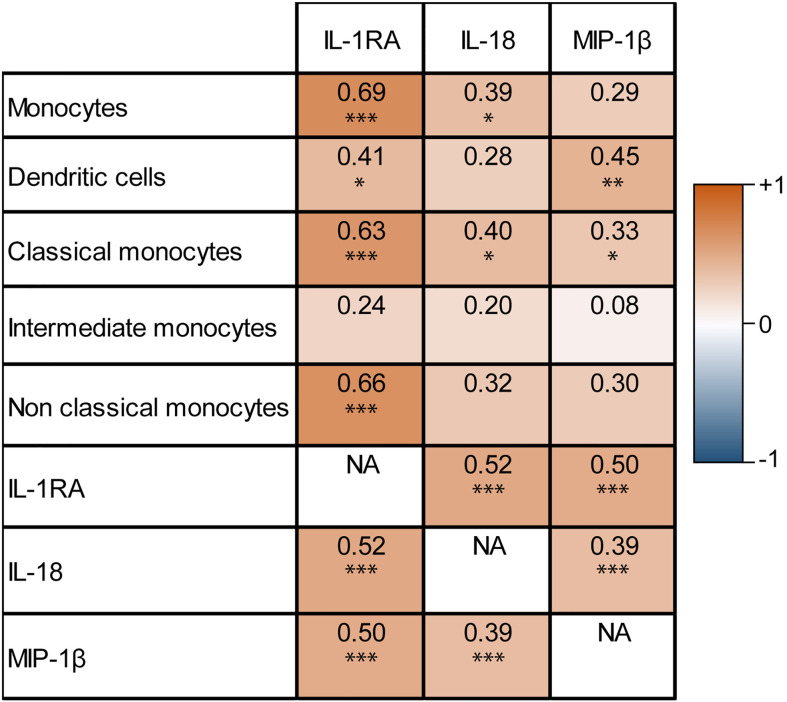
Patients with high serum IL-1RA concentrations after one cycle of chemotherapy were less likely to have tumor progression during FOLFIRINOX (OR 0.25, =0.040). Increase of circulating IL-1RA concentrations correlated with increase of total, classical (CD14+CD16-), and non-classical monocytes (CD14-CD16+), and dendritic cells. In multivariable cox regression, including the variables chemotherapy response outcome and baseline CA19-9 level, serum concentrations of IL-7 (HR 2.14, =0.010), IL-18 (HR 2.00, =0.020), and MIP-1β (HR 0.51, =0.025) after one cycle of FOLFIRINOX showed correlations with OS.
Circulating IL-1RA, IL-7, IL-18, and MIP-1β concentrations are biomarkers associated with FOLFIRINOX response in PDAC patients, suggesting an important role for specific immune cells in chemotherapy response and PDAC progression. Cytokine-based treatment might improve patient outcome and should be evaluated in future studies.
生物标志物可预测治疗反应,有助于对胰腺导管腺癌(PDAC)患者进行分层,以选择合适的治疗方法。本研究旨在评估循环细胞因子与 FOLFIRINOX 反应和总生存期(OS)的相关性。
收集所有疾病阶段的 PDAC 患者(n=83)开始 FOLFIRINOX 治疗前和第一周期后的血清样本。采用多重免疫分析法分析了 34 种循环细胞因子。此外,通过流式细胞术测定外周血免疫细胞计数的变化,以与细胞因子水平的差异相关联。根据 RECIST 1.1 标准,通过 CT 扫描确定化疗反应,FOLFIRINOX 治疗 8 个周期内疾病控制(n=64)或进展(n=19)。
化疗第一周期后血清 IL-1RA 浓度较高的患者在 FOLFIRINOX 期间肿瘤进展的可能性较低(OR 0.25,=0.040)。循环 IL-1RA 浓度的增加与总、经典(CD14+CD16-)和非经典单核细胞(CD14-CD16+)以及树突状细胞的增加相关。在包括化疗反应结果和基线 CA19-9 水平的多变量 Cox 回归中,FOLFIRINOX 第一周期后血清中 IL-7(HR 2.14,=0.010)、IL-18(HR 2.00,=0.020)和 MIP-1β(HR 0.51,=0.025)的浓度与 OS 相关。
循环 IL-1RA、IL-7、IL-18 和 MIP-1β 浓度是与 PDAC 患者 FOLFIRINOX 反应相关的生物标志物,提示特定免疫细胞在化疗反应和 PDAC 进展中具有重要作用。基于细胞因子的治疗可能改善患者的预后,应在未来的研究中进行评估。