MacDonald William J, Purcell Connor, Pinho-Schwermann Maximilian, Stubbs Nolan M, Srinivasan Praveen R, El-Deiry Wafik S
Laboratory of Translational Oncology and Experimental Cancer Therapeutics, The Warren Alpert Medical School, Brown University, Providence, RI 02903, USA.
Department of Pathology and Laboratory Medicine, The Warren Alpert Medical School, Brown University, Providence, RI 02903, USA.
Cancers (Basel). 2025 Jan 28;17(3):441. doi: 10.3390/cancers17030441.
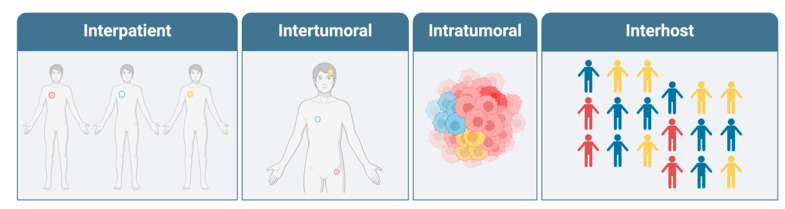
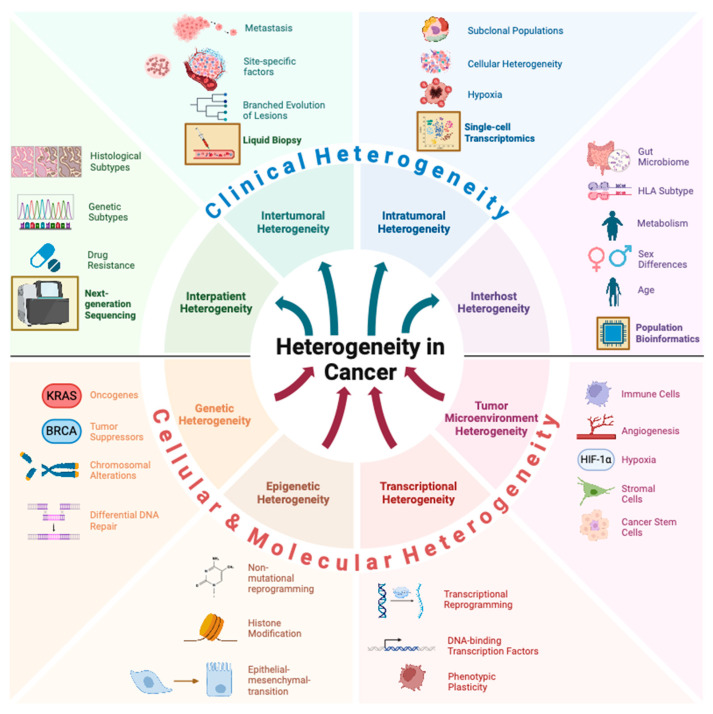
Cancer heterogeneity is a major challenge in oncology, complicating diagnosis, prognostication, and treatment. The clinical heterogeneity of cancer, which leads to differential treatment outcomes between patients with histopathologically similar cancers, is attributable to molecular diversity manifesting through genetic, epigenetic, transcriptomic, microenvironmental, and host biology differences. Heterogeneity is observed between patients, individual metastases, and within individual lesions. This review discusses clinical implications of heterogeneity, emphasizing need for personalized approaches to overcome challenges posed by cancer's diverse presentations. Understanding of emerging molecular diagnostic and analytical techniques can provide a view into the multidimensional complexity of cancer heterogeneity. With over 90% of cancer-related deaths associated with metastasis, we additionally explore the role heterogeneity plays in treatment resistance and recurrence of metastatic lesions. Molecular insights from next-generation sequencing, single-cell transcriptomics, liquid biopsy technology, and artificial intelligence will facilitate the development of combination therapy regimens that can potentially induce lasting and even curative treatment outcomes.
癌症异质性是肿瘤学中的一项重大挑战,使诊断、预后评估和治疗变得复杂。癌症的临床异质性导致组织病理学相似的癌症患者之间出现不同的治疗结果,这归因于通过基因、表观遗传、转录组、微环境和宿主生物学差异表现出来的分子多样性。在患者之间、单个转移灶之间以及单个病灶内部均可观察到异质性。本综述讨论了异质性的临床意义,强调了采用个性化方法来克服癌症多样表现所带来挑战的必要性。对新兴分子诊断和分析技术的理解可以让我们洞察癌症异质性的多维度复杂性。由于超过90%的癌症相关死亡与转移有关,我们还探讨了异质性在转移性病灶的治疗耐药性和复发中所起的作用。来自下一代测序、单细胞转录组学、液体活检技术和人工智能的分子见解将有助于开发联合治疗方案,这些方案有可能带来持久甚至治愈性的治疗效果。