Huang Ren-Wen, Chang Kai-Ping, Marchi Filippo, Loh Charles Yuen Yung, Lin Yu-Jr, Chang Chee-Jen, Kao Huang-Kai
Department of Plastic and Reconstructive Surgery, Chang Gung Memorial Hospital at, Linkou, Taiwan.
Otolaryngology-Head and Neck Surgery, Chang Gung Memorial Hospital at, Linkou, Taiwan.
Front Oncol. 2022 Aug 25;12:871915. doi: 10.3389/fonc.2022.871915. eCollection 2022.
Depression is common among patients with head and neck cancer, thereby affecting their survival rate. However, whether close monitoring of depression affects the survival outcomes of these patients is unknown. Therefore, this study aimed to determine whether depression treatment continuity after the diagnosis of cancer affects the survival of these patients.
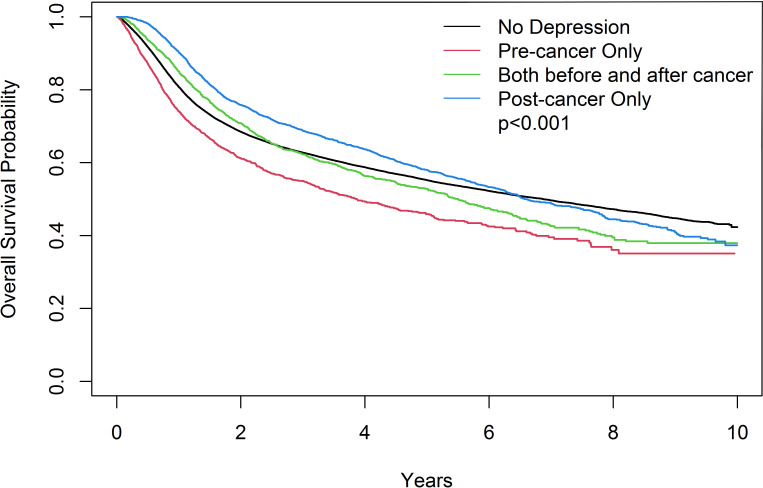
A total of 55,069 patients diagnosed with head and neck cancer in the Cancer Registration System database in Taiwan were enrolled. This cohort was followed from January 1, 2007 to December 31, 2017. Furthermore, the patients were divided into four groups, namely, "no depression," "pre-cancer only," "post-cancer only," and "both before and after cancer," on the basis of the diagnosis of depression and the duration of the follow-up period in the psychiatric clinic. Further, the Cox proportional hazard model was applied to estimate the hazard of death for the four groups.
A total of 6,345 (11.52%) patients were diagnosed with depression in this cohort. The "pre-cancer only" group had a lower overall survival (HR = 1.18; 95% CI = 1.11-1.25) compared with the "no depression" group. Moreover, the "post-cancer only" group had better overall survival (HR = 0.88; 95% CI = 0.83-0.94) compared with the "no depression" group, especially in advanced-stage patients. Patients who were diagnosed with depression before cancer and had continuous depression treatments after the cancer diagnosis had better overall survival (HR = 0.78; 95% CI = 0.71-0.86) compared with patients who had treatment interruptions.
Patients with pre-cancer depression had poorer survival outcomes, especially those who did not receive psychiatric clinic visits after their cancer diagnosis. Nonetheless, in patients with advanced-stage cancer, depression treatment may improve overall survival.
抑郁症在头颈癌患者中很常见,从而影响他们的生存率。然而,密切监测抑郁症是否会影响这些患者的生存结果尚不清楚。因此,本研究旨在确定癌症诊断后的抑郁症治疗连续性是否会影响这些患者的生存情况。
纳入台湾癌症登记系统数据库中55069例诊断为头颈癌的患者。该队列从2007年1月1日至2017年12月31日进行随访。此外,根据抑郁症诊断情况以及在精神科诊所的随访时间,将患者分为四组,即“无抑郁症”“仅癌症前”“仅癌症后”以及“癌症前后均有”。进一步应用Cox比例风险模型估计四组的死亡风险。
该队列中共有6345例(11.52%)患者被诊断为抑郁症。与“无抑郁症”组相比,“仅癌症前”组的总生存率较低(HR = 1.18;95% CI = 1.11 - 1.25)。此外,与“无抑郁症”组相比,“仅癌症后”组的总生存率更好(HR = 0.88;95% CI = 0.83 - 0.94),尤其是在晚期患者中。与治疗中断的患者相比,癌症前被诊断为抑郁症且癌症诊断后持续接受抑郁症治疗的患者总生存率更好(HR = 0.78;95% CI = 0.71 - 0.86)。
癌症前患有抑郁症的患者生存结果较差,尤其是那些在癌症诊断后未接受精神科门诊治疗的患者。尽管如此,在晚期癌症患者中,抑郁症治疗可能会提高总生存率。