Deckers Thomas, Hall Gabriella Nilsson, Papantoniou Ioannis, Aerts Jean-Marie, Bloemen Veerle
Measure, Model and Manage Bioresponses (M3-BIORES), Department of Biosystems, KU Leuven, Leuven, Belgium.
Surface and Interface Engineered Materials (SIEM), Group T Leuven Campus, KU Leuven, Leuven, Belgium.
Front Bioeng Biotechnol. 2022 Aug 26;10:946992. doi: 10.3389/fbioe.2022.946992. eCollection 2022.
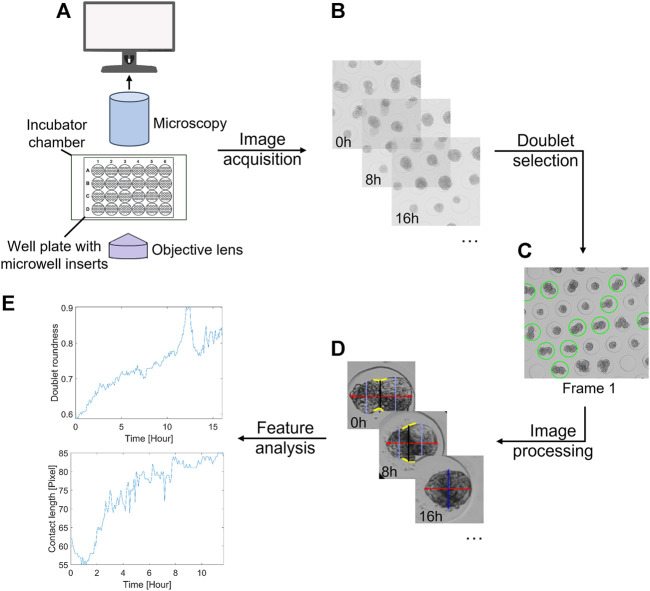
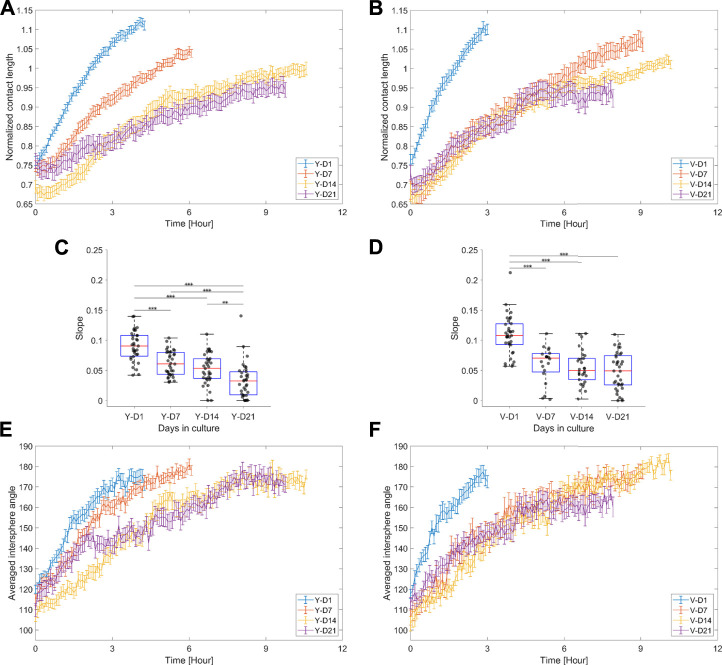
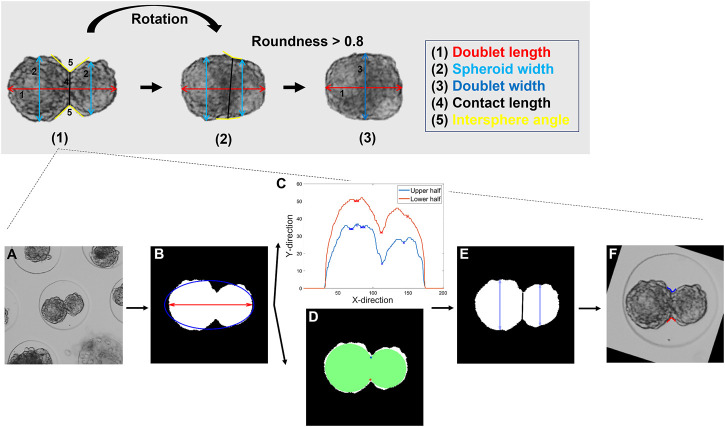
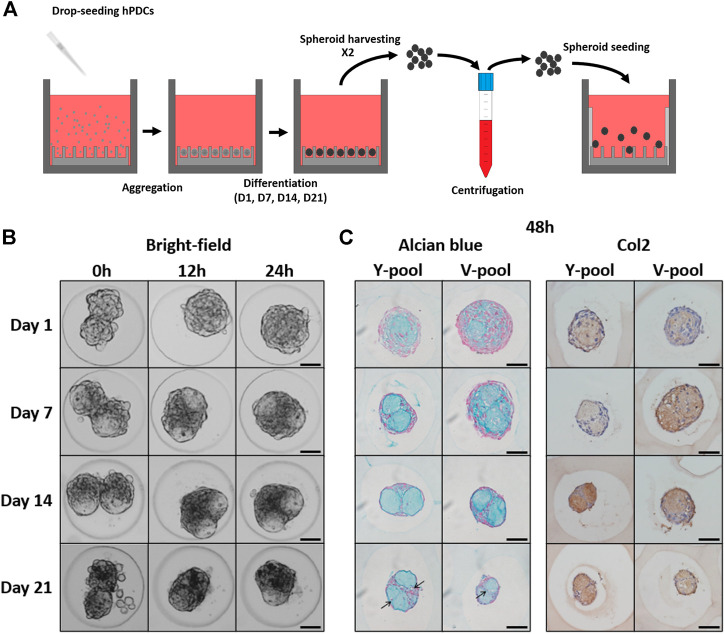
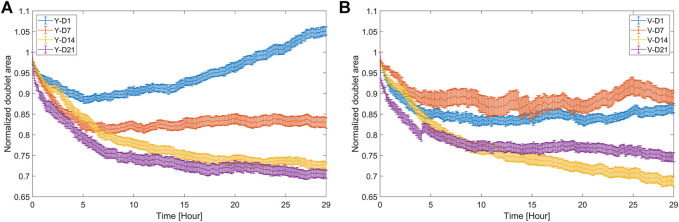
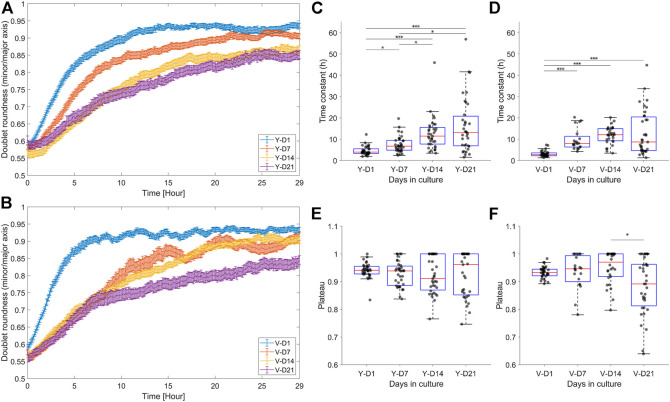
Spheroids are widely applied as building blocks for biofabrication of living tissues, where they exhibit spontaneous fusion toward an integrated structure upon contact. Tissue fusion is a fundamental biological process, but due to a lack of automated monitoring systems, the in-depth characterization of this process is still limited. Therefore, a quantitative high-throughput platform was developed to semi-automatically select doublet candidates and automatically monitor their fusion kinetics. Spheroids with varying degrees of chondrogenic maturation (days 1, 7, 14, and 21) were produced from two different cell pools, and their fusion kinetics were analyzed via the following steps: (1) by applying a novel spheroid seeding approach, the background noise was decreased due to the removal of cell debris while a sufficient number of doublets were still generated. (2) The doublet candidates were semi-automatically selected, thereby reducing the time and effort spent on manual selection. This was achieved by automatic detection of the microwells and building a random forest classifier, obtaining average accuracies, sensitivities, and precisions ranging from 95.0% to 97.4%, from 51.5% to 92.0%, and from 66.7% to 83.9%, respectively. (3) A software tool was developed to automatically extract morphological features such as the doublet area, roundness, contact length, and intersphere angle. For all data sets, the segmentation procedure obtained average sensitivities and precisions ranging from 96.8% to 98.1% and from 97.7% to 98.8%, respectively. Moreover, the average relative errors for the doublet area and contact length ranged from 1.23% to 2.26% and from 2.30% to 4.66%, respectively, while the average absolute errors for the doublet roundness and intersphere angle ranged from 0.0083 to 0.0135 and from 10.70 to 13.44°, respectively. (4) The data of both cell pools were analyzed, and an exponential model was used to extract kinetic parameters from the time-series data of the doublet roundness. For both cell pools, the technology was able to characterize the fusion rate and quality in an automated manner and allowed us to demonstrate that an increased chondrogenic maturity was linked with a decreased fusion rate. The platform is also applicable to other spheroid types, enabling an increased understanding of tissue fusion. Finally, our approach to study spheroid fusion over time will aid in the design of controlled fabrication of "assembloids" and bottom-up biofabrication of living tissues using spheroids.
球体广泛应用于生物制造活组织的构建模块,在接触时它们会自发融合形成一个整合结构。组织融合是一个基本的生物学过程,但由于缺乏自动化监测系统,对这一过程的深入表征仍然有限。因此,开发了一个定量高通量平台,用于半自动选择双球体候选物并自动监测它们的融合动力学。从两个不同的细胞库中制备了具有不同软骨生成成熟度(第1、7、14和21天)的球体,并通过以下步骤分析它们的融合动力学:(1)通过应用一种新颖的球体接种方法,由于去除了细胞碎片,背景噪声降低,同时仍产生了足够数量的双球体。(2)半自动选择双球体候选物,从而减少了手动选择所花费的时间和精力。这是通过自动检测微孔并构建随机森林分类器实现的,平均准确率、灵敏度和精确率分别在95.0%至97.4%、51.5%至92.0%和66.7%至83.9%之间。(3)开发了一个软件工具来自动提取形态特征,如双球体面积、圆度、接触长度和球间角度。对于所有数据集,分割程序获得的平均灵敏度和精确率分别在96.8%至98.1%和97.7%至98.8%之间。此外,双球体面积和接触长度的平均相对误差分别在1.23%至2.26%和2.30%至4.66%之间,而双球体圆度和球间角度的平均绝对误差分别在0.0083至0.0135和10.70至13.44°之间。(4)分析了两个细胞库的数据,并使用指数模型从双球体圆度的时间序列数据中提取动力学参数。对于两个细胞库,该技术能够以自动化方式表征融合速率和质量,并使我们能够证明软骨生成成熟度的增加与融合速率的降低有关。该平台也适用于其他类型的球体,有助于加深对组织融合的理解。最后,我们研究球体随时间融合的方法将有助于设计“组装体”的可控制造以及使用球体进行活组织的自下而上生物制造。