Romero-Luna Haydee Eliza, Colina Jhoana, Guzmán-Rodríguez Lorena, Sierra-Carmona Celia Gabriela, Farías-Campomanes Ángela María, García-Pinilla Santiago, González-Tijera María Margarita, Malagón-Alvira Karen Otilia, Peredo-Lovillo Audry
Instituto Tecnológico Superior de Xalapa, Tecnológico Nacional de México, Reserva Territorial S/N, Sección 5, Santa Bárbara, CP 91096 Xalapa-Enríquez, Veracruz México.
Ingeniería de Alimentos, Fundación Universitaria Agraria de Colombia, Calle 170 #54a-10, CP 111156 Bogotá, Colombia.
J Food Sci Technol. 2022 Sep 4;60(11):1-11. doi: 10.1007/s13197-022-05578-y.
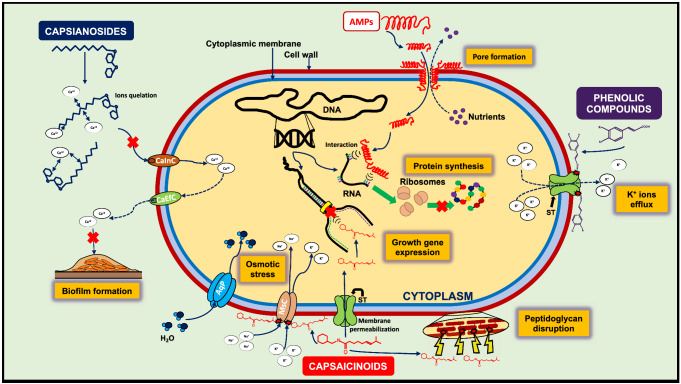
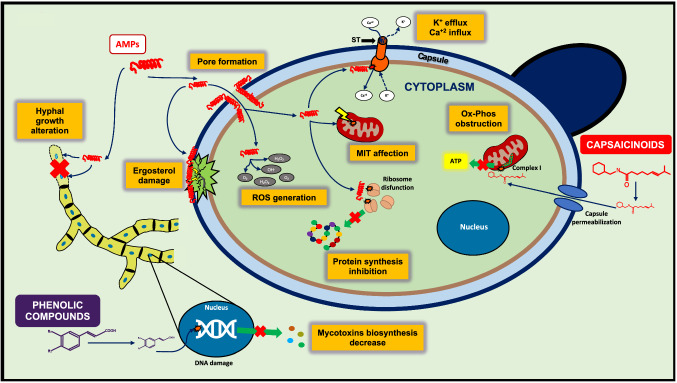
spp. fruits (CFs) are a basic ingredient in the diet and have been used as active ingredients in the pharmaceutical, cosmetic, and food products, due to their antioxidant, anti-inflammatory, antiseptic, and antimicrobial properties. The antimicrobial activity is the most studied property due to its effectiveness against pathogenic species, however, few studies have focused on the mechanisms of action involved. Therefore, this review discusses the effects generated by the CFs compounds on the viability and metabolism of microorganisms, highlighting the mechanisms by which these compounds exert their antimicrobial effects. The information provided shows that CFs are mainly source of capsaicinoids and phenolic compounds responsible for the inhibition of bacteria, yeasts, and fungi, through an increase in the permeabilization of the membrane and cell wall. Also, these compounds show an antiviral effect associated with the inactivation of virus binding proteins, preventing their replication and infection. Despite this, there is still a lack of information about the mechanisms that regulate the interactions between CFs compounds and food-important-microorganisms. Therefore, future research should focus on new antimicrobial compounds from CFs for their subsequent use against novel infectious agents, mainly virus of importance in health such as SARS-CoV-2.
辣椒属果实(CFs)是饮食中的一种基本成分,由于其具有抗氧化、抗炎、防腐和抗菌特性,已被用作药品、化妆品和食品中的活性成分。由于其对致病物种的有效性,抗菌活性是研究最多的特性,然而,很少有研究关注其中涉及的作用机制。因此,本综述讨论了CFs化合物对微生物活力和代谢产生的影响,突出了这些化合物发挥抗菌作用的机制。所提供的信息表明,CFs主要是辣椒素类和酚类化合物的来源,它们通过增加膜和细胞壁的通透性来抑制细菌、酵母和真菌。此外,这些化合物显示出与病毒结合蛋白失活相关的抗病毒作用,阻止其复制和感染。尽管如此,关于调节CFs化合物与食品重要微生物之间相互作用的机制仍然缺乏信息。因此,未来的研究应集中于来自CFs的新型抗菌化合物,以便随后用于对抗新型感染因子,主要是对健康重要的病毒,如严重急性呼吸综合征冠状病毒2(SARS-CoV-2)。