Hong Liang, Xu Huan, Ge Chonglin, Tao Hong, Shen Xiao, Song Xiaochun, Guan Donghai, Zhang Cui
Cardiovascular Intensive Care Unit, Department of Critical Care Medicine, Nanjing First Hospital, Nanjing Medical University, Nanjing, China.
College of Computer Science and Technology, Nanjing University of Aeronautics and Astronautics, Nanjing, China.
Front Med (Lausanne). 2022 Aug 24;9:973147. doi: 10.3389/fmed.2022.973147. eCollection 2022.
This study aimed to develop machine learning models to predict Low Cardiac Output Syndrome (LCOS) in patients following cardiac surgery using machine learning algorithms.
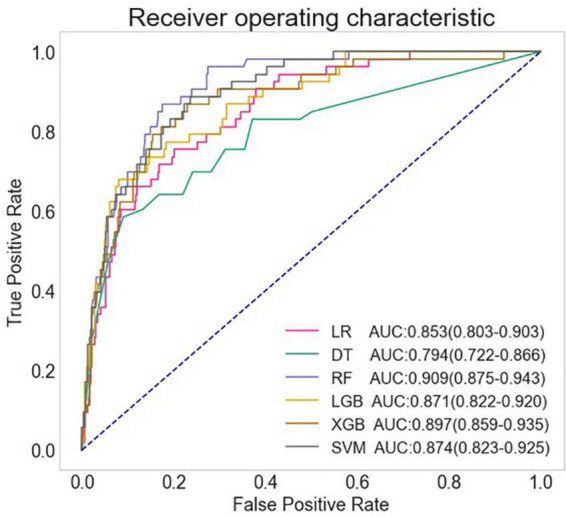
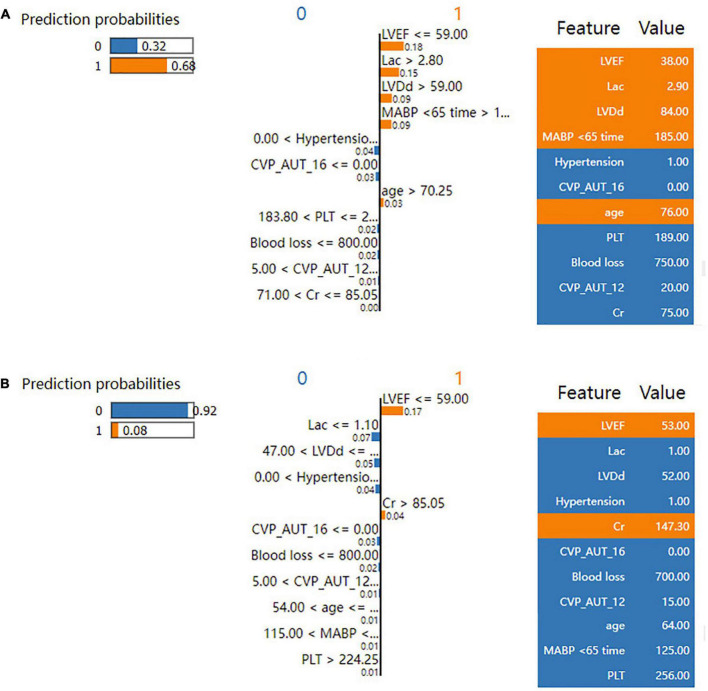
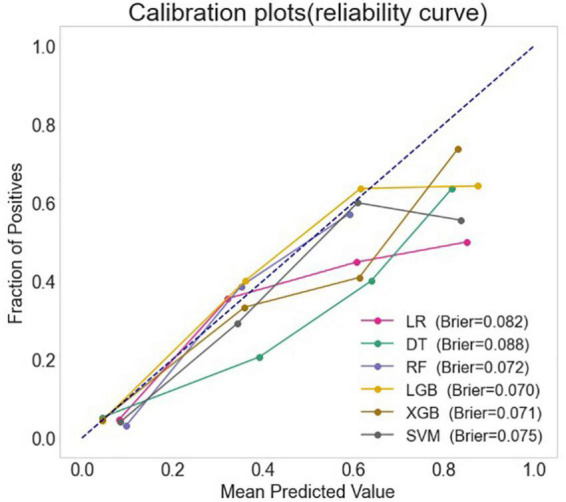
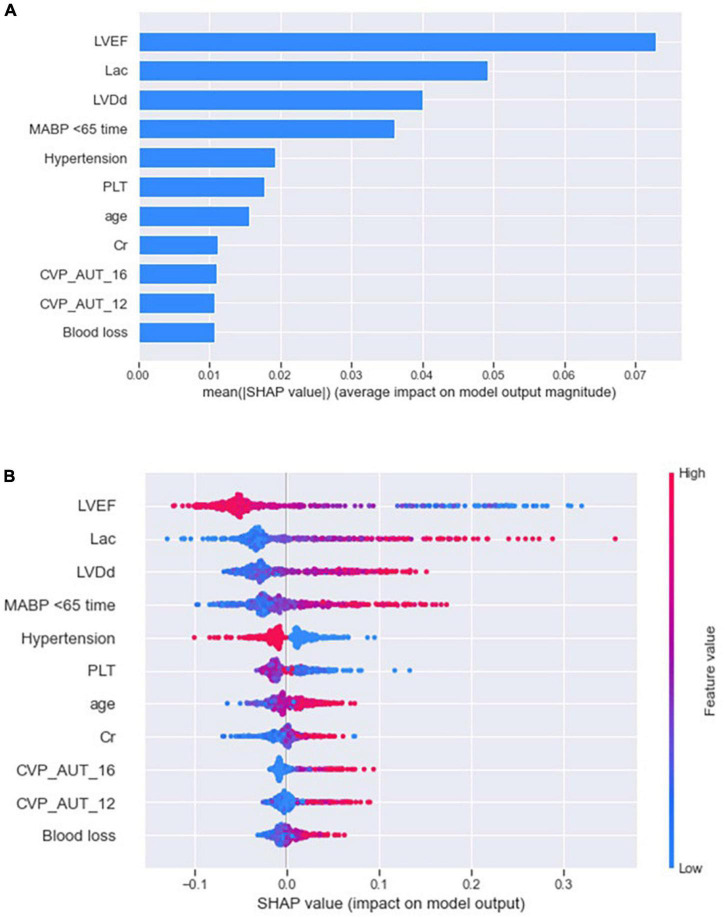
The clinical data of cardiac surgery patients in Nanjing First Hospital between June 2019 and November 2020 were retrospectively extracted from the electronic medical records. Six conventional machine learning algorithms, including logistic regression, support vector machine, decision tree, random forest, extreme gradient boosting and light gradient boosting machine, were employed to construct the LCOS predictive models with all predictive features (full models) and selected predictive features (reduced models). The discrimination of these models was evaluated by the area under the receiver operating characteristic curve (AUC) and the calibration of the models was assessed by the calibration curve. Shapley Additive explanation (SHAP) and Local Interpretable Model-Agnostic Explanations (LIME) were used to interpret the predictive models.
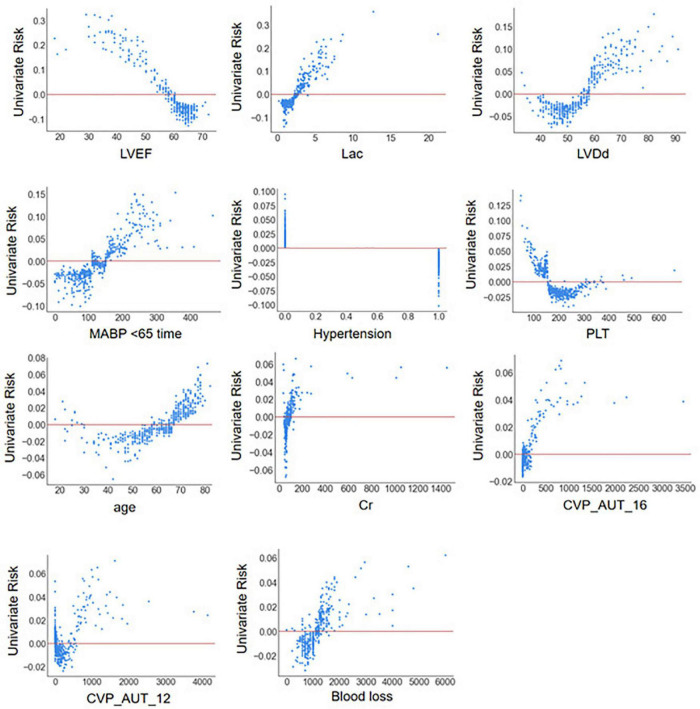
Data from 1,585 patients [982 (62.0%) were male, aged 18 to 88, 212 (13.4%) with LCOS] were employed to train and validate the LCOS models. Among the full models, the RF model (AUC: 0.909, 95% CI: 0.875-0.943; Sensitivity: 0.849, 95% CI: 0.724-0.933; Specificity: 0.835, 95% CI: 0.796-0.869) and the XGB model (AUC: 0.897, 95% CI: 0.859-0.935; Sensitivity: 0.830, 95% CI: 0.702-0.919; Specificity: 0.809, 95% CI: 0.768-0.845) exhibited well predictive power for LCOS. Eleven predictive features including left ventricular ejection fraction (LVEF), first post-operative blood lactate (Lac), left ventricular diastolic diameter (LVDd), cumulative time of mean artery blood pressure (MABP) lower than 65 mmHg (MABP < 65 time), hypertension history, platelets level (PLT), age, blood creatinine (Cr), total area under curve above threshold central venous pressure (CVP) 12 mmHg and 16 mmHg, and blood loss during operation were used to build the reduced models. Among the reduced models, RF model (AUC: 0.895, 95% CI: 0.857-0.933; Sensitivity: 0.830, 95% CI: 0.702-0.919; Specificity: 0.806, 95% CI: 0.765-0.843) revealed the best performance. SHAP and LIME plot showed that LVEF, Lac, LVDd and MABP < 65 time significantly contributed to the prediction model.
In this study, we successfully developed several machine learning models to predict LCOS after surgery, which may avail to risk stratification, early detection and management of LCOS after cardiac surgery.
本研究旨在使用机器学习算法开发机器学习模型,以预测心脏手术后患者的低心排血量综合征(LCOS)。
回顾性提取2019年6月至2020年11月南京第一医院心脏手术患者的临床数据。采用六种传统机器学习算法,包括逻辑回归、支持向量机、决策树、随机森林、极端梯度提升和轻梯度提升机,构建具有所有预测特征的LCOS预测模型(完整模型)和选择的预测特征(简化模型)。通过受试者工作特征曲线下面积(AUC)评估这些模型的辨别力,并通过校准曲线评估模型的校准。使用Shapley加性解释(SHAP)和局部可解释模型无关解释(LIME)来解释预测模型。
来自1585例患者的数据[982例(62.0%)为男性,年龄18至88岁,212例(13.4%)发生LCOS]用于训练和验证LCOS模型。在完整模型中,随机森林(RF)模型(AUC:0.909,95%CI:0.875 - 0.943;灵敏度:0.849,95%CI:0.724 - 0.933;特异性:0.835,95%CI:0.796 - 0.869)和极端梯度提升(XGB)模型(AUC:0.897,95%CI:0.859 - 0.935;灵敏度:0.830,95%CI:0.702 - 0.919;特异性:0.809,95%CI:0.768 - 0.845)对LCOS表现出良好的预测能力。包括左心室射血分数(LVEF)、术后首次血乳酸(Lac)、左心室舒张直径(LVDd)、平均动脉血压(MABP)低于65 mmHg的累计时间(MABP < 65时间)、高血压病史、血小板水平(PLT)、年龄、血肌酐(Cr)、中心静脉压(CVP)高于12 mmHg和16 mmHg时曲线下总面积以及术中失血量在内的11个预测特征用于构建简化模型。在简化模型中,RF模型(AUC:0.895,95%CI:0.857 - 0.933;灵敏度:0.830,95%CI:0.702 - 0.919;特异性:0.806,95%CI:0.765 - 0.843)表现出最佳性能。SHAP和LIME图显示LVEF、Lac、LVDd和MABP < 65时间对预测模型有显著贡献。
在本研究中,我们成功开发了几种机器学习模型来预测术后LCOS,这可能有助于心脏手术后LCOS的风险分层、早期检测和管理。