Institute of Child and Adolescent Health, School of Public Health, Peking University, Beijing, China.
National Health Commission Key Laboratory of Reproductive Health, Beijing, China.
Front Endocrinol (Lausanne). 2022 Aug 25;13:952825. doi: 10.3389/fendo.2022.952825. eCollection 2022.
Metabolically healthy obesity (MHO) is a group of subjects with overweight/obesity who present a metabolically healthy profile; however, associated factors are complex and are far from completely understood. The aim of the current study was to estimate the prevalence of different metabolic body size phenotypes and investigate the associated factors in Chinese children and adolescents.
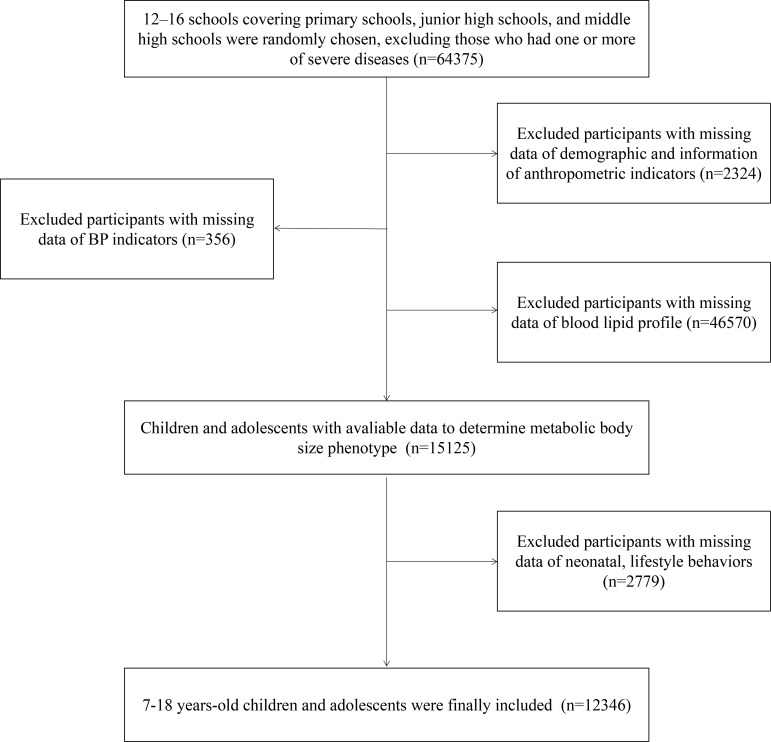
A cross-sectional survey was conducted of 12,346 children and adolescents aged 7-18 years from seven provinces in China in 2013. Anthropometric, blood pressure, and biochemical measurements were obtained. A multi-component questionnaire covering demographic, neonatal, and lifestyle characteristics was administered. The classification of metabolic body size phenotype based on three definitions was compared. With metabolically healthy with normal weight (MHNW) as a reference group, logistic regression analyses were used to estimate the potential effects of associated risk factors, with adjustment for age, sex, single-child status, and residence area.
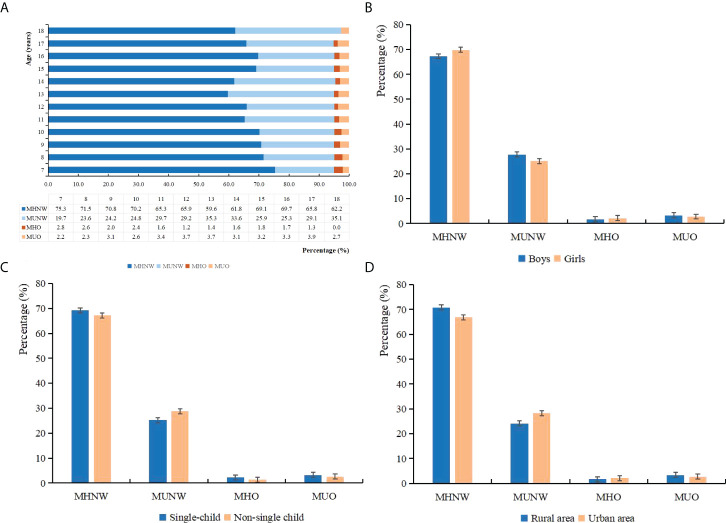
The prevalence of MHNW, MHO, metabolically unhealthy with normal weight (MUNW), and metabolically unhealthy overweight/obesity (MUO) phenotype was 68.6%, 2.0%, 26.4%, and 3.0%, respectively. There were 39.3% MHO and 60.7% MUO among obese participants and 72.2% MHNW and 27.8% MUNW among those with normal weight. Compared to cardiometabolic risk factor (CMRF) criteria and metabolic syndrome (MetS) component definition, the application of the 2018 consensus-based definition may identify more children with abnormal cardiovascular risks, independent of weight status. Compared to younger children, older-aged adolescents were positively associated with higher risks of MUNW (odds ratio (OR) = 1.38, 95% CI = 1.27-1.50) and MUO (OR = 1.29, 95% CI = 1.04-1.60), while factors positively associated with MHO were younger age, single-child status, urban residence, high birth weight, prolonged breastfeeding duration, parental overweight/obesity status, long screen time, and less physical activity.
There were still a high proportion of children and adolescents at high cardiometabolic risk in China. Our findings reinforce the need for cardiometabolic risk prevention in children and adolescents irrespective of their weight statuses, such as parental educational programs and healthy lifestyle interventions.
代谢健康型肥胖(MHO)是指超重/肥胖人群中代谢健康的一组人群;然而,相关因素复杂,远未完全了解。本研究旨在评估中国儿童和青少年中不同代谢体型表型的流行情况,并探讨相关因素。
2013 年对中国 7 个省份的 12346 名 7-18 岁儿童和青少年进行了横断面调查。测量了人体测量学、血压和生化指标。并进行了涵盖人口统计学、新生儿和生活方式特征的多组分问卷。比较了基于三种定义的代谢体型表型的分类。以代谢健康正常体重(MHNW)为参考组,使用逻辑回归分析估计相关危险因素的潜在影响,同时调整年龄、性别、独生子状况和居住区域。
MHNW、MHO、代谢不健康正常体重(MUNW)和代谢不健康超重/肥胖(MUO)表型的患病率分别为 68.6%、2.0%、26.4%和 3.0%。肥胖者中 MHO 和 MUO 的比例分别为 39.3%和 60.7%,体重正常者中 MHNW 和 MUNW 的比例分别为 72.2%和 27.8%。与心血管代谢风险因素(CMRF)标准和代谢综合征(MetS)成分定义相比,2018 年基于共识的定义的应用可能会识别出更多心血管风险异常的儿童,而与体重状况无关。与年龄较小的儿童相比,年龄较大的青少年患 MUNW(优势比(OR)=1.38,95%可信区间(CI)=1.27-1.50)和 MUO(OR=1.29,95%CI=1.04-1.60)的风险更高,而与 MHO 相关的因素是年龄较小、独生子状况、城市居住、高出生体重、延长母乳喂养时间、父母超重/肥胖状况、长时间屏幕时间和较少的身体活动。
中国仍有相当比例的儿童和青少年存在较高的心血管代谢风险。我们的研究结果强调,需要对儿童和青少年进行心血管代谢风险预防,无论其体重状况如何,例如父母教育计划和健康生活方式干预。