Institute of Child and Adolescent Health, School of Public Health, Peking University, Beijing 100191, China.
National Health Commission Key Laboratory of Reproductive Health, Peking University, Beijing 100191, China.
Nutrients. 2022 May 10;14(10):1999. doi: 10.3390/nu14101999.
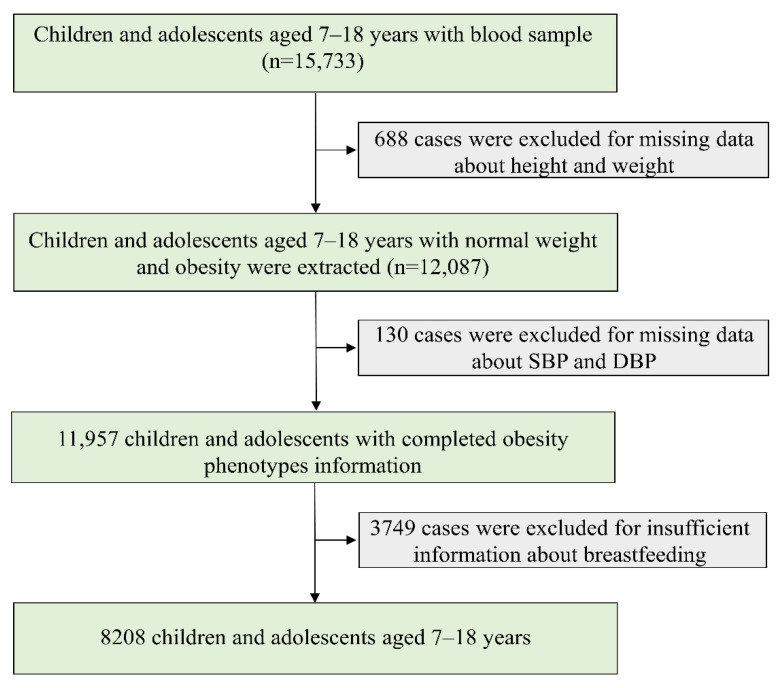
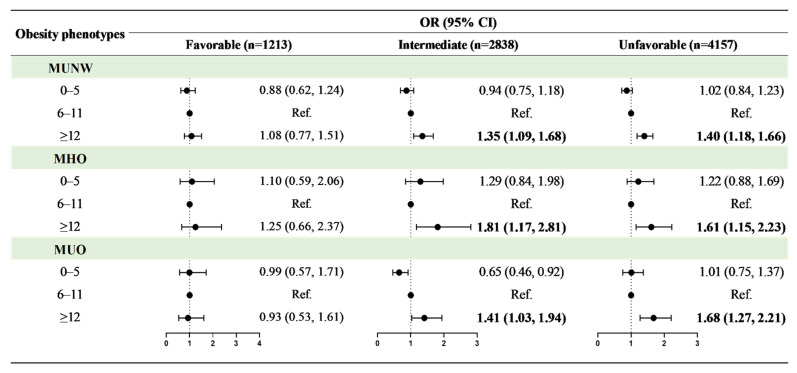
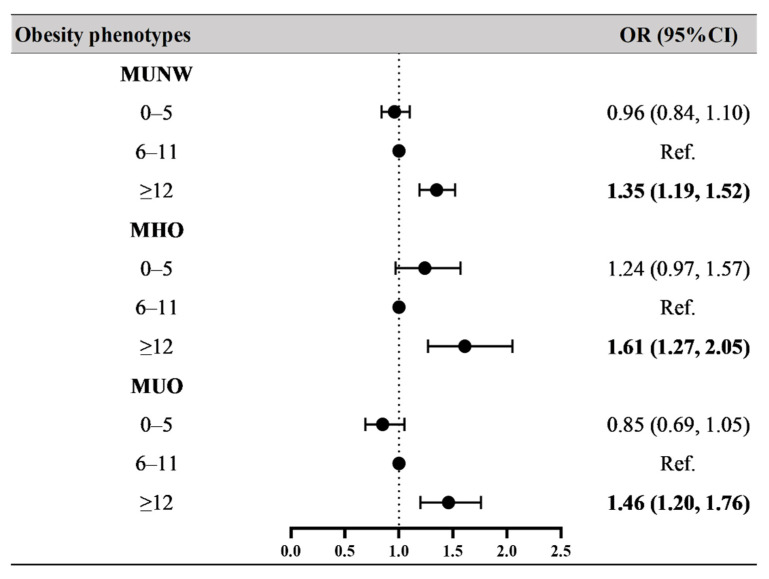
: Additional metabolic indicators ought to be combined as outcome variables when exploring the impact of breastfeeding on obesity risk. Given the role of a healthy lifestyle in reducing obesity, we aimed to assess the effect of breastfeeding duration on different obesity phenotypes according to metabolic status in children and adolescents, and to explore the offsetting effect of healthy lifestyle factors on the associations between breastfeeding duration and obesity phenotypes. : A total of 8208 eligible children and adolescents aged 7-18 years were recruited from a Chinese national cross-sectional study conducted in 2013. Anthropometric indicators were measured in the survey sites, metabolic indicators were tested from fasting blood samples, and breastfeeding duration and sociodemographic factors were collected by questionnaires. According to anthropometric and metabolic indicators, obesity phenotypes were divided into metabolic healthy normal weight (MHNW), metabolic unhealthy normal weight (MUNW), metabolic healthy obesity (MHO), and metabolic unhealthy obesity (MUO). Four common obesity risk factors (dietary consumption, physical activity, screen time, and sleep duration) were used to construct a healthy lifestyle score. Scores on the lifestyle index ranged from 0 to 4 and were further divided into unfavorable lifestyles (zero or one healthy lifestyle factor), intermediate lifestyles (two healthy lifestyle factors), and favorable lifestyle (three or four healthy lifestyle factors). Multinomial logistic regression was used to estimate the odds ratio (OR) and 95% confidence interval (95% CI) for the associations between breastfeeding duration and obesity phenotypes. Furthermore, the interaction terms of breastfeeding duration and each healthy lifestyle category were tested to explore the offsetting effect of lifestyle factors. : The prevalence of obesity among Chinese children and adolescents aged 7-18 years was 11.0%. Among the children and adolescents with obesity, the prevalence of MHO and MUO was 41.0% and 59.0%, respectively. Compared to the children and adolescents who were breastfed for 6-11 months, prolonged breastfeeding (≥12 months) increased the risks of MUNW (OR = 1.35, 95% CI: 1.19-1.52), MHO (OR = 1.61, 95% CI: 1.27-2.05), and MUO (OR = 1.46, 95% CI: 1.20-1.76). When stratified by healthy lifestyle category, there was a typical dose-response relationship between duration of breastfeeding over 12 months and MUNW, MHO, and MUO, with an increased risk of a favorable lifestyle moved to an unfavorable lifestyle. : Prolonged breastfeeding (≥12 months) may be associated with increased risks of MUNW, MHO, and MUO, and the benefits of breastfeeding among children and adolescents may begin to wane around the age of 12 months. The increased risks may be largely offset by a favorable lifestyle.
:当探讨母乳喂养对肥胖风险的影响时,应该将其他代谢指标作为结果变量进行合并。鉴于健康生活方式在降低肥胖中的作用,我们旨在根据儿童和青少年的代谢状况评估母乳喂养时间对不同肥胖表型的影响,并探讨健康生活方式因素对母乳喂养时间与肥胖表型之间关联的抵消作用。:共纳入 2013 年进行的中国全国性横断面研究中 8208 名年龄在 7-18 岁的合格儿童和青少年。在调查现场测量了人体测量指标,从空腹血样中检测了代谢指标,并通过问卷收集了母乳喂养时间和社会人口统计学因素。根据人体测量和代谢指标,将肥胖表型分为代谢健康正常体重(MHNW)、代谢不健康正常体重(MUNW)、代谢健康肥胖(MHO)和代谢不健康肥胖(MUO)。使用四种常见的肥胖风险因素(饮食摄入、体力活动、屏幕时间和睡眠时间)构建健康生活方式评分。生活方式指数的得分为 0 至 4 分,并进一步分为不利生活方式(零或一个健康生活方式因素)、中间生活方式(两个健康生活方式因素)和有利生活方式(三个或四个健康生活方式因素)。使用多变量逻辑回归估计母乳喂养时间与肥胖表型之间关联的比值比(OR)和 95%置信区间(95%CI)。此外,还测试了母乳喂养时间和每个健康生活方式类别的交互项,以探讨生活方式因素的抵消作用。:中国 7-18 岁儿童和青少年肥胖的患病率为 11.0%。在肥胖的儿童和青少年中,MHO 和 MUO 的患病率分别为 41.0%和 59.0%。与母乳喂养 6-11 个月的儿童和青少年相比,延长母乳喂养时间(≥12 个月)会增加 MUNW(OR=1.35,95%CI:1.19-1.52)、MHO(OR=1.61,95%CI:1.27-2.05)和 MUO(OR=1.46,95%CI:1.20-1.76)的患病风险。按健康生活方式类别分层,母乳喂养时间超过 12 个月与 MUNW、MHO 和 MUO 之间存在典型的剂量-反应关系,有利生活方式的风险增加会转移到不利生活方式。:延长母乳喂养时间(≥12 个月)可能与 MUNW、MHO 和 MUO 的患病风险增加有关,母乳喂养对儿童和青少年的益处可能在 12 个月左右开始减弱。这种增加的风险可能在很大程度上被有利的生活方式所抵消。