
脂肪间充质干细胞分泌的细胞外囊泡通过递送 miR-223-3p 缓解非酒精性脂肪性肝病。
Adipose-derived mesenchymal stem cell-secreted extracellular vesicles alleviate non-alcoholic fatty liver disease delivering miR-223-3p.
机构信息
Department of Liver Center, the Affiliated Hospital of Qingdao University, Qingdao P.R. China.
Department of Infectious Diseases, the Affiliated Hospital of Qingdao University, Qingdao P.R. China.
出版信息
Adipocyte. 2022 Dec;11(1):572-587. doi: 10.1080/21623945.2022.2098583.
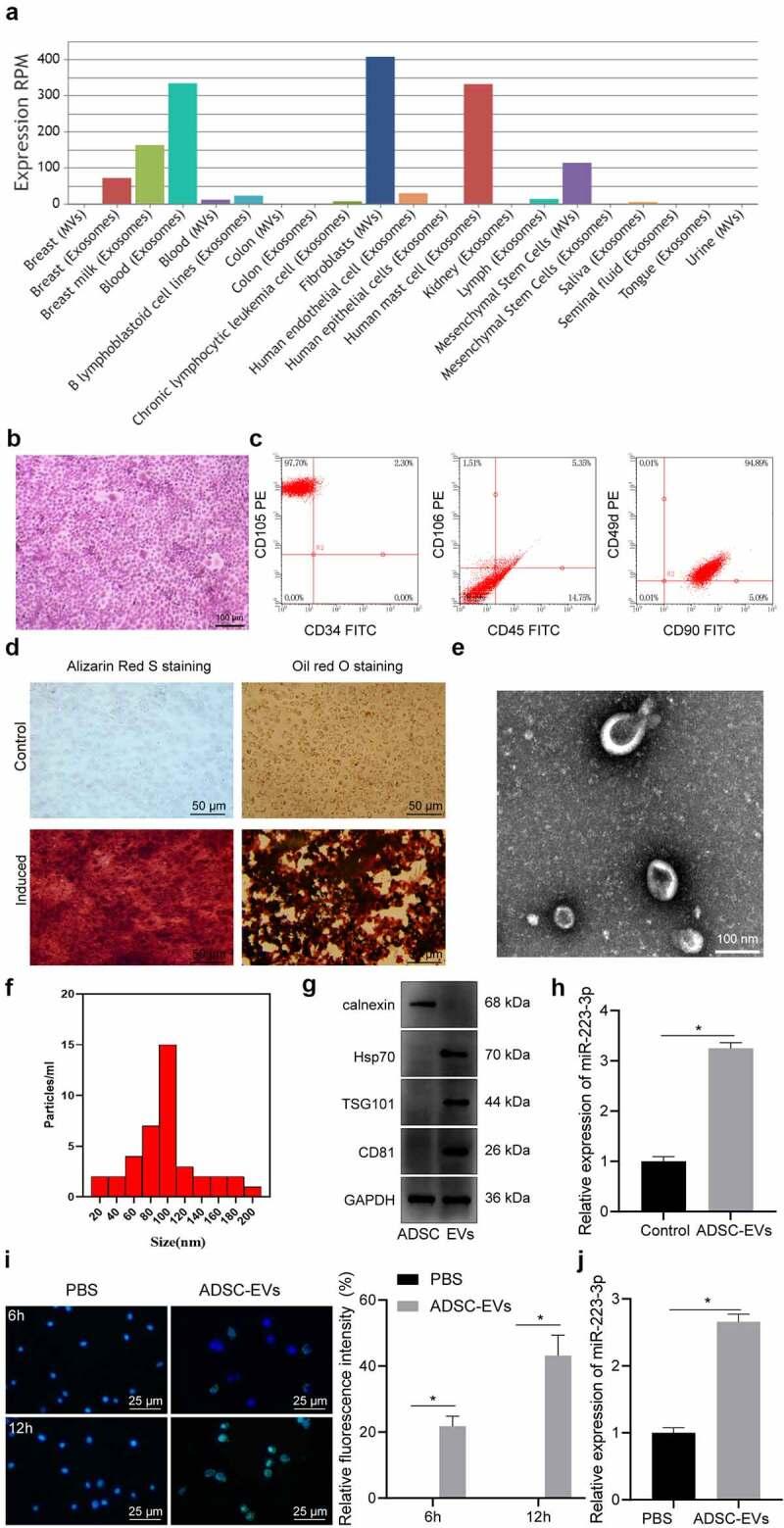
Increasing studies have identified the potential of mesenchymal stem cell-derived extracellular vesicles (MSC-EVs) in non-alcoholic fatty liver disease (NAFLD) treatment. Hence, we further focused on the potential of adipose-derived MSC (ADSC)-EVs in NAFLD by delivering miR-223-3p. The uptake of isolated ADSC-EVs by hepatocytes was assessed, and the expression of miR-223-3p in ADSC-EVs and hepatocytes was characterized. It was established that miR-223-3p, enriched in ADSC-EVs, could be delivered by ADSC-EVs into hepatocytes. Using co-culture system and gain-of-function approach, we evaluated the effect of ADSC-EVs carrying miR-223-3p on lipid accumulation and liver fibrosis in pyrrolizidine alkaloids (PA)-induced hepatocytes and a high-fat diet-induced NAFLD mouse model. Bioinformatics websites and dual-luciferase reporter gene assay were performed to determine the interactions between miR-223-3p and E2F1, which was further validated by rescue experiments. ADSC-EVs containing miR-223-3p displayed suppressive effects on lipid accumulation and liver fibrosis through E2F1 inhibition, since E2F1 was demonstrated as a target gene of miR-223-3p. The protective role of ADSC-EVs by delivering miR-223-3p was then confirmed in the mouse model. Collectively, this study elucidated that ADSC-EVs delayed the progression NAFLD through the delivery of anti-fibrotic miR-223-3p and subsequent E2F1 suppression, which may suggest miR-223-3p-loaded ADSC-EVs to be a potential therapeutic approach for NAFLD.
越来越多的研究已经确定了间充质干细胞衍生的细胞外囊泡 (MSC-EVs) 在非酒精性脂肪性肝病 (NAFLD) 治疗中的潜力。因此,我们通过递送 miR-223-3p 进一步关注脂肪来源的间充质干细胞 (ADSC)-EV 在 NAFLD 中的潜力。评估了肝细胞对分离的 ADSC-EVs 的摄取,并对 ADSC-EVs 和肝细胞中的 miR-223-3p 表达进行了表征。结果表明,富含 ADSC-EVs 的 miR-223-3p 可以通过 ADSC-EVs 递送到肝细胞中。使用共培养系统和功能获得方法,我们评估了携带 miR-223-3p 的 ADSC-EVs 对吡咯里西啶生物碱 (PA) 诱导的肝细胞和高脂肪饮食诱导的 NAFLD 小鼠模型中脂质积累和肝纤维化的影响。通过生物信息学网站和双荧光素酶报告基因检测,确定了 miR-223-3p 与 E2F1 之间的相互作用,通过挽救实验进一步验证了这一点。含有 miR-223-3p 的 ADSC-EVs 通过抑制 E2F1 显示出对脂质积累和肝纤维化的抑制作用,因为 E2F1 被证明是 miR-223-3p 的靶基因。随后在小鼠模型中证实了 ADSC-EVs 通过递送 miR-223-3p 发挥保护作用。总之,这项研究阐明了 ADSC-EVs 通过递送抗纤维化 miR-223-3p 并随后抑制 E2F1 来延缓 NAFLD 的进展,这可能表明 miR-223-3p 负载的 ADSC-EVs 是治疗 NAFLD 的一种有潜力的方法。



 Zotero 插件