Lao Tropical and Public Health Institute, Ministry of Health, Vientiane, Lao PDR.
Department of Global Public Health, Karolinska Institutet, Stockholm, Sweden.
BMC Pregnancy Childbirth. 2022 Sep 12;22(1):701. doi: 10.1186/s12884-022-05018-x.
Antibiotics are important medicines to prevent maternal and child morbidity and mortality. Women's knowledge and attitudes towards antibiotic use influence their practice. When they become mothers, this may be mirrored in the use of antibiotics for their newborn children. The current study aimed to assess knowledge, attitudes, and reported practice of pregnant women regarding antibiotic use and antibiotic resistance as well as their approach towards antibiotic use for their newborn babies.
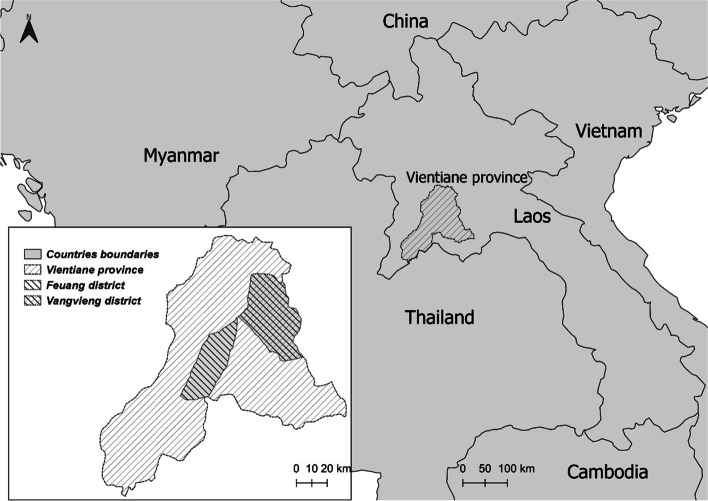
This was a follow-up study with data collected via structured interviews between September 2019 and August 2020 in Feuang (rural) and Vangvieng (urban) districts in Vientiane province, Lao PDR. We identified and invited all women attending antenatal care in their third trimester of pregnancy in the selected areas. Using a structured questionnaire at third trimester of pregnancy we captured data on knowledge regarding antibiotic use and resistance. We collected information on attitudes and reported practice at two time points: (i) at third trimester of pregnancy and (ii) 6 months after birth. Univariate analysis and frequency distributions were used to study pattern of responses. Chi-square and Mann-Whitney tests were used to compare categorical and continuous variables respectively. P value < 0.05 was considered statistically significant.
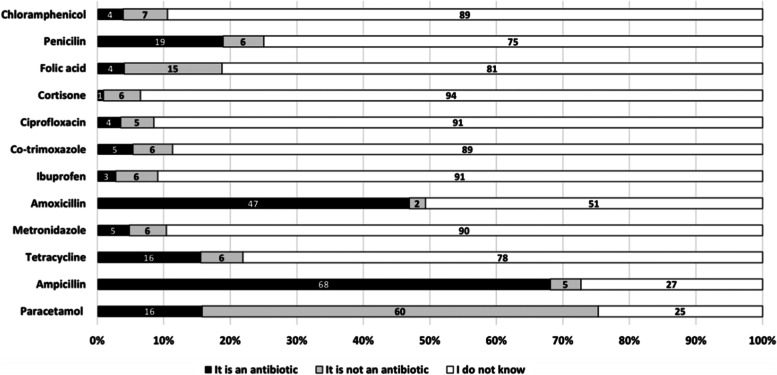
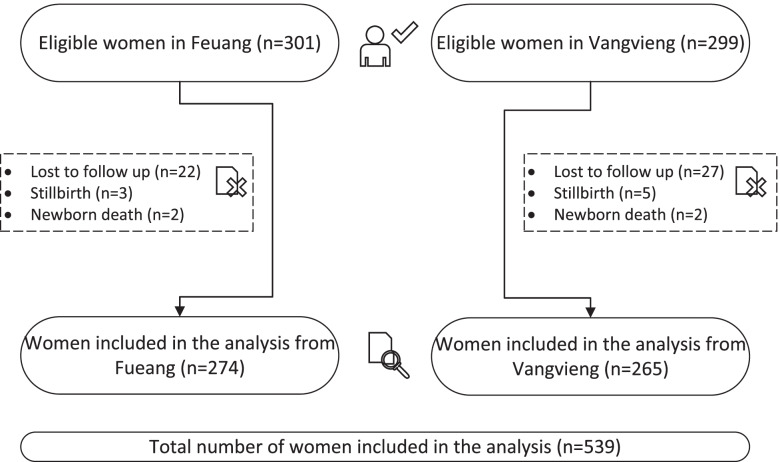
We surveyed 539 women with a mean age of 25 years. Two oral antibiotics, i) ampicillin and ii) amoxicillin were correctly identified by 68 and 47% of participants respectively. Only 24% of women (19% in Feuang and 29% in Vangvieng) answered correctly that antibiotics are effective against bacterial infections. The most prevalent response was "I don't know" suggesting the questions were challenging. Significantly less women would use antibiotics from a previous illness for their child than for themselves (16% vs 29%), however they would be more willing to use antibiotics for their baby even in case of mild symptoms (29% vs 17% while pregnant). The majority of antibiotics were prescribed by healthcare providers and 46% of children with the common cold received antibiotics.
Women's knowledge was sub-optimal, still, they manifested appropriate attitudes towards antibiotic use during pregnancy and for their child. Nearly half of children received antibiotics for the common cold. There is a need for context adapted programs aiming at improving women's knowledge, as well as healthcare providers, emphasising rational antibiotic prescribing during pregnancy and for children.
抗生素是预防母婴发病率和死亡率的重要药物。女性对抗生素使用的知识和态度影响她们的实践。当她们成为母亲时,这可能会反映在她们对新生儿使用抗生素上。本研究旨在评估孕妇对抗生素使用和抗生素耐药性的知识、态度和报告实践,以及她们对新生儿使用抗生素的方法。
这是一项后续研究,数据于 2019 年 9 月至 2020 年 8 月在老挝万象省丰安县(农村)和万荣县(城市)收集,通过在选定地区的第三次产前检查中对所有孕妇进行了问卷调查。我们在第三次产前检查时使用了一份结构式问卷,以收集有关抗生素使用和耐药性的知识。我们收集了在两个时间点的态度和报告实践信息:(i)第三次产前检查和(ii)出生后 6 个月。我们使用单变量分析和频率分布来研究反应模式。卡方检验和曼-惠特尼检验分别用于比较分类变量和连续变量。P 值<0.05 被认为具有统计学意义。
我们调查了 539 名平均年龄为 25 岁的女性。有 68%和 47%的参与者分别正确识别了两种口服抗生素,即氨苄西林和阿莫西林。只有 24%的女性(丰安县为 19%,万荣县为 29%)正确回答抗生素对细菌感染有效。最常见的回答是“我不知道”,这表明这些问题具有挑战性。明显较少的女性会将以前生病时使用的抗生素用于孩子,而不是用于自己(16%比 29%),但她们更愿意在孩子出现轻微症状时使用抗生素(29%比 17%在怀孕期间)。大多数抗生素是由医疗保健提供者开具的,46%的感冒儿童接受了抗生素治疗。
女性的知识不足,但她们在怀孕期间和为孩子使用抗生素时表现出了适当的态度。近一半的儿童因普通感冒而接受了抗生素治疗。需要制定适应国情的方案,以提高妇女的知识水平,以及医疗保健提供者,强调在怀孕期间和为儿童合理使用抗生素。