Department of Pediatrics, Graduate School of Medical Sciences, Kyushu University, Fukuoka, Japan.
Department of Pediatrics, Faculty of Medicine, Saga University, 5-1-1 Nabashima, Saga, 849-8501, Japan.
Sci Rep. 2022 Sep 12;12(1):15305. doi: 10.1038/s41598-022-19509-6.
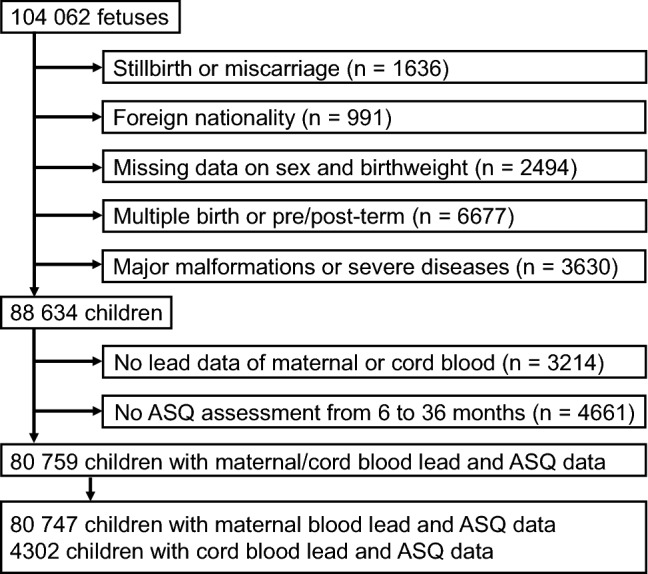
Compared with the relatively well-investigated effects of childhood exposure to lead on neurocognitive deficits, those of prenatal exposure remain relatively inconclusive. We aimed to investigate the association between prenatal blood lead levels and neurodevelopmental delay during the first three years of life. From a prospective cohort of the Japan Environment and Children's Study, we analyzed a total of 80,759 children. The exposure factors were prenatal lead concentrations measured from maternal whole blood in the second/third trimesters and umbilical cord blood at birth. Neurodevelopment was assessed at 6, 12, 18, 24, 30, and 36 months old using a screening tool, the Ages and Stages Questionnaires, third edition (ASQ). The outcome measures were any suspected neurodevelopmental delay (sNDD) identified via the ASQ during the first (sNDD-1Y), second (sNDD-2Y), and third (sNDD-3Y) years of life. sNDD-1Y, 2Y, and 3Y were identified in 18.0%, 16.2%, and 17.2% of children, respectively. The geometric means of blood lead concentration in this study were much lower (0.62 μg/dL in maternal blood and 0.50 μg/dL in cord blood) than previously investigated levels. Multivariable regression models revealed that there were no associations between maternal blood lead and sNDD-1Y and 2Y and between cord blood lead and sNDD-1Y, 2Y, and 3Y. Although a higher maternal blood lead was associated with a reduced risk of sNDD-3Y (adjusted relative risk: 0.84, 95% confidence interval 0.75-0.94, per 1 increase in common logarithm of lead concentration), there were no dose-response relationships in the analysis using quintiles of lead concentrations. Using a large-scale data set, the present study demonstrated no convincing evidence for an inverse association between levels of prenatal blood lead and neurodevelopment in early childhood. Longitudinal measurements of prenatal and postnatal lead levels are needed to understand the relationship between lead exposure and neurocognitive development.
与儿童时期暴露于铅对神经认知缺陷的研究相比,产前暴露于铅的影响仍不明确。本研究旨在探讨生命最初三年中,孕妇血铅水平与神经发育迟缓之间的关系。我们对日本环境与儿童研究的前瞻性队列研究中的 80759 名儿童进行了分析。暴露因素为孕妇在妊娠第二/三阶段和分娩时的脐血中测量的血铅浓度。使用筛查工具——《年龄与阶段问卷》(ASQ)第三版,在 6、12、18、24、30 和 36 个月时评估神经发育情况。结局指标为使用 ASQ 在生命第一年(sNDD-1Y)、第二年(sNDD-2Y)和第三年(sNDD-3Y)识别的任何疑似神经发育迟缓(sNDD)。分别有 18.0%、16.2%和 17.2%的儿童出现 sNDD-1Y、sNDD-2Y 和 sNDD-3Y。本研究中血液铅浓度的几何平均值(母亲血液中为 0.62μg/dL,脐带血中为 0.50μg/dL)远低于以往的研究水平。多变量回归模型显示,母亲血铅与 sNDD-1Y 和 2Y 之间以及脐带血铅与 sNDD-1Y、2Y 和 3Y 之间均无关联。虽然母亲血铅浓度较高与 sNDD-3Y 风险降低相关(调整后的相对风险:0.84,95%置信区间 0.75-0.94,每增加一个对数值的铅浓度增加 1),但在使用铅浓度五分位数的分析中未发现剂量反应关系。本研究使用大规模数据集,未提供令人信服的证据表明产前血铅水平与儿童早期神经发育呈负相关。需要进行纵向测量产前和产后的铅水平,以了解铅暴露与神经认知发育之间的关系。