Department of Psychology and Neuroscience, Duke University, Durham, North Carolina.
Center for Genomic and Computational Biology, Duke University, Durham, North Carolina.
JAMA Psychiatry. 2019 Apr 1;76(4):418-425. doi: 10.1001/jamapsychiatry.2018.4192.
Millions of adults now entering middle age were exposed to high levels of lead, a developmental neurotoxin, as children. Although childhood lead exposure has been linked to disrupted behavioral development, the long-term consequences for adult mental and behavioral health have not been fully characterized.
To examine whether childhood lead exposure is associated with greater psychopathology across the life course and difficult adult personality traits.
DESIGN, SETTING, AND PARTICIPANTS: This prospective cohort study was based on a population-representative birth cohort of individuals born between April 1, 1972, and March 31, 1973, in Dunedin, New Zealand, the Dunedin Multidisciplinary Health and Development Study. Members were followed up in December 2012 when they were 38 years of age. Data analysis was performed from March 14, 2018, to October 24, 2018.
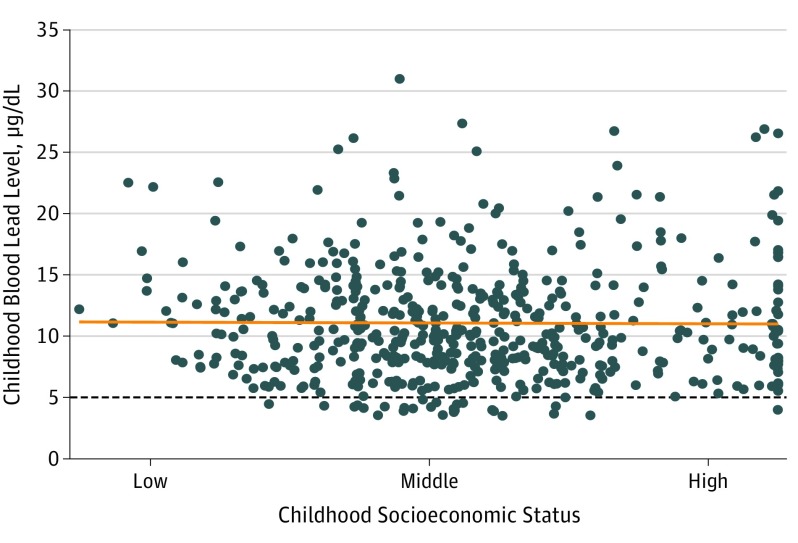
Childhood lead exposure ascertained as blood lead levels measured at 11 years of age. Blood lead levels were unrelated to family socioeconomic status.
Primary outcomes were adult mental health disorder symptoms assessed through clinical interview at 18, 21, 26, 32, and 38 years of age and transformed through confirmatory factor analysis into continuous measures of general psychopathology and internalizing, externalizing, and thought disorder symptoms (all standardized to a mean [SD] of 100 [15]) and adult personality assessed through informant report using the Big Five Personality Inventory (assessing neuroticism, extraversion, openness to experience, agreeableness, and conscientiousness) at 26, 32, and 38 years of age (all scores standardized to a mean [SD] of 0 [1]). Hypotheses were formulated after data collection; an analysis plan was posted in advance.
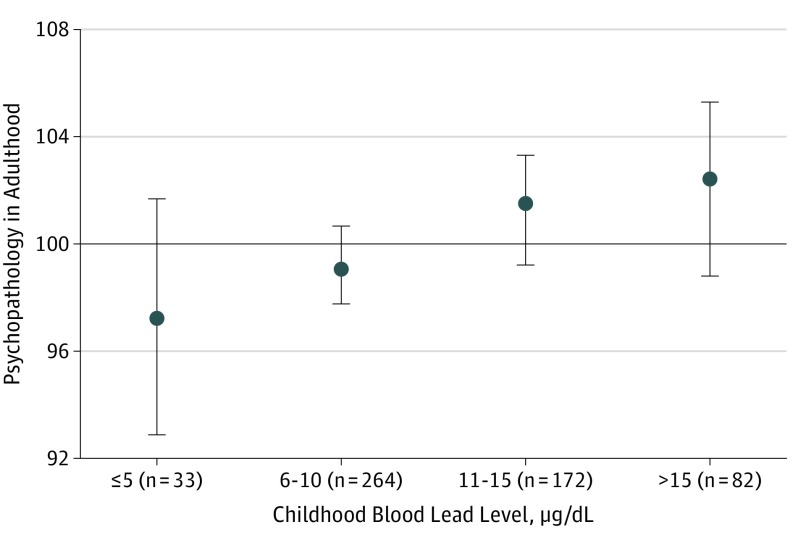
Of 1037 original study members, 579 (55.8%) were tested for lead exposure at 11 years of age (311 [53.7%] male). The mean (SD) blood lead level was 11.08 (4.96) μg/dL. After adjusting for study covariates, each 5-μg/dL increase in childhood blood lead level was associated with a 1.34-point increase (95% CI, 0.11-2.57; P = .03) in general psychopathology, driven by internalizing (b = 1.41; 95% CI, 0.19-2.62; P = .02) and thought disorder (b = 1.30; 95% CI, 0.06-2.54; P = .04) symptoms. Each 5-μg/dL increase in childhood blood lead level was also associated with a 0.10-SD increase in neuroticism (95% CI, 0.02-0.08; P = .02), a 0.09-SD decrease in agreeableness (95% CI, -0.18 to -0.01; P = .03), and a 0.14-SD decrease in conscientiousness (95% CI, -0.25 to -0.03; P = .01). There were no statistically significant associations with informant-rated extraversion (b = -0.09; 95% CI, -0.17 to 0.004; P = .06) and openness to experience (b = -0.07; 95% CI, -0.17 to 0.03; P = .15).
In this multidecade, longitudinal study of lead-exposed children, higher childhood blood lead level was associated with greater psychopathology across the life course and difficult adult personality traits. Childhood lead exposure may have long-term consequences for adult mental health and personality.
重要性:数以百万计的成年人在儿童时期接触过高水平的铅,这是一种发育性神经毒素。虽然儿童期铅暴露与行为发育障碍有关,但对成年期精神和行为健康的长期后果尚未完全确定。
目的:研究儿童期铅暴露是否与一生中更大的精神病理学和成年期困难的人格特质有关。
设计、环境和参与者:这是一项基于人群代表性的出生队列研究,参与者于 1972 年 4 月 1 日至 1973 年 3 月 31 日出生在新西兰达尼丁,达尼丁多学科健康与发展研究。1972 年 12 月对成员进行了随访,当时他们 38 岁。数据分析于 2018 年 3 月 14 日至 2018 年 10 月 24 日进行。
暴露:儿童期铅暴露是通过在 11 岁时测量的血铅水平来确定的。血铅水平与家庭社会经济地位无关。
主要结果和测量:主要结果是通过临床访谈在 18、21、26、32 和 38 岁时评估的成年心理健康障碍症状,并通过确认性因素分析转化为一般精神病理学和内化、外化和思维障碍症状的连续测量(均标准化为 100 [15]),以及通过 26、32 和 38 岁时的大五人格量表(评估神经质、外向性、开放性、宜人性和尽责性)报告的成年人格(所有分数标准化为 0 [1])。假设是在数据收集后制定的;分析计划事先公布。
结果:在 1037 名原始研究成员中,有 579 名(55.8%)在 11 岁时接受了铅暴露测试(311 名[53.7%]为男性)。平均(SD)血铅水平为 11.08(4.96)μg/dL。在调整研究协变量后,儿童期血铅水平每增加 5μg/dL,一般精神病理学评分增加 1.34 分(95%CI,0.11-2.57;P=0.03),主要是内化(b=1.41;95%CI,0.19-2.62;P=0.02)和思维障碍(b=1.30;95%CI,0.06-2.54;P=0.04)症状。儿童期血铅水平每增加 5μg/dL,神经质评分增加 0.10 个标准差(95%CI,0.02-0.08;P=0.02),宜人性评分降低 0.09 个标准差(95%CI,-0.18 至-0.01;P=0.03),尽责性评分降低 0.14 个标准差(95%CI,-0.25 至-0.03;P=0.01)。在报告者评定的外向性(b=-0.09;95%CI,-0.17 至 0.004;P=0.06)和开放性(b=-0.07;95%CI,-0.17 至 0.03;P=0.15)方面,没有统计学上显著的关联。
结论和相关性:在这项多十年的纵向研究中,接触过铅的儿童与一生中更大的精神病理学和成年期困难的人格特质有关。儿童期铅暴露可能对成年心理健康和人格有长期影响。