Department of Radiology, Okayama University Hospital, 2-5-1 Shikata-cho, Kita-ku, Okayama, 700-8558, Japan.
Department of Radiology, Faculty of Medicine, Dentistry and Pharmaceutical Sciences, Okayama University, 2-5-1 Shikata-cho, Kita-ku, Okayama, 700-8558, Japan.
Jpn J Radiol. 2022 Oct;40(10):1035-1045. doi: 10.1007/s11604-022-01335-5. Epub 2022 Sep 13.
This review aimed to summarize the treatment outcomes of percutaneous radiofrequency ablation (RFA) and microwave ablation (MWA) for metastatic liver tumors based on the findings of published studies over the last decade.
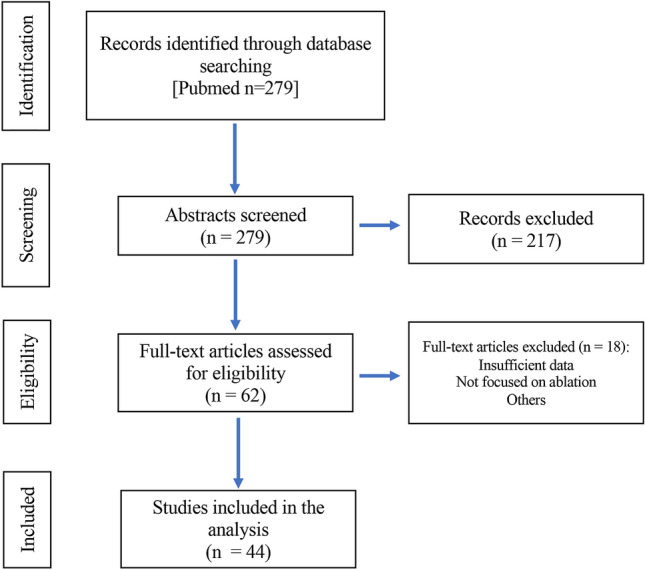
Literature describing the survival outcomes of ablation therapy for liver metastases was explored using the PubMed database on April 26, 2022, and articles published in 2012 or later were selected. The included studies met the following criteria: (i) English literature, (ii) original clinical studies, and (iii) literature describing overall survival (OS) of thermal ablation for metastatic liver tumors. All case reports and cohort studies with fewer than 20 patients and those that evaluated ablation for palliative purposes were excluded.
RFA was the most commonly used method for ablation, while MWA was used in several recent studies. RFA and MWA for liver metastases from various primary tumors have been reported; however, majority of the studies focused on colorectal cancer. The local control rate by RFA and MWA varied widely among the studies, ranging approximately 50-90%. Five-year survival rates of 20-60% have been reported following ablation for colorectal liver metastases by a number of studies, and several reports of 10-year survival rates were also noted.
Comparative studies of local therapies for colorectal liver metastases demonstrated that RFA provides comparable survival outcomes to surgical metastasectomy and stereotactic body radiation therapy.
本综述旨在总结过去十年发表的研究中经皮射频消融(RFA)和微波消融(MWA)治疗转移性肝肿瘤的治疗结果。
2022 年 4 月 26 日,我们利用 PubMed 数据库对描述消融治疗肝转移瘤生存结果的文献进行了检索,并选择了 2012 年或之后发表的文章。纳入的研究符合以下标准:(i)英文文献,(ii)原始临床研究,以及(iii)描述热消融治疗转移性肝肿瘤总生存(OS)的文献。所有少于 20 例患者的病例报告和队列研究,以及评估为姑息性消融的研究均被排除在外。
RFA 是最常用的消融方法,而 MWA 在最近的几项研究中也有应用。RFA 和 MWA 已被用于治疗来自各种原发肿瘤的肝转移瘤,但大多数研究都集中在结直肠癌上。RFA 和 MWA 治疗肝转移瘤的局部控制率在不同的研究中差异很大,约为 50-90%。多项研究报道了 RFA 治疗结直肠癌肝转移的 5 年生存率为 20-60%,也有一些研究报道了 10 年生存率。
针对结直肠癌肝转移的局部治疗的对比研究表明,RFA 提供了与手术转移瘤切除术和立体定向体放射治疗相当的生存结果。