Department of Chemistry, Saint Louis University, St. Louis, MO, USA.
Department of Biochemistry, University of Missouri, Columbia, MO, USA.
Nat Chem Biol. 2022 Nov;18(11):1263-1269. doi: 10.1038/s41589-022-01121-4. Epub 2022 Sep 12.
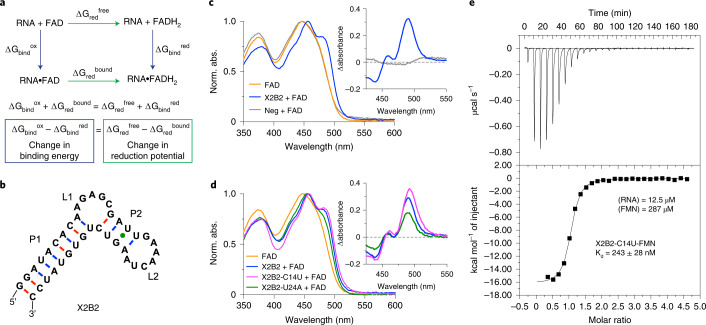
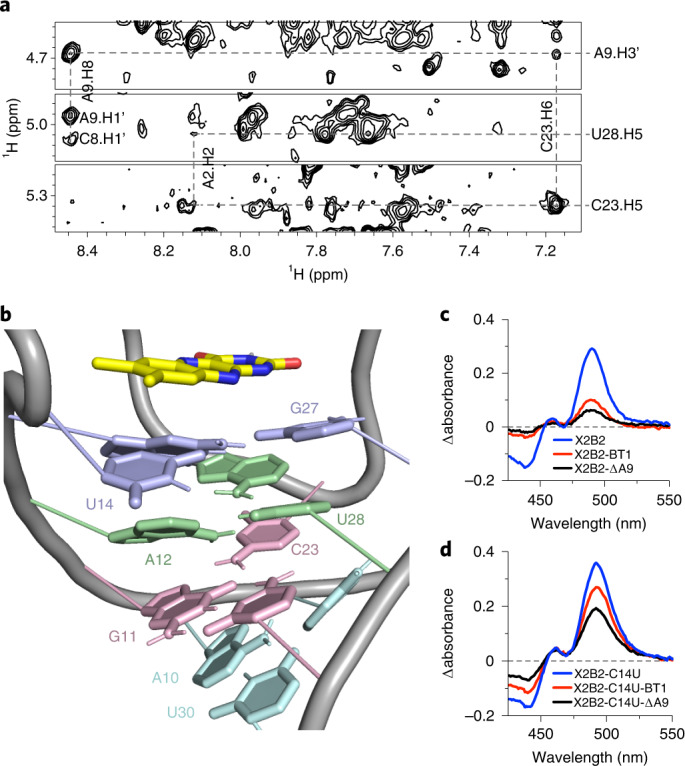
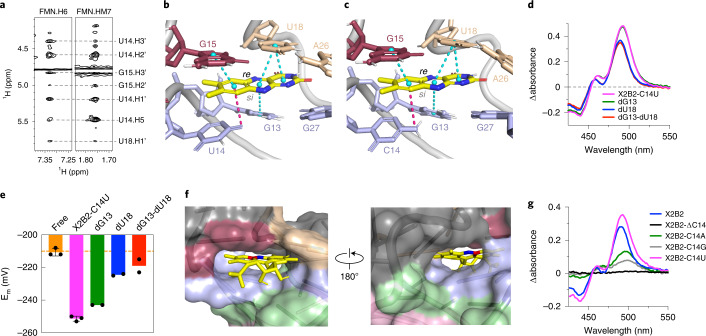
The discovery of ribozymes has inspired exploration of RNA's potential to serve as primordial catalysts in a hypothesized RNA world. Modern oxidoreductase enzymes employ differential binding between reduced and oxidized forms of redox cofactors to alter cofactor reduction potential and enhance the enzyme's catalytic capabilities. The utility of differential affinity has been underexplored as a chemical strategy for RNA. Here we show an RNA aptamer that preferentially binds oxidized forms of flavin over reduced forms and markedly shifts flavin reduction potential by -40 mV, similar to shifts for oxidoreductases. Nuclear magnetic resonance structural analysis revealed π-π and donor atom-π interactions between the aptamer and flavin that cause unfavorable contacts with the electron-rich reduced form, suggesting a mechanism by which the local environment of the RNA-binding pocket drives the observed shift in cofactor reduction potential. It seems likely that primordial RNAs could have used similar strategies in RNA world metabolisms.
核酶的发现激发了人们对 RNA 作为假定的 RNA 世界中原始催化剂的潜力的探索。现代氧化还原酶通过在还原和氧化形式的氧化还原辅因子之间的差异结合来改变辅因子还原电势并增强酶的催化能力。作为 RNA 的化学策略,差异亲和力的用途尚未得到充分探索。在这里,我们展示了一个 RNA 适体,它优先结合黄素的氧化形式而不是还原形式,并且将黄素还原电势明显降低 40mV,类似于氧化还原酶的变化。核磁共振结构分析显示,适体与黄素之间存在 π-π 和供体原子-π 相互作用,导致与富电子的还原形式产生不利接触,这表明 RNA 结合口袋的局部环境驱动了观察到的辅因子还原电势的变化的机制。原始 RNA 很可能在 RNA 世界的新陈代谢中使用了类似的策略。