Horak Sven, Suseno Yuliani
St. John's University, The Peter J. Tobin College of Business, Bent Hall, Queens, USA.
School of Management, College of Business and Law, RMIT University, Melbourne, VIC 3000 Australia.
J Bus Ethics. 2022 Sep 8:1-23. doi: 10.1007/s10551-022-05244-5.
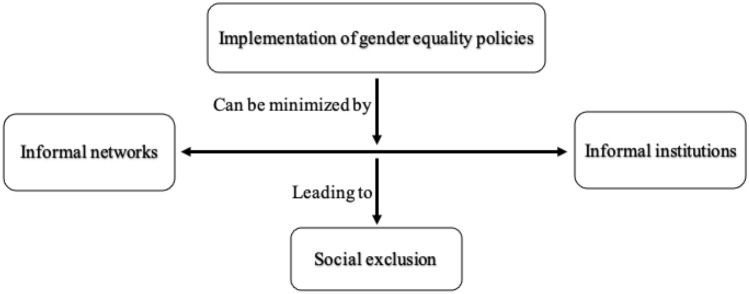
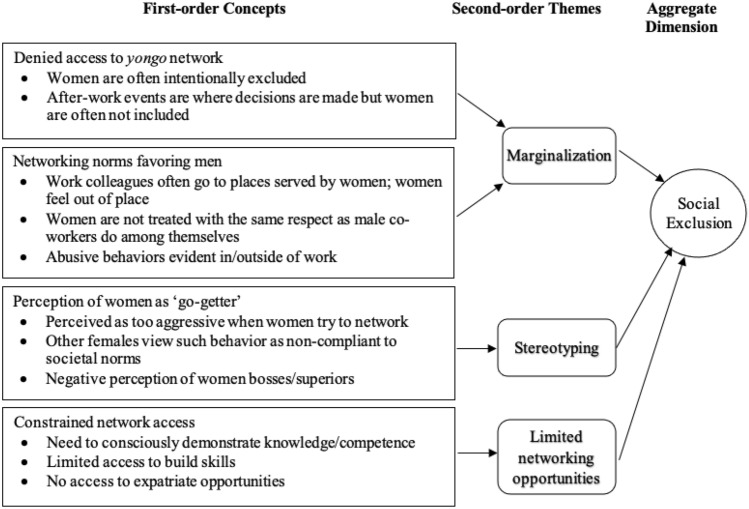
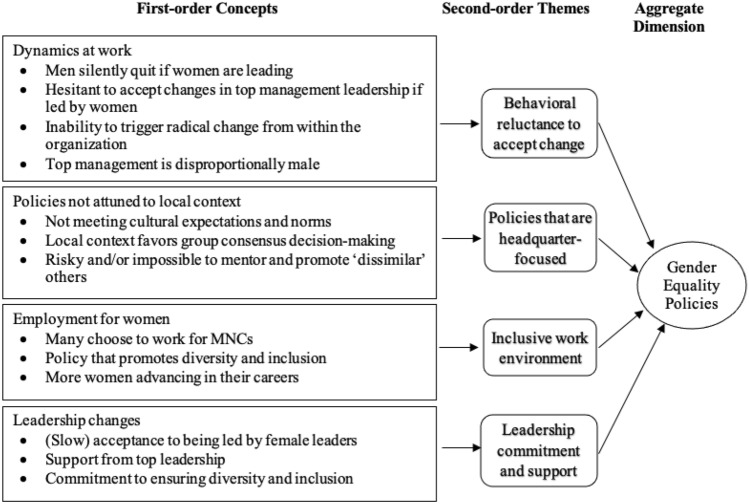
Drawing on interviews with decision makers in multinational corporations (MNCs) in South Korea, we examine the role of informal networks in the social exclusion of women in the workforce. Although legislation in the country is in favor of gender equality, we found that informal barriers in the workplace remain difficult to overcome. Informal networks in Korea, , present an ethical issue in the workplace, as they tend to socially exclude women, limiting possibilities for their participation and career progression. We found that informal networks are pervasive and strong because of the informal institutions in which they are embedded and that there is a complex interplay between informal networks and informal institutions that socially excludes women. Due to difficulties accessing , women appear to build , a network type that is more open and accessible. We also found that MNCs in Korea can compensate for the lack of local informal networks for their female employees. However, despite providing a more supportive environment for women at work, gender equality policies in MNCs are not yet as effective as they could be due to the dynamics of the workplace and the fact that the policies are not tailored to the local context. We have seen evidence in recent years that MNCs can serve as role models for implementing gender equality policies by creating a more inclusive work environment and demonstrating leadership commitment and support.
通过对韩国跨国公司(MNCs)决策者的访谈,我们研究了非正式网络在劳动力市场中女性社会排斥问题上所起的作用。尽管该国的立法支持性别平等,但我们发现职场中的非正式障碍仍然难以克服。韩国的非正式网络在职场中引发了一个道德问题,因为它们往往在社会层面排斥女性,限制了她们参与和职业发展的可能性。我们发现,由于其所嵌入的非正式制度,非正式网络普遍且强大,并且在社会层面排斥女性的非正式网络和非正式制度之间存在复杂的相互作用。由于难以融入(原文此处accessing后内容缺失),女性似乎构建了一种更开放、更容易融入的网络类型。我们还发现,韩国的跨国公司可以弥补其女性员工缺乏本地非正式网络的问题。然而,尽管跨国公司在工作中为女性提供了更有利的环境,但由于职场的动态变化以及这些政策并非针对当地情况制定,其性别平等政策尚未达到应有的效果。近年来,我们看到有证据表明,跨国公司可以通过营造更具包容性的工作环境以及展现领导承诺与支持,成为实施性别平等政策的榜样。