MRC Laboratory of Molecular Biologygrid.42475.30, Protein and Nucleic Acid Division, Cambridge, United Kingdom.
mBio. 2022 Oct 26;13(5):e0234622. doi: 10.1128/mbio.02346-22. Epub 2022 Sep 13.
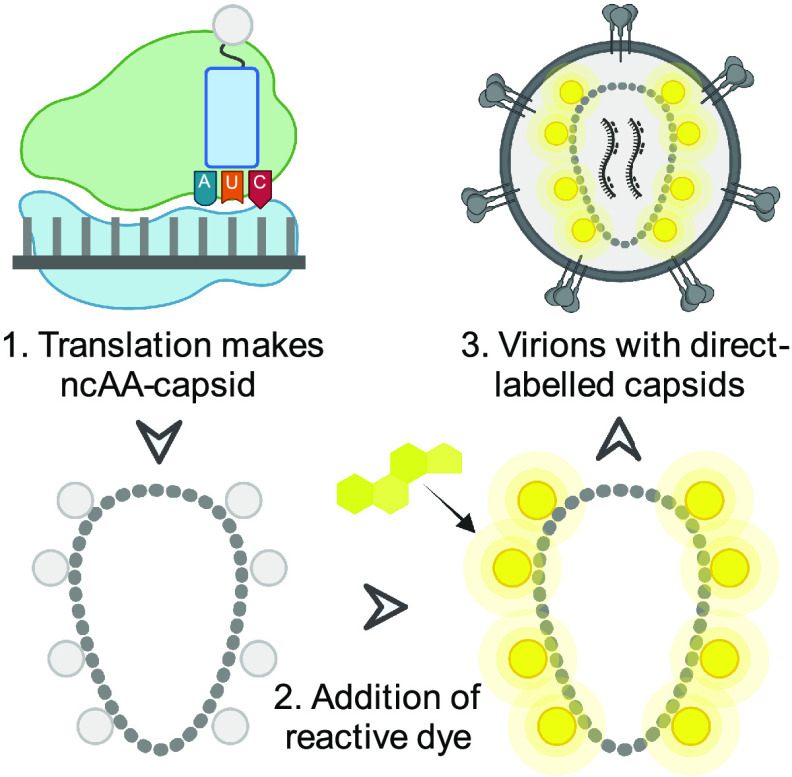
Microscopy is one of the few techniques that can directly observe the HIV-1 capsid as it traverses the cell. However, an extrinsic or intrinsic label is needed to facilitate detection and this can perturb capsid behavior. Now, S. Schifferdecker, V. Zila, T. G. Muller, V. Sakin, et al. (mBio:e0195922, 2022, https://journals.asm.org/doi/10.1128/mbio.01959-22) have developed an ingenious direct labeling technology that uses genetic code expansion and click chemistry to produce infectious viruses whose capsids are labeled with only a single modified amino acid. Using this new system, together with electron tomography, the authors demonstrate that the capsid remains intact during its transport into the nucleus of T cells, supporting a late model of uncoating immediately before integration. Combining direct-labeled capsids with fluorescent nonstructural viral proteins or host cofactors promises to be hugely enabling for future studies. Moreover, the potential to install a bio-orthogonal label site specifically in the capsid is likely to have exciting applications beyond imaging.
显微镜是少数几种可以直接观察 HIV-1 衣壳在细胞中穿行的技术之一。然而,需要外在或内在的标记物来促进检测,这可能会改变衣壳的行为。现在,S. Schifferdecker、V. Zila、T. G. Muller、V. Sakin 等人(mBio:e0195922,2022,https://journals.asm.org/doi/10.1128/mbio.01959-22)开发了一种巧妙的直接标记技术,该技术利用遗传密码扩展和点击化学,产生感染性病毒,其衣壳仅被单一修饰氨基酸标记。利用这个新系统,结合电子断层摄影术,作者证明衣壳在其运输到 T 细胞的细胞核的过程中保持完整,支持在整合之前立即进行晚期脱壳模型。将直接标记的衣壳与荧光非结构病毒蛋白或宿主辅助因子结合,有望为未来的研究提供巨大的支持。此外,在衣壳中特异性安装生物正交标记物的潜力可能会在成像之外带来令人兴奋的应用。