Plant Sciences (IBG-2), Forschungszentrum Jülich GmbH, D-52425 Jülich, Germany.
Department of Biological Sciences, Macquarie University, North Ryde, NSW, 2109 Australia.
Plant Physiol. 2022 Nov 28;190(4):2279-2294. doi: 10.1093/plphys/kiac422.
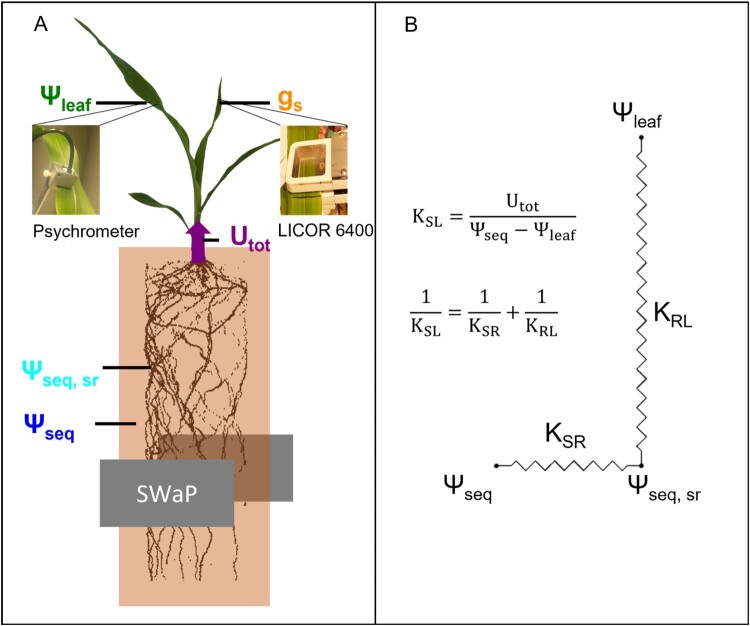
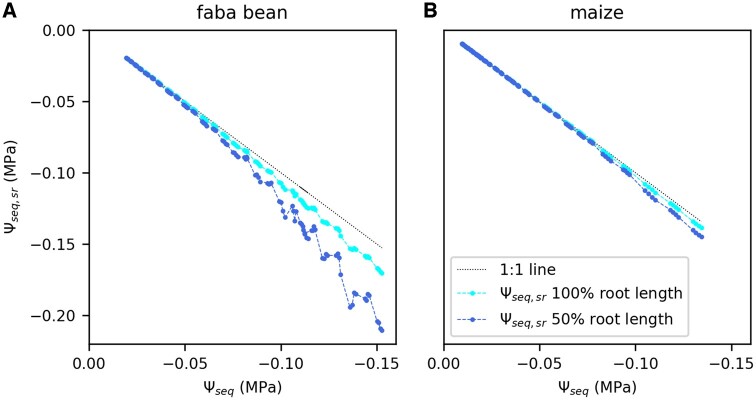
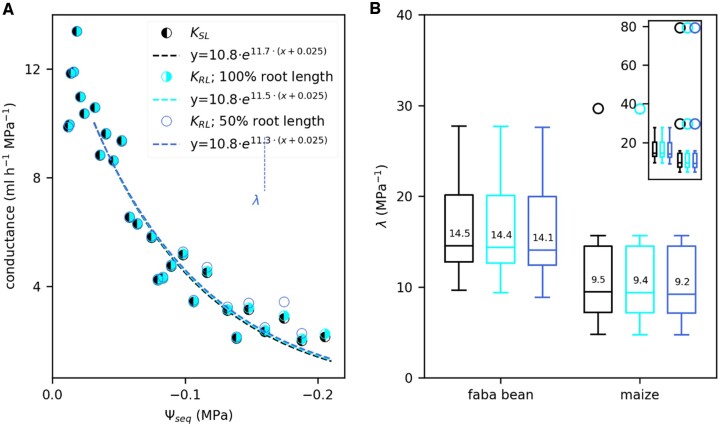
Although regulation of stomatal conductance is widely assumed to be the most important plant response to soil drying, the picture is incomplete when hydraulic conductance from soil to the leaf, upstream of the stomata, is not considered. Here, we investigated to what extent soil drying reduces the conductance between soil and leaf, whether this reduction differs between species, how it affects stomatal regulation, and where in the hydraulic pathway it occurs. To this end, we noninvasively and continuously measured the total root water uptake rate, soil water potential, leaf water potential, and stomatal conductance of 4-week-old, pot-grown maize (Zea mays) and faba bean (Vicia faba) plants during 4 days of water restriction. In both species, the soil-plant conductance, excluding stomatal conductance, declined exponentially with soil drying and was reduced to 50% above a soil water potential of -0.1 MPa, which is far from the permanent wilting point. This loss of conductance has immediate consequences for leaf water potential and the associated stomatal regulation. Both stomatal conductance and soil-plant conductance declined at a higher rate in faba bean than in maize. Estimations of the water potential at the root surface and an incomplete recovery 22 h after rewatering indicate that the loss of conductance, at least partly, occurred inside the plants, for example, through root suberization or altered aquaporin gene expression. Our findings suggest that differences in the stomatal sensitivity among plant species are partly explained by the sensitivity of root hydraulic conductance to soil drying.
尽管人们普遍认为气孔导度的调节是植物对土壤干燥的最重要响应,但如果不考虑从土壤到叶片(气孔上游)的水力传导率,那么情况就不完整了。在这里,我们研究了土壤干燥在多大程度上降低了土壤与叶片之间的传导率,这种降低在不同物种之间是否存在差异,它如何影响气孔调节,以及它发生在水力途径的哪个部位。为此,我们在 4 天的水分限制期间,非侵入性地连续测量了 4 周龄盆栽玉米(Zea mays)和蚕豆(Vicia faba)植株的总根水吸收速率、土壤水势、叶片水势和气孔导度。在这两个物种中,不包括气孔导度的土壤-植物导度随土壤干燥呈指数下降,并在土壤水势低于-0.1 MPa 时减少到 50%,这远低于永久萎蔫点。这种导力的丧失对叶片水势和相关的气孔调节有直接影响。蚕豆的气孔导度和土壤-植物导度下降速度都高于玉米。对根表面水势的估计和重新浇水 22 小时后的不完全恢复表明,导力的丧失至少部分发生在植物内部,例如,通过根栓化或改变水通道蛋白基因表达。我们的研究结果表明,植物物种间气孔敏感性的差异部分可以通过根系水力传导率对土壤干燥的敏感性来解释。