College of Health Medicine and Wellbeing, The University of Newcastle, Callaghan, NSW, Australia.
Hunter Medical Research Institute, New Lambton Heights, NSW, Australia.
Int J Equity Health. 2022 Sep 13;21(1):134. doi: 10.1186/s12939-022-01738-w.
Indigenous academics have advocated for the use and validity of Indigenous methodologies and methods to centre Indigenous ways of knowing, being and doing in research. Yarning is the most reported Indigenous method used in Aboriginal and Torres Strait Islander qualitative health research. Despite this, there has been no critical analysis of how Yarning methods are applied to research conduct and particularly how they privilege Indigenous peoples.
To investigate how researchers are applying Yarning method to health research and examine the role of Aboriginal and Torres Strait Islander researchers in the Yarning process as reported in health publications.
Narrative review of qualitative studies.
Lowitja Institute LitSearch January 2008 to December 2021 to access all literature reporting on Aboriginal and Torres Strait Islander health research in the PubMed database. A subset of extracted data was used for this review to focus on qualitative publications that reported using Yarning methods.
Thematic analysis was conducted using hybrid of inductive and deductive coding. Initial analysis involved independent coding by two authors, with checking by a third member. Once codes were developed and agreed, the remaining publications were coded and checked by a third team member.
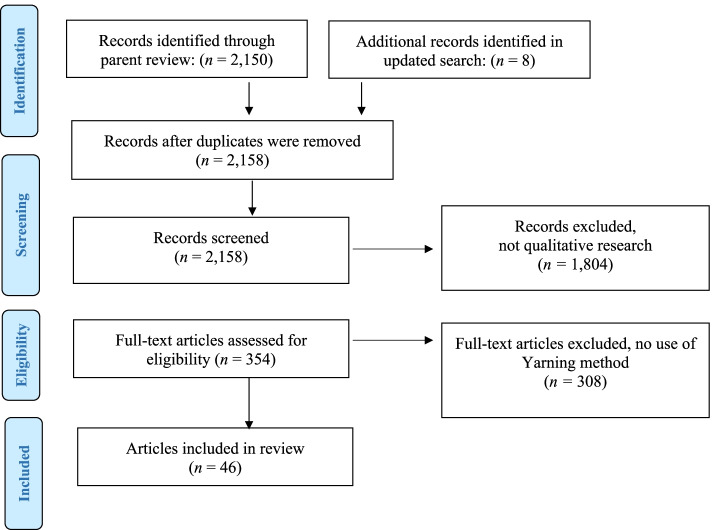
Forty-six publications were included for review. Yarning was considered a culturally safe data collection process that privileges Indigenous knowledge systems. Details of the Yarning processes and team positioning were vague. Some publications offered a more comprehensive description of the research team, positioning and demonstrated reflexive practice. Training and experience in both qualitative and Indigenous methods were often not reported. Only 11 publications reported being Aboriginal and/or Torres Strait Islander led. Half the publications reported Aboriginal and Torres Strait Islander involvement in data collection, and 24 reported involvement in analysis. Details regarding the role and involvement of study reference or advisory groups were limited.
Aboriginal and Torres Strait Islander people should be at the forefront of Indigenous research. While Yarning method has been identified as a legitimate research method to decolonising research practice, it must be followed and reported accurately. Researcher reflexivity and positioning, and Aboriginal and Torres Strait Islander ownership, stewardship and custodianship of data collected were significantly under detailed in the publications included in our review. Journals and other establishments should review their processes to ensure necessary details are reported in publications and engage Indigenous Editors and peer reviewers to uphold respectful, reciprocal, responsible and ethical research practice.
本土学者提倡使用和验证本土方法,以将本土的认知、存在和行动方式置于研究的中心。在澳大利亚原住民和托雷斯海峡岛民的定性健康研究中,“Yarning”是最常被报道的本土方法。尽管如此,对于“Yarning”方法如何应用于研究以及它们如何使原住民受益,还没有进行批判性分析。
调查研究人员如何将“Yarning”方法应用于健康研究,并研究在健康出版物中报告的土著和托雷斯海峡岛民研究人员在“Yarning”过程中的作用。
定性研究的叙述性综述。
利用 Lowitja 研究所的 LitSearch,从 2008 年 1 月至 2021 年 12 月,在 PubMed 数据库中检索所有报告澳大利亚原住民和托雷斯海峡岛民健康研究的文献。从提取的数据中选取了一部分进行本综述,重点关注报告使用“Yarning”方法的定性出版物。
使用归纳和演绎相结合的主题分析。最初的分析由两位作者独立进行,然后由第三位成员进行检查。一旦制定并达成了代码,其余的出版物就由第三位团队成员进行编码和检查。
共纳入 46 篇出版物进行综述。“Yarning”被认为是一种文化安全的数据收集过程,它使本土知识系统具有优先权。有关“Yarning”过程和团队定位的细节很模糊。一些出版物更全面地描述了研究团队的定位,并展示了反思性实践。在定性和本土方法方面的培训和经验往往没有报告。只有 11 篇出版物报告了由土著人领导。有一半的出版物报告了澳大利亚原住民和/或托雷斯海峡岛民在数据收集方面的参与,有 24 篇报告了在分析方面的参与。有关研究参考或咨询小组的角色和参与的细节有限。
澳大利亚原住民和托雷斯海峡岛民应该成为本土研究的前沿。虽然“Yarning”方法已被确定为使研究实践非殖民化的合法研究方法,但必须准确遵循和报告该方法。研究人员的反思和定位,以及澳大利亚原住民和托雷斯海峡岛民对所收集数据的所有权、管理和保管,在我们综述中包括的出版物中没有得到详细说明。期刊和其他机构应审查其流程,以确保在出版物中报告必要的详细信息,并聘请土著编辑和同行评审员来维护尊重、互惠、负责和符合道德的研究实践。