Cuenca-Zaldivar Juan Nicolás, Monroy Acevedo Álvaro, Fernández-Carnero Josué, Sánchez-Romero Eleuterio A, Villafañe Jorge Hugo, Barragán Carballar Carlos
Research Group in Nursing and Health Care, Puerta de Hierro Health Research Institute-Segovia de Arana (IDIPHISA), 28222 Majadahonda, Spain.
Rehabilitation Service, Guadarrama Hospital, 28440 Madrid, Spain.
Biology (Basel). 2022 Jul 20;11(7):1084. doi: 10.3390/biology11071084.
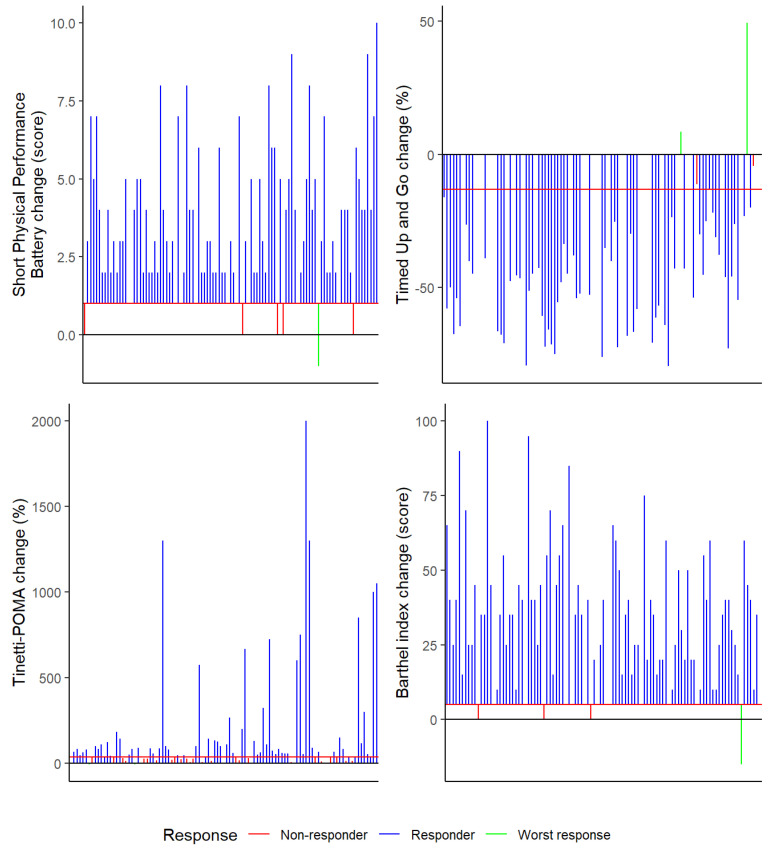
Background: Older adult patients with post-COVID-19 syndrome present greater physical impairment accompanied by frailty than younger patients, which is why multicomponent exercise programs (MEP) are recommended for their positive effects on improving frailty and physical capacity. The aim of this study was to evaluate the effects of a short MEP (Vivifrail; <4 weeks) on improving frailty in post-COVID-19 older adults after intensive care units. Methods: To develop a retrospective cohort study, data were collected from the functional gait training program based on selected Vivifrail MEP in a single-group and applied to patients admitted with a diagnosis of post-COVID-19 functional impairment. The MEP was carried out for 3 weeks, with daily sessions lasting 40 min. Patients included were assessed at the beginning and at the end of the protocol by using the Short Performance Physical Battery (SPPB), the number of falls in the last year, the number of falls with medical attention, the Timed Up and Go (TUG) test, the presence of dementia, the Trunk Control Test (TCT), the Tinetti balance and gait test, Barthel Index, Medical Research Council Sum Score (MRCSS) and handgrip strength dynamometry. Results: The results of this study show statistically significant improvements in physical fitness and frailty with increases in the Short Physical Performance Battery (Z = 9.12, p < 0.001) by means of the MET applied in its short version (<4 weeks) showing even clinically relevant improvements (>2.5 points). Statistically significant improvements were also found in Medical Research Council Sum Score (Z = 12.345, p < 0.001), Barthel Index Score (Z = 12.272, p < 0.001), Trunk Control Test (Z = 12. 36, p < 0.001), Tinetti−POMA (Z = 12.293, p < 0.001) including the balance (Z = 12.11, p < 0.001), gait (Z = 12.164, p < 0.001) subscales and in the hand dynamometry (Z = 12.172, p < 0.001). Conclusions: The selected Vivifrail MEP is effective and safe for improving frailty in post-COVID-19 older adult’s patients.
与年轻患者相比,患有新冠后综合征的老年患者身体损伤更严重,且伴有虚弱,这就是为什么推荐多组分运动计划(MEP),因为其对改善虚弱和身体能力有积极作用。本研究的目的是评估短期MEP(Vivifrail;<4周)对改善新冠后老年重症监护病房患者虚弱状况的效果。方法:开展一项回顾性队列研究,从基于选定的Vivifrail MEP的功能步态训练计划中收集数据,该计划应用于诊断为新冠后功能障碍的患者。MEP持续3周,每天训练40分钟。纳入的患者在方案开始和结束时通过使用简易体能状况量表(SPPB)、过去一年的跌倒次数、需要就医的跌倒次数、定时起立行走测试(TUG)、痴呆症的存在情况、躯干控制测试(TCT)、Tinetti平衡和步态测试、巴氏指数、医学研究委员会总分(MRCSS)和握力测力计进行评估。结果:本研究结果显示,通过应用短期版本(<4周)的代谢当量(MET),简易体能状况量表得分增加(Z = 9.12,p < 0.001),在身体素质和虚弱状况方面有统计学显著改善,甚至显示出临床相关改善(>2.5分)。医学研究委员会总分(Z = 12.345,p < 0.001)、巴氏指数评分(Z = 12.272,p < 0.001)、躯干控制测试(Z = 12. 36,p < 0.001)、Tinetti - POMA(Z = 12.293,p < 0.001),包括平衡(Z = 12.11,p < 0.001)、步态(Z = 12.164,p < 0.001)子量表以及握力测试(Z = 12.172,p < 0.001)也有统计学显著改善。结论:选定的Vivifrail MEP对改善新冠后老年患者的虚弱状况有效且安全。