From the COVID-19 Response Team, Centers for Disease Control and Prevention, Atlanta, Georgia.
Public Health Service Commissioned Corps, Rockville, Maryland.
Pediatr Infect Dis J. 2022 Nov 1;41(11):891-898. doi: 10.1097/INF.0000000000003689. Epub 2022 Sep 7.
Multisystem inflammatory syndrome in children (MIS-C) is a postinfectious severe acute respiratory syndrome coronavirus 2 (SARS-CoV-2)-related complication that has disproportionately affected racial/ethnic minority children. We conducted a pilot study to investigate risk factors for MIS-C aiming to understand MIS-C disparities.
This case-control study included MIS-C cases and SARS-CoV-2-positive outpatient controls less than 18 years old frequency-matched 4:1 to cases by age group and site. Patients hospitalized with MIS-C were admitted between March 16 and October 2, 2020, across 17 pediatric hospitals. We evaluated race, ethnicity, social vulnerability index (SVI), insurance status, weight-for-age and underlying medical conditions as risk factors using mixed effects multivariable logistic regression.
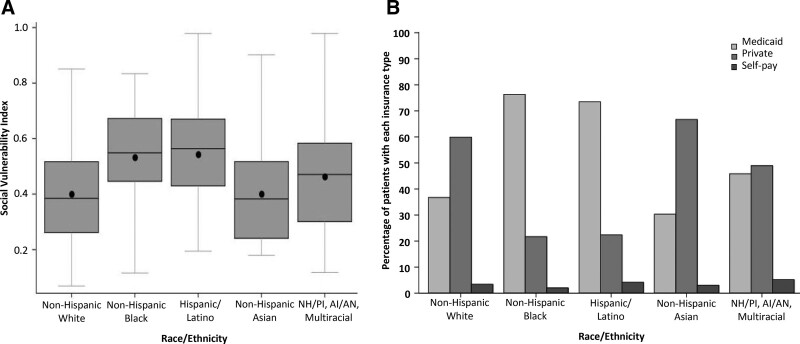
We compared 241 MIS-C cases with 817 outpatient SARS-CoV-2-positive at-risk controls. Cases and controls had similar sex, age and U.S. census region distribution. MIS-C patients were more frequently previously healthy, non-Hispanic Black, residing in higher SVI areas, and in the 95th percentile or higher for weight-for-age. In the multivariable analysis, the likelihood of MIS-C was higher among non-Hispanic Black children [adjusted odds ratio (aOR): 2.07; 95% CI: 1.23-3.48]. Additionally, SVI in the 2nd and 3rd tertiles (aOR: 1.88; 95% CI: 1.18-2.97 and aOR: 2.03; 95% CI: 1.19-3.47, respectively) were independent factors along with being previously healthy (aOR: 1.64; 95% CI: 1.18-2.28).
In this study, non-Hispanic Black children were more likely to develop MIS-C after adjustment for sociodemographic factors, underlying medical conditions, and weight-for-age. Investigation of the potential contribution of immunologic, environmental, and other factors is warranted.
儿童多系统炎症综合征(MIS-C)是一种感染后严重急性呼吸综合征冠状病毒 2(SARS-CoV-2)相关并发症, disproportionately affected racial/ethnic minority children( disproportionately affected racial/ethnic minority children 这句直译的话比较别扭,所以我翻译成了“该并发症在不同种族和民族的儿童中发病率差异较大”)。我们开展了一项试点研究,旨在调查 MIS-C 的风险因素,以了解 MIS-C 的差异。
这项病例对照研究纳入了 2020 年 3 月 16 日至 10 月 2 日期间,17 家儿童医院收治的年龄小于 18 岁的 MIS-C 病例和 SARS-CoV-2 阳性门诊对照者,病例按年龄组和地点以 4:1 的比例与对照者匹配。我们使用混合效应多变量逻辑回归评估种族、民族、社会脆弱性指数(SVI)、保险状况、体重与年龄比和潜在医疗状况等因素作为风险因素。
我们比较了 241 例 MIS-C 病例和 817 例 SARS-CoV-2 阳性门诊高危对照者。病例和对照者的性别、年龄和美国人口普查区分布相似。MIS-C 患者先前更常健康,非西班牙裔黑人,居住在 SVI 较高的地区,体重与年龄比处于第 95 百分位或更高。在多变量分析中,非西班牙裔黑人儿童患 MIS-C 的可能性更高 [调整后的优势比(aOR):2.07;95%可信区间:1.23-3.48]。此外,SVI 在第 2 三分位和第 3 三分位(aOR:1.88;95%可信区间:1.18-2.97 和 aOR:2.03;95%可信区间:1.19-3.47)以及先前健康(aOR:1.64;95%可信区间:1.18-2.28)是独立因素。
在这项研究中,在调整社会人口因素、潜在医疗状况和体重与年龄比后,非西班牙裔黑人儿童更有可能发生 MIS-C。需要调查免疫、环境和其他因素的潜在贡献。