The Jockey Club School of Public Health and Primary Care, Faculty of Medicine, The Chinese University of Hong Kong, Hong Kong, China.
Stanley Ho Centre for Emerging Infectious Diseases, The Chinese University of Hong Kong, Hong Kong, China.
PLoS One. 2022 Sep 14;17(9):e0274498. doi: 10.1371/journal.pone.0274498. eCollection 2022.
To assess impacts of early detection and prompt antiretroviral therapy (ART) on the latest epidemiologic situation to inform intervention strategy.
We analysed data from two clinical cohorts in Hong Kong where sexual transmission accounted for the majority of HIV infections. The two cohorts comprised patients newly diagnosed in 2007-2008 and 2016-2018 respectively. Secular trend and differences between men who have sex with men (MSM) and heterosexual patients were examined. Predictors of late presentation (defined as CD4 ≤350 or AIDS-defining illness within 3 months of diagnosis) and prolonged interval between diagnosis and ART initiation were assessed by multivariable regressions.
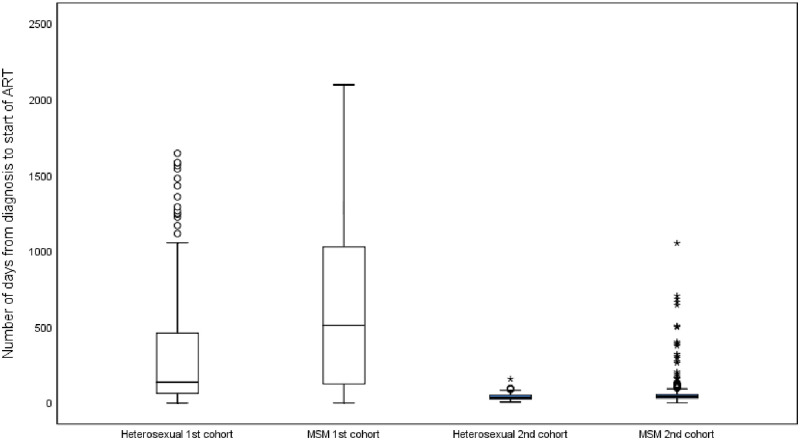
There were 1,136 newly diagnosed HIV patients with 644 in the first and 492 in the second cohort, a majority (91.7%) presented with sexually acquired infection. There were less MSM in the first than the second cohort (50.3%% vs 87.8%, χ2 = 117.05, p<0.001). The mean (SD) number of days between diagnosis and ART initiation decreased from 514.3 (516.1) to 61.8 (94.2) days across the two cohorts. Younger age, non-Chinese, outpatient-based service and lower CD4 count were predictors of faster ART initiation in the first but not in the second cohort. Interval between diagnosis and ART initiation became highly uniform among groups in the second cohort. Nearly 60% were classified as late presenters in both cohorts. Heterosexuals (aOR 1.58, 95% CI 1.13-2.19) had a higher risk of late presentation.
There was remarkable improvement in acceleration of ART initiation. Clinical implementation of accelerated ART recommendations has been effective for both MSM and heterosexuals. Late presentation was more marked among heterosexuals and remained a problem. The continued phenomenon of late presentation could offset the epidemiologic gains from accelerated ART initiation.
评估早期发现和及时抗逆转录病毒治疗(ART)对最新流行病学情况的影响,为干预策略提供信息。
我们分析了香港两个临床队列的数据,其中性传播是 HIV 感染的主要途径。这两个队列分别由 2007-2008 年和 2016-2018 年新诊断的患者组成。研究了男男性行为者(MSM)和异性恋患者之间的趋势差异。通过多变量回归评估了晚期就诊(定义为诊断后 3 个月内 CD4 ≤350 或出现艾滋病定义性疾病)和诊断与开始 ART 之间时间延长的预测因素。
共有 1136 例新诊断的 HIV 患者,第一队列中有 644 例,第二队列中有 492 例,大多数(91.7%)为性获得性感染。第一队列中的 MSM 比例低于第二队列(50.3%比 87.8%,χ2=117.05,p<0.001)。两个队列中,诊断与开始 ART 之间的平均(SD)天数从 514.3(516.1)天减少到 61.8(94.2)天。在第一队列中,年龄较小、非中国人、门诊服务和较低的 CD4 计数是更快开始 ART 的预测因素,但在第二队列中并非如此。在第二队列中,各组之间的诊断与开始 ART 之间的时间间隔变得非常一致。两个队列中近 60%的患者被归类为晚期就诊者。异性恋者(aOR 1.58,95%CI 1.13-2.19)晚期就诊的风险更高。
ART 启动的加速有显著改善。加速 ART 建议的临床实施对 MSM 和异性恋者都有效。异性恋者的晚期就诊更为明显,仍是一个问题。继续出现晚期就诊的现象可能会抵消加速 ART 启动带来的流行病学获益。