Chen Jiadong, Chen Chunhong, Qin Minkai, Li Ben, Lin Binbin, Mao Qing, Yang Hongbin, Liu Bin, Wang Yong
Advanced Materials and Catalysis Group, Center of Chemistry for Frontier Technologies, State Key Laboratory of Clean Energy Utilization, Institute of Catalysis, Department of Chemistry, Zhejiang University, Hangzhou, 310028, PR China.
School of Chemical and Biomedical Engineering, Nanyang Technological University, Singapore, 637459, Singapore.
Nat Commun. 2022 Sep 14;13(1):5382. doi: 10.1038/s41467-022-33007-3.
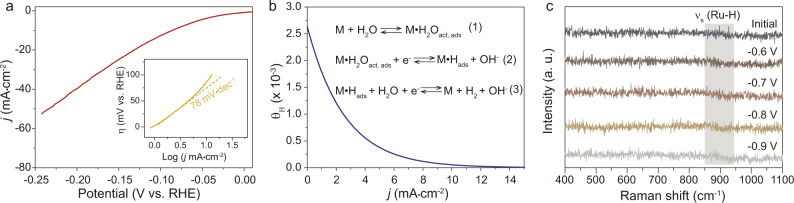
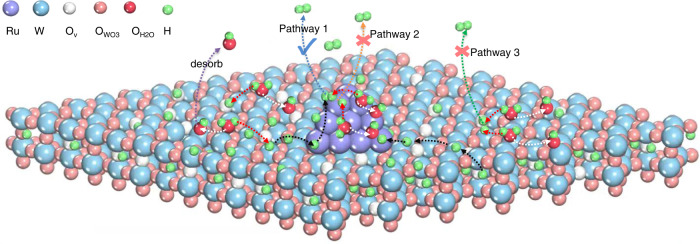
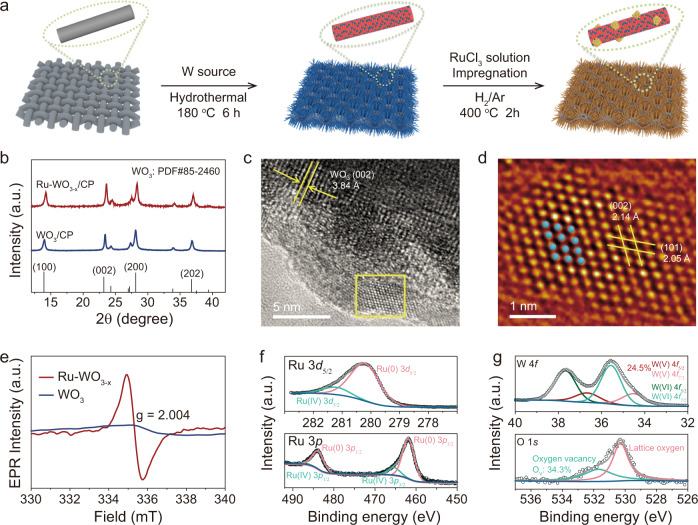
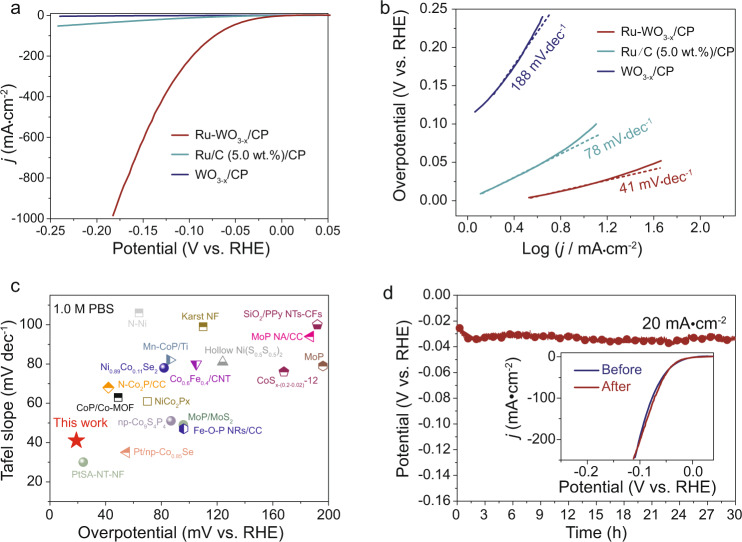
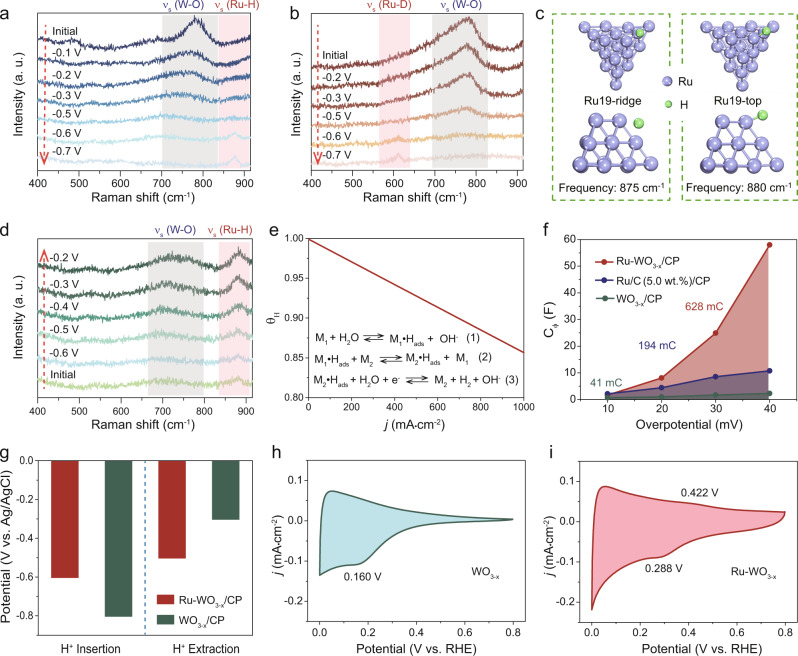
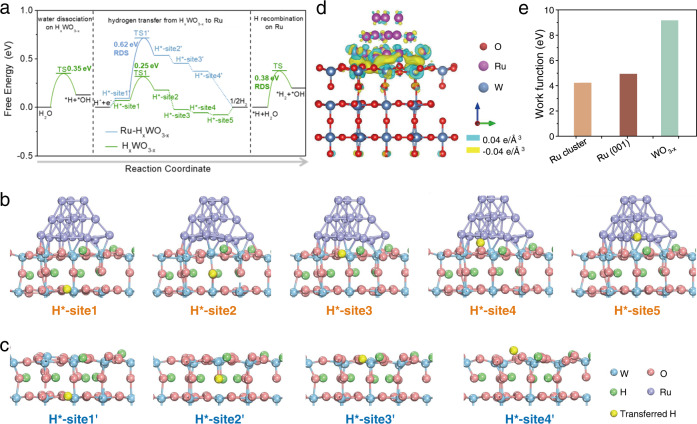
Noble metal electrocatalysts (e.g., Pt, Ru, etc.) suffer from sluggish kinetics of water dissociation for the electrochemical reduction of water to molecular hydrogen in alkaline and neutral pH environments. Herein, we found that an integration of Ru nanoparticles (NPs) on oxygen-deficient WO manifested a 24.0-fold increase in hydrogen evolution reaction (HER) activity compared with commercial Ru/C electrocatalyst in neutral electrolyte. Oxygen-deficient WO is shown to possess large capacity for storing protons, which could be transferred to the Ru NPs under cathodic potential. This significantly increases the hydrogen coverage on the surface of Ru NPs in HER and thus changes the rate-determining step of HER on Ru from water dissociation to hydrogen recombination.
贵金属电催化剂(如Pt、Ru等)在碱性和中性pH环境中,对于将水电化学还原为分子氢的反应,存在水解离动力学缓慢的问题。在此,我们发现,与商业Ru/C电催化剂相比,在缺氧的WO上集成Ru纳米颗粒(NPs)在中性电解质中的析氢反应(HER)活性提高了24.0倍。结果表明,缺氧的WO具有大量储存质子的能力,在阴极电位下,质子可转移至Ru NPs上。这显著增加了HER过程中Ru NPs表面的氢覆盖率,从而将Ru上HER的速率决定步骤从水解离转变为氢重组。