Center for Computational Health, IBM Research, Cambridge, MA.
Institute of Diabetes Research, Helmholtz Zentrum München-German Research Center for Environmental Health, Munich-Neuherberg, Germany.
Diabetes. 2022 Dec 1;71(12):2632-2641. doi: 10.2337/db22-0360.
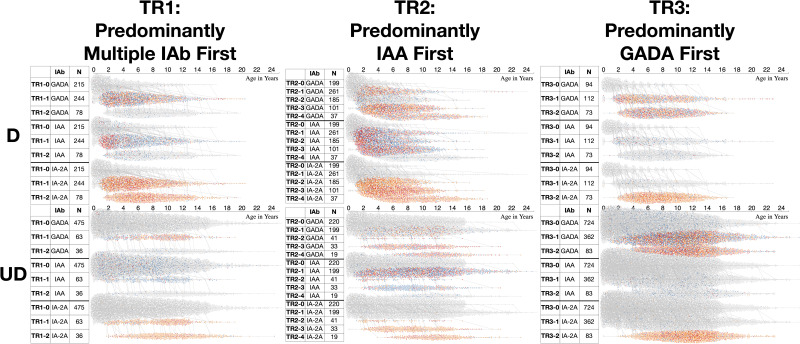
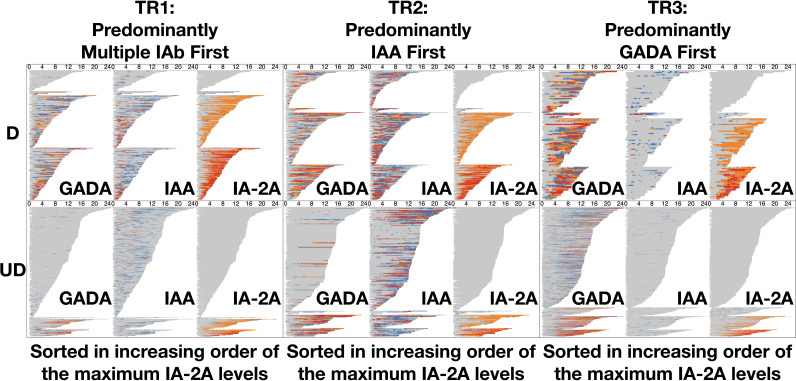
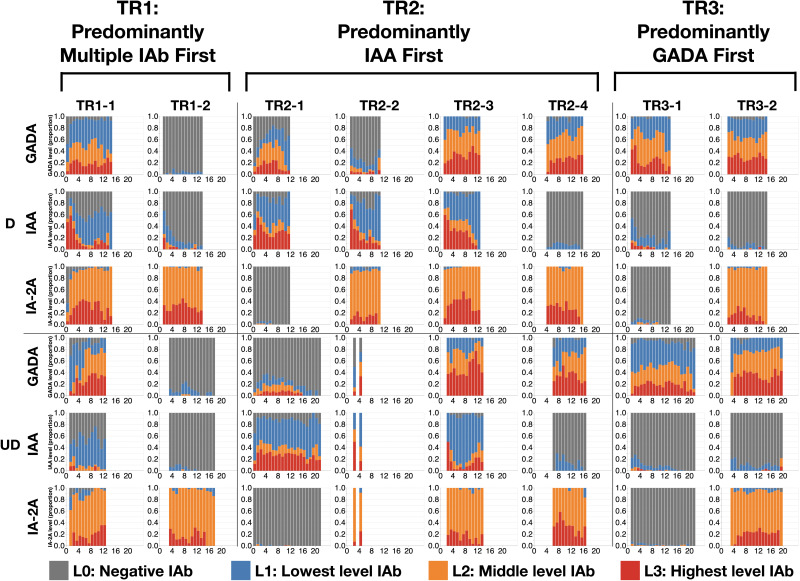
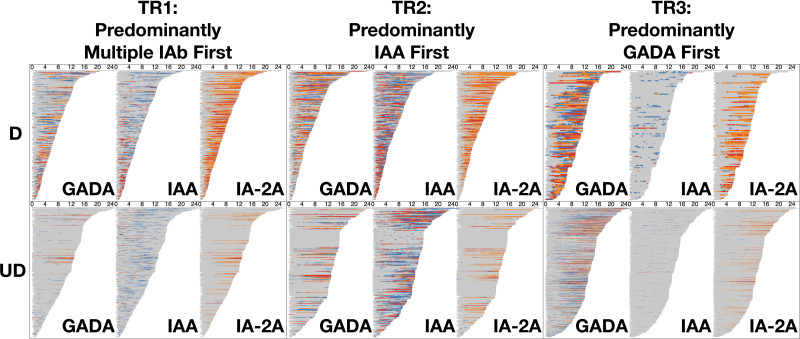
In our previous data-driven analysis of evolving patterns of islet autoantibodies (IAb) against insulin (IAA), GAD (GADA), and islet antigen 2 (IA-2A), we discovered three trajectories, characterized according to multiple IAb (TR1), IAA (TR2), or GADA (TR3) as the first appearing autoantibodies. Here we examined the evolution of IAb levels within these trajectories in 2,145 IAb-positive participants followed from early life and compared those who progressed to type 1 diabetes (n = 643) with those remaining undiagnosed (n = 1,502). With use of thresholds determined by 5-year diabetes risk, four levels were defined for each IAb and overlaid onto each visit. In diagnosed participants, high IAA levels were seen in TR1 and TR2 at ages <3 years, whereas IAA remained at lower levels in the undiagnosed. Proportions of dwell times (total duration of follow-up at a given level) at the four IAb levels differed between the diagnosed and undiagnosed for GADA and IA-2A in all three trajectories (P < 0.001), but for IAA dwell times differed only within TR2 (P < 0.05). Overall, undiagnosed participants more frequently had low IAb levels and later appearance of IAb than diagnosed participants. In conclusion, while it has long been appreciated that the number of autoantibodies is an important predictor of type 1 diabetes, consideration of autoantibody levels within the three autoimmune trajectories improved differentiation of IAb-positive children who progressed to type 1 diabetes from those who did not.
在我们之前基于数据的对胰岛自身抗体(IAb)针对胰岛素(IAA)、谷氨酸脱羧酶(GADA)和胰岛抗原 2(IA-2A)的演变模式的分析中,我们发现了三种轨迹,根据多种 IAb(TR1)、IAA(TR2)或 GADA(TR3)作为最初出现的自身抗体进行了特征描述。在这里,我们研究了在从早期开始随访的 2145 名 IAb 阳性参与者中,这些轨迹内的 IAb 水平的演变,并比较了那些进展为 1 型糖尿病(n=643)的参与者和那些未被诊断的参与者(n=1502)。使用 5 年糖尿病风险确定的阈值,为每个 IAb 定义了四个水平,并在每个访视中进行了叠加。在确诊的参与者中,在<3 岁时,TR1 和 TR2 中观察到高 IAA 水平,而未确诊的参与者中 IAA 水平较低。在所有三个轨迹中,GADA 和 IA-2A 在确诊和未确诊参与者之间,在四个 IAb 水平的停留时间(给定水平的随访总持续时间)比例不同(P<0.001),但 IAA 的停留时间仅在 TR2 中不同(P<0.05)。总的来说,未确诊的参与者比确诊的参与者更频繁地出现低 IAb 水平和较晚出现 IAb。总之,尽管人们早就意识到自身抗体的数量是 1 型糖尿病的一个重要预测因素,但在三个自身免疫轨迹内考虑自身抗体水平,可以更好地区分从那些没有进展为 1 型糖尿病的 IAb 阳性儿童。