Takada Kohichi, Kubo Tomohiro, Kikuchi Junko, Yoshida Makoto, Murota Ayako, Arihara Yohei, Nakamura Hajime, Nagashima Hiroyuki, Tanabe Hiroki, Sugita Shintaro, Tanaka Yumi, Miura Ayana, Ohhara Yoshihito, Ishiguro Atsushi, Yokouchi Hiroshi, Kawamoto Yasuyuki, Mizukami Yusuke, Ohnishi Hirofumi, Kinoshita Ichiro, Sakurai Akihiro
Department of Medical Oncology, Sapporo Medical University School of Medicine, Sapporo, Japan.
Division of Clinical Cancer Genomics, Hokkaido University Hospital, Sapporo, Japan.
Front Oncol. 2022 Sep 2;12:988527. doi: 10.3389/fonc.2022.988527. eCollection 2022.
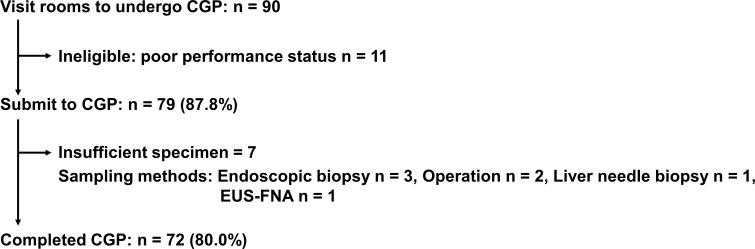
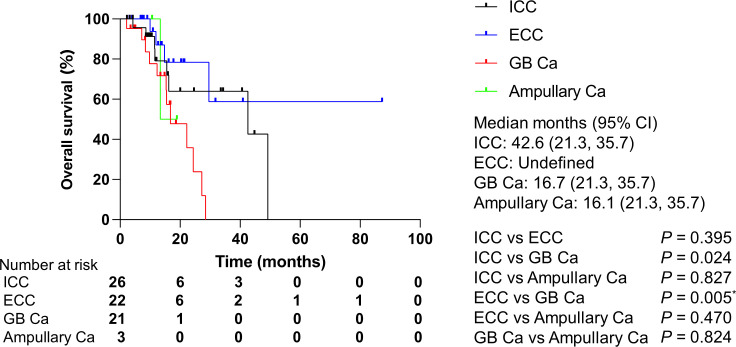
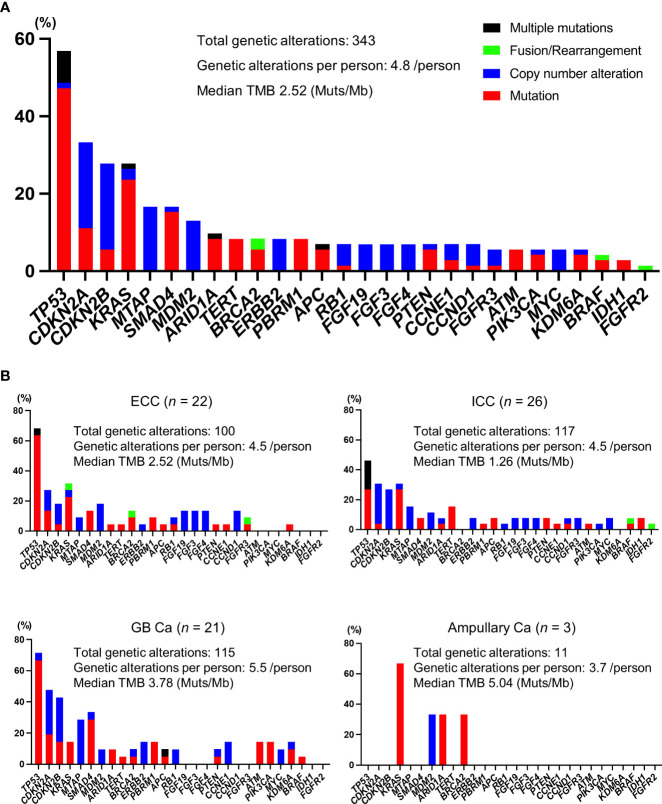
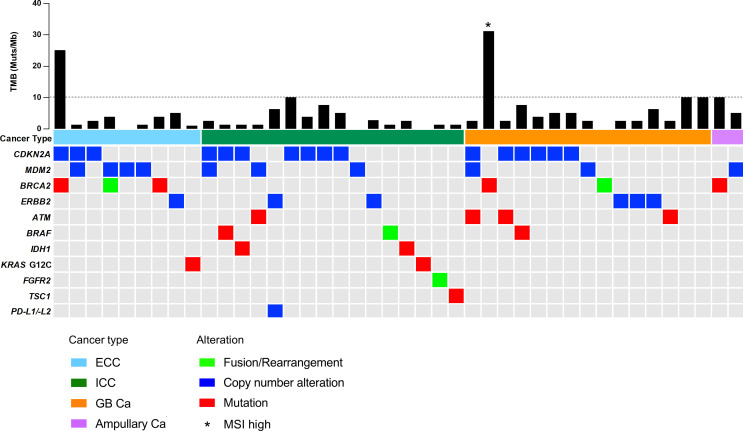
Characterization of the genomic landscape of biliary tract cancer (BTC) may lead to applying genotype-matched therapy for patients with this disease. Evidence that comprehensive cancer genomic profiling (CGP) guides genotype-matched therapy to improve clinical outcomes is building. However, the significance of CGP in patients with BTC remains unclarified in clinical practice. Therefore, the purposes of this study were to assess the utility of CGP and identify associations between clinical outcomes and genomic alterations in patients with BTC. In this prospective analysis, detection rates for actionable genomic alterations and access rates for genotype-matched therapy were analyzed in 72 patients with advanced BTC who had undergone commercial CGP. Cox regression analyses assessed relationships between overall survival and genomic alterations detected with CGP. The most common genomic alterations detected were (41, 56.9%), followed by (24, 33.3%/20, 27.8%), and (20, 27.8%). Actionable genomic alterations were identified in 58.3% (42/72) of patients. Detection rates for fusions, mutations, and V600E were low in this cohort. Eight (11.1%) patients received genotype-matched therapy. For patients with intrahepatic cholangiocarcinoma (ICC), loss was associated with shorter overall survival. These real-world data demonstrate that CGP can identify therapeutic options in patients with advanced BTC. loss was identified as a poor prognostic factor in patients with ICC. Thus, this study provides a rationale for considering CGP in planning therapeutic strategies for advanced BTC.
胆管癌(BTC)基因组格局的特征分析可能会促使针对该疾病患者应用基因匹配疗法。越来越多的证据表明,全面癌症基因组分析(CGP)可指导基因匹配疗法以改善临床结局。然而,在临床实践中,CGP对BTC患者的意义仍不明确。因此,本研究的目的是评估CGP的效用,并确定BTC患者临床结局与基因组改变之间的关联。在这项前瞻性分析中,对72例接受商业CGP的晚期BTC患者的可操作基因组改变检测率和基因匹配疗法的应用率进行了分析。Cox回归分析评估了总生存期与CGP检测到的基因组改变之间的关系。检测到的最常见基因组改变是 (41例,56.9%),其次是 (24例,33.3%/20例,27.8%),以及 (20例,27.8%)。58.3%(42/72)的患者发现了可操作的基因组改变。该队列中 融合、 突变和 V600E的检测率较低。8例(11.1%)患者接受了基因匹配疗法。对于肝内胆管癌(ICC)患者, 缺失与较短的总生存期相关。这些真实世界数据表明,CGP可以为晚期BTC患者确定治疗选择。 缺失被确定为ICC患者的不良预后因素。因此,本研究为在制定晚期BTC治疗策略时考虑CGP提供了理论依据。