Xie Ke-Hang, Chen Li-Chun, Liu Ling-Ling, Su Chu-Yin, Li Hua, Liu Run-Ni, Chen Qing-Qing, He Jia-Sheng, Ruan Yong-Kun, He Wang-Kai
Department of Neurology, Zhuhai Hospital of Integrated Traditional Chinese and Western Medicine, Zhuhai, China.
Department of Encephalopathy, Shantou Hospital of Traditional Chinese Medicine, Shantou, China.
Front Neurol. 2022 Sep 1;13:857133. doi: 10.3389/fneur.2022.857133. eCollection 2022.
The present study aimed to determine whether residual dizziness (RD) after successful repositioning treatment in benign paroxysmal positional vertigo (BPPV) patients could be predicted by red blood cell distribution width (RDW).
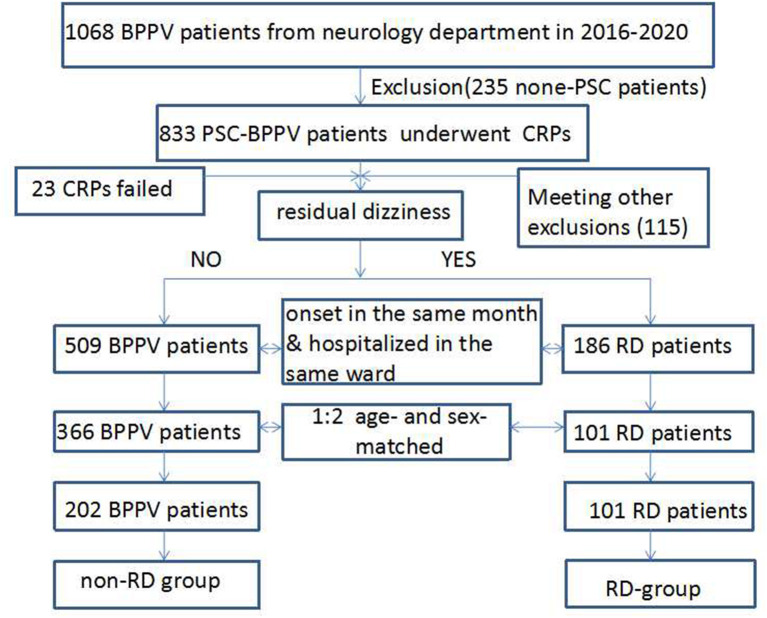
In this study, a total of 303 BBPV patients hospitalized at the neurology department were investigated. The enrolled patients were divided into two groups after successful repositioning treatment: non-RD group included patients who were completely cured, and RD group included patients with RD. We collected data on all subjects, including general information, blood routine examination, blood biochemical examination, and magnetic resonance imaging tests.
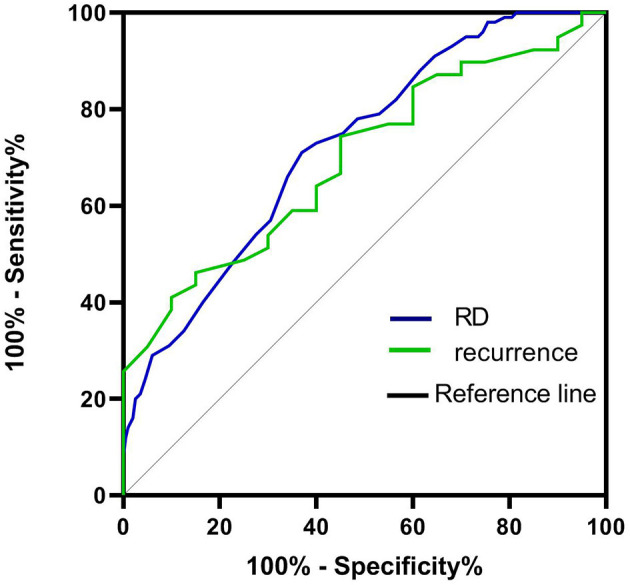
The mean RDW values of patients in the RD group were significantly higher than that in the non-RD group (13.63 ± 1.8 vs. 12.5 ± 0.8; < 0.001). In subsequent multivariate analysis, elevated RDW levels were a statistically significant risk factor associated with the occurrence of RD [odds ratio = 2.62, 95% confidence interval (CI) 1.88-3.64, < 0.001]. The area under the ROC curve was 0.723 in terms of its predictive ability to distinguish patients with RD. A cut-off point of 12.95% of RDW predicted RD with a sensitivity of 75.6% and a specificity of 69.5%. Moreover, the AUC for the ability of the RDW to predict recurrence were 0.692 (95% CI = 0.561-0.831; < 0.014).
Elevated RDW level was related to increased risk of RD among BPPV patients, requiring further efforts to clarify the actual underlying pathophysiology.
本研究旨在确定红细胞分布宽度(RDW)是否可预测良性阵发性位置性眩晕(BPPV)患者成功复位治疗后的残余头晕(RD)。
本研究共调查了303例在神经内科住院的BPPV患者。入选患者在成功复位治疗后分为两组:非RD组包括完全治愈的患者,RD组包括有RD的患者。我们收集了所有受试者的资料,包括一般信息、血常规检查、血液生化检查和磁共振成像检查。
RD组患者的平均RDW值显著高于非RD组(13.63±1.8 vs. 12.5±0.8;<0.001)。在随后的多因素分析中,RDW水平升高是与RD发生相关的统计学显著危险因素[比值比=2.62,95%置信区间(CI)1.88 - 3.64,<0.001]。就区分RD患者的预测能力而言,ROC曲线下面积为0.723。RDW的截断点为12.95%时预测RD的敏感性为75.6%,特异性为69.5%。此外,RDW预测复发能力的AUC为0.692(95%CI = 0.561 - 0.831;<0.014)。
BPPV患者中RDW水平升高与RD风险增加有关,需要进一步努力阐明实际潜在的病理生理学机制。