Tarik Farhan Bin, Famili Azadeh, Lao Yingjie, Ryckman Judson D
Holcombe Department of Electrical and Computer Engineering, Clemson University, Clemson, SC, 29634, USA.
Sci Rep. 2022 Sep 19;12(1):15653. doi: 10.1038/s41598-022-19796-z.
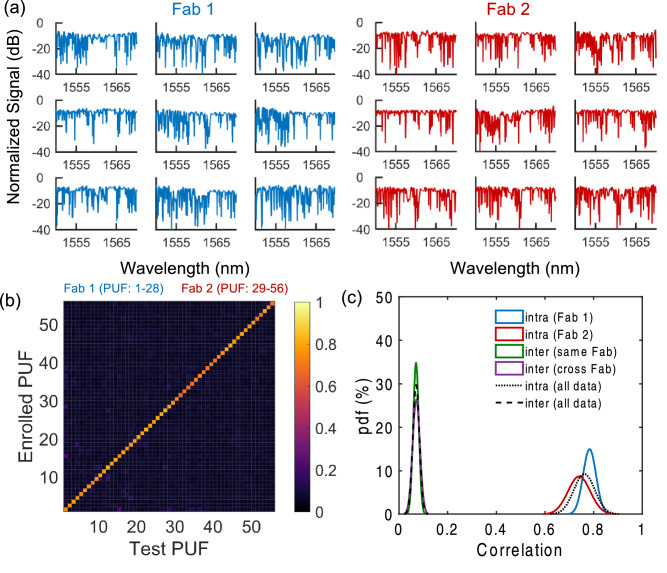
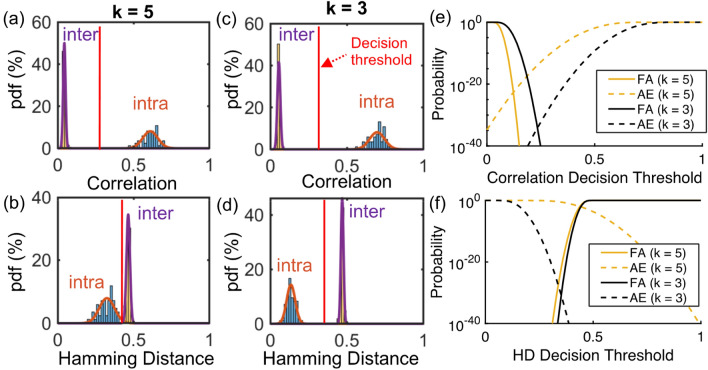
We demonstrate the uniqueness, unclonability and secure authentication of N = 56 physical unclonable functions (PUFs) realized from silicon photonic moiré quasicrystal interferometers. Compared to prior photonic-PUF demonstrations typically limited in scale to only a handful of unique devices and on the order of 10 false authentication attempts, this work examines > 10 inter-device comparisons and false authentication attempts. Device fabrication is divided across two separate fabrication facilities, allowing for cross-fab analysis and emulation of a malicious foundry with exact knowledge of the PUF photonic circuit design and process. Our analysis also compares cross-correlation based authentication to the traditional Hamming distance method and experimentally demonstrates an authentication error rate AER = 0%, false authentication rate FAR = 0%, and an estimated probability of cloning below 10. This work validates the potential scalability of integrated photonic-PUFs which can attractively leverage mature wafer-scale manufacturing and automated contact-free optical probing. Such structures show promise for authenticating hardware in the untrusted supply chain or augmenting conventional electronic-PUFs to enhance system security.
我们展示了由硅光子莫尔准晶体干涉仪实现的N = 56个物理不可克隆函数(PUF)的唯一性、不可克隆性和安全认证。与之前的光子PUF演示相比,之前的演示通常在规模上仅限于少数几个独特的器件,并且错误认证尝试次数约为10次,而这项工作研究了超过10次的器件间比较和错误认证尝试。器件制造分布在两个独立的制造工厂,从而允许进行跨工厂分析以及对恶意代工厂进行仿真,恶意代工厂对PUF光子电路设计和工艺有确切了解。我们的分析还将基于互相关的认证与传统汉明距离方法进行了比较,并通过实验证明认证错误率AER = 0%,错误认证率FAR = 0%,以及克隆估计概率低于10。这项工作验证了集成光子PUF的潜在可扩展性,其可以有吸引力地利用成熟的晶圆级制造和自动化非接触式光学探测。这种结构有望在不可信供应链中对硬件进行认证,或增强传统电子PUF以提高系统安全性。