Department of Behavioural Sciences and Learning, Division of Psychology, Linköping University, Linköping, Sweden.
Department of Clinical Neuroscience, Karolinska Institutet, Psychiatry unit, Stockholm, Sweden.
BMC Psychol. 2022 Sep 19;10(1):220. doi: 10.1186/s40359-022-00927-0.
Religion is an important ingroup characteristic for many people. For different reasons, people with different religious affiliations might prefer members of their religious outgroup. Previous studies have investigated perceptions of and behaviour toward religious ingroup and outgroup members in various contexts. The four studies presented here investigated whether competence and likeability ratings differ depending on the target's and participant's religious affiliations in a recruitment context. Two studies were conducted in Sweden, while the other two were conducted in the USA.
Participants in 4 studies rated a Christian, Muslim or atheist job applicant and a control applicant on 4 competence and 3 likeability items on 7-point Likert scales. The difference in ratings between the target applicant and control applicant was used to measure perceived competence and likeability of the target applicant. In the two latter studies, one in Sweden and one in the USA, participants also chose to hire either the target or the control applicant.
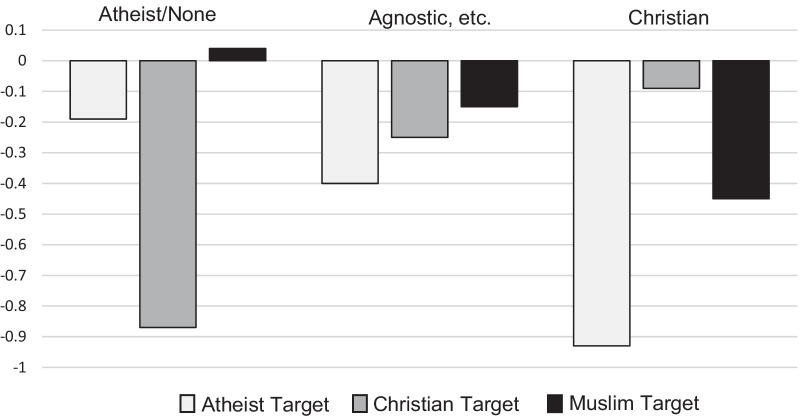
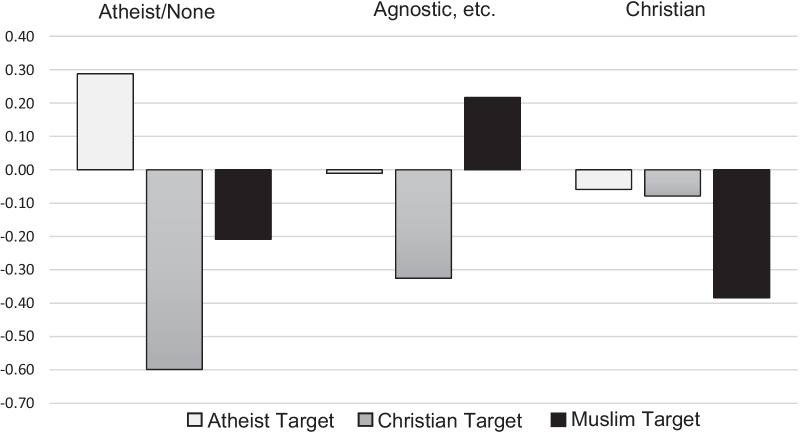
Overall, participants in three studies rated control applicants as more likeable than target applicants. In the two US studies, targets were also rated as less competent than control applicants. Christian participants in the two US studies rated the Christian applicant as more likeable than both other targets. In the second US study, atheist participants rated Christians as less likeable than both other targets. In one of the Swedish studies, atheist participants rated the atheist applicant as more likeable than both other targets. The only significant difference in competence ratings between targets was made by Christian Swedes, who rated Muslim applicants as less competent than Christian applicants. The only significant difference in hiring decisions was that Swedish atheist participants hired Christians less often than they hired control applicants.
Together, the results suggest that job applicants are sometimes viewed as more likeable if they belong to a religious ingroup rather than a religious outgroup, but that this only rarely translate to significant differences in competence ratings or hiring decisions.
宗教对许多人来说是一个重要的群体特征。出于不同的原因,具有不同宗教信仰的人可能会更喜欢他们宗教群体之外的成员。以前的研究已经在不同的背景下调查了人们对宗教群体内部和外部成员的看法和行为。本文介绍的四项研究调查了在招聘背景下,目标和参与者的宗教信仰是否会影响对目标的能力和好感评价。其中两项研究在瑞典进行,另外两项在美国进行。
在四项研究中,参与者对一名基督教徒、穆斯林或无神论者求职者和一名对照组求职者进行了四项能力和三项好感评价,评价采用七点李克特量表。通过目标求职者和对照组求职者之间的评分差异来衡量目标求职者的感知能力和好感度。在后两项研究中,其中一项在瑞典进行,另一项在美国进行,参与者还选择雇佣目标求职者或对照组求职者。
总的来说,三项研究中的参与者认为对照组求职者比目标求职者更具好感。在美国的两项研究中,目标求职者的能力也被认为不如对照组求职者。美国的两项研究中,基督教参与者认为基督教求职者比其他两个目标更具好感。在美国的第二项研究中,无神论参与者认为基督教徒比其他两个目标更不具好感。在一项瑞典研究中,无神论参与者认为无神论求职者比其他两个目标更具好感。在目标求职者之间,唯一显著的能力评价差异是由瑞典的基督教徒做出的,他们认为穆斯林求职者不如基督教求职者有能力。唯一在雇佣决策方面的显著差异是,瑞典的无神论参与者比雇佣对照组求职者更不愿意雇佣基督教徒。
总的来说,这些结果表明,如果求职者属于宗教群体内部而不是群体外部,他们有时会被认为更具好感,但这很少会转化为能力评价或雇佣决策方面的显著差异。