Biology Education Research Lab, School of Life Sciences, Arizona State University, Tempe, Arizona, United States of America.
PLoS One. 2020 Jan 29;15(1):e0226826. doi: 10.1371/journal.pone.0226826. eCollection 2020.
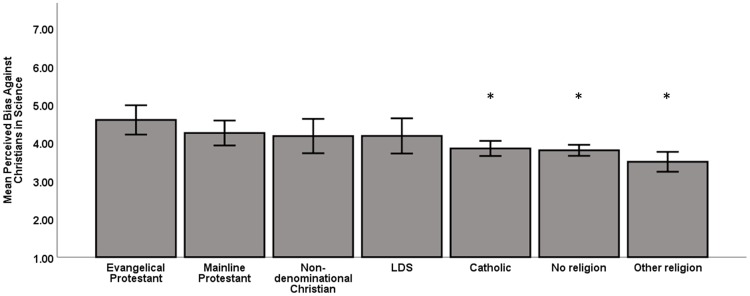
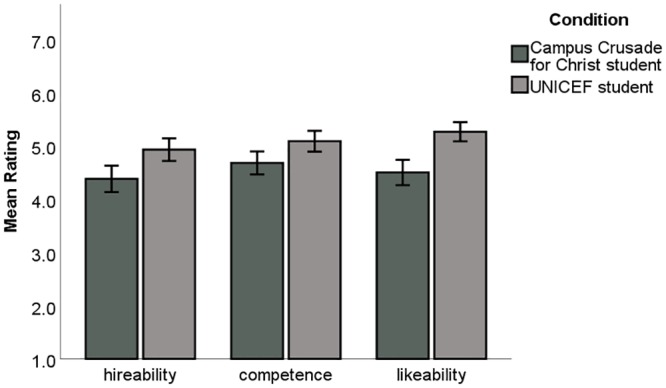
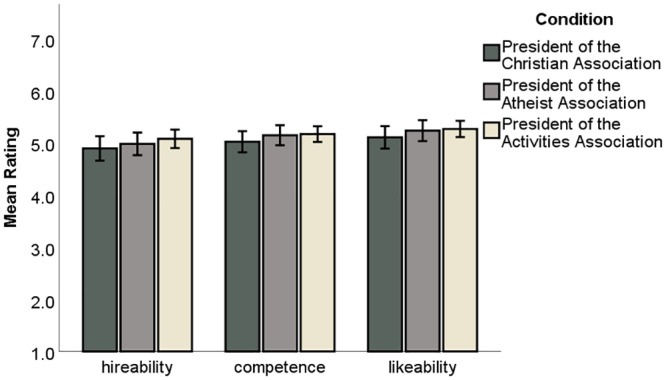
Christians are one of the most underrepresented groups in science, and one potential explanation is that scientists have a bias against Christian students, which could discourage and actively prevent Christian students from becoming scientists. Although there is a general perception in society that there is bias against Christians in science, we do not know whether science students, who frequently interact with scientists, perceive this bias. Further, no researchers have attempted to experimentally document the existence of bias against Christians in science. To address these gaps in the literature, we designed three studies. In the first study, we found that college science students report a perceived bias against Christians in science and that evangelical Christians perceive greater bias than Catholic and non-Christian students. Then in two studies, biology professors evaluated Ph.D. program applicants and we examined whether the professors rated a student less favorably when the student revealed a Christian religious identity. We found no statistically significant differences in how biology professors rated a student who was President of the Christian Association compared to a student who was President of the Atheist Association or a student who was President of the Activities Association. However, in Study 3, biology professors did rate a Christian student who went on a mission trip with Campus Crusade for Christ as less hireable, less competent, and less likeable than a student who did not reveal a Christian identity. Taken together, these studies indicate that perceived bias against Christians in science may contribute to underrepresentation of Christians but actual bias against Christians in science may be restricted to a specific type of Christianity that scientists call fundamentalist and/or evangelical.
基督徒是科学界代表性最低的群体之一,一个潜在的解释是,科学家对基督徒学生存在偏见,这可能会阻碍并积极阻止基督徒学生成为科学家。尽管社会上普遍认为科学界对基督徒存在偏见,但我们不知道经常与科学家互动的科学专业学生是否能察觉到这种偏见。此外,没有研究人员试图通过实验记录科学界对基督徒的偏见是否存在。为了解决文献中的这些空白,我们设计了三项研究。在第一项研究中,我们发现大学生理科生报告称,科学界存在对基督徒的偏见,福音派基督徒比天主教徒和非基督徒学生感受到的偏见更大。然后在两项研究中,生物学教授评估了博士生项目的申请人,我们研究了当学生透露自己的基督教宗教身份时,教授是否会对学生评价较低。我们没有发现生物学教授对基督教协会主席的学生与无神论协会主席或活动协会主席的学生评价有统计学上的显著差异。然而,在研究 3 中,生物学教授确实认为参加校园十字军东征的基督教学生在可雇用性、能力和可爱程度上不如没有透露基督教身份的学生。综上所述,这些研究表明,科学界对基督徒的偏见可能导致基督徒代表性不足,但科学界对基督徒的实际偏见可能仅限于科学家称之为原教旨主义和/或福音派的特定类型的基督教。