Ghai Suhani
Surgical Oncology, Dharamshila Narayana Superspeciality Hospital, New Delhi, IND.
Cureus. 2022 Aug 6;14(8):e27734. doi: 10.7759/cureus.27734. eCollection 2022 Aug.
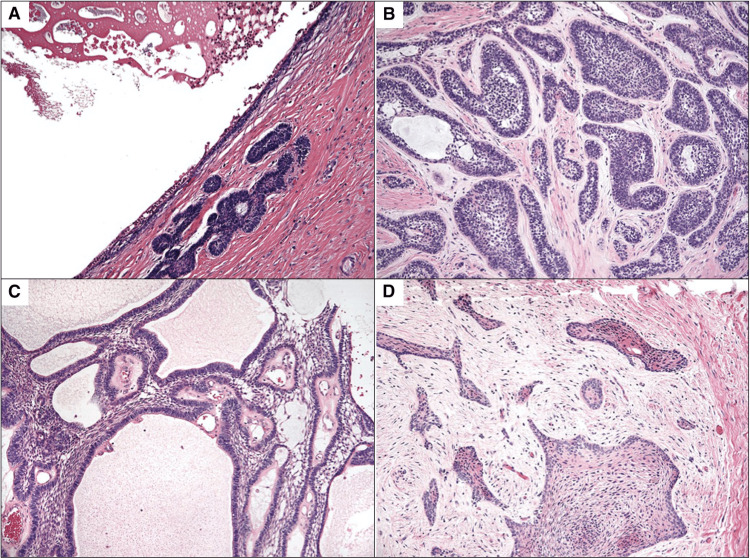
Ameloblastoma is one of the most common benign odontogenic tumors of the jaw that constitutes about 10% of all tumors that arise in the mandible and maxilla. It is a slow-growing but locally invasive tumor that presents with painless swelling of the mandible or maxilla. The World Health Organization (WHO) classification of 2017 describes ameloblastomas of the following four types: ameloblastoma; unicystic ameloblastoma; extraosseous/peripheral ameloblastoma; and metastasizing ameloblastoma. The diagnosis of ameloblastoma requires computerized tomography (CT) imaging as well as a biopsy. A biopsy is helpful in differentiating ameloblastoma from ossifying fibroma, osteomyelitis, giant cell tumor, cystic fibrous dysplasia, myeloma, and sarcoma. The best treatment of ameloblastoma is aggressive en bloc resection with simultaneous reconstruction. The high recurrence rate and large tissue defects have been long-standing issues in the treatment of ameloblastoma. Recent molecular developments strongly suggest the possibility of targeted therapy with better outcomes in ameloblastomas. We present a detailed updated narrative review of our current understanding and management of this enigmatic tumor.
成釉细胞瘤是颌骨最常见的良性牙源性肿瘤之一,约占下颌骨和上颌骨所有肿瘤的10%。它是一种生长缓慢但具有局部侵袭性的肿瘤,表现为下颌骨或上颌骨无痛性肿胀。世界卫生组织(WHO)2017年的分类描述了以下四种类型的成釉细胞瘤:成釉细胞瘤;单囊性成釉细胞瘤;骨外/外周性成釉细胞瘤;以及转移性成釉细胞瘤。成釉细胞瘤的诊断需要计算机断层扫描(CT)成像以及活检。活检有助于将成釉细胞瘤与骨化性纤维瘤、骨髓炎、巨细胞瘤、囊性纤维性骨发育不良、骨髓瘤和肉瘤相鉴别。成釉细胞瘤的最佳治疗方法是积极的整块切除并同时进行重建。高复发率和大的组织缺损一直是成釉细胞瘤治疗中的长期问题。最近的分子研究进展有力地表明,在成釉细胞瘤中进行靶向治疗有可能取得更好的疗效。我们对这种神秘肿瘤的当前认识和治疗进行了详细的最新叙述性综述。